
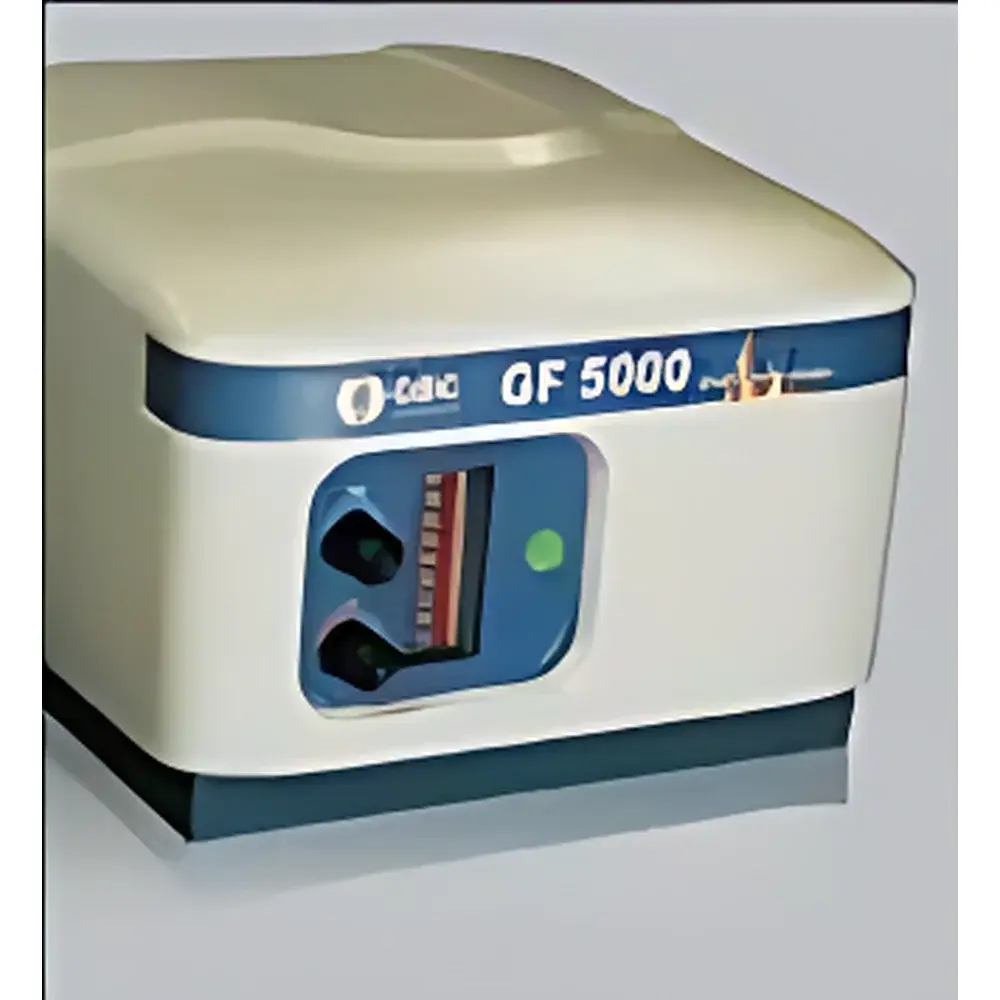
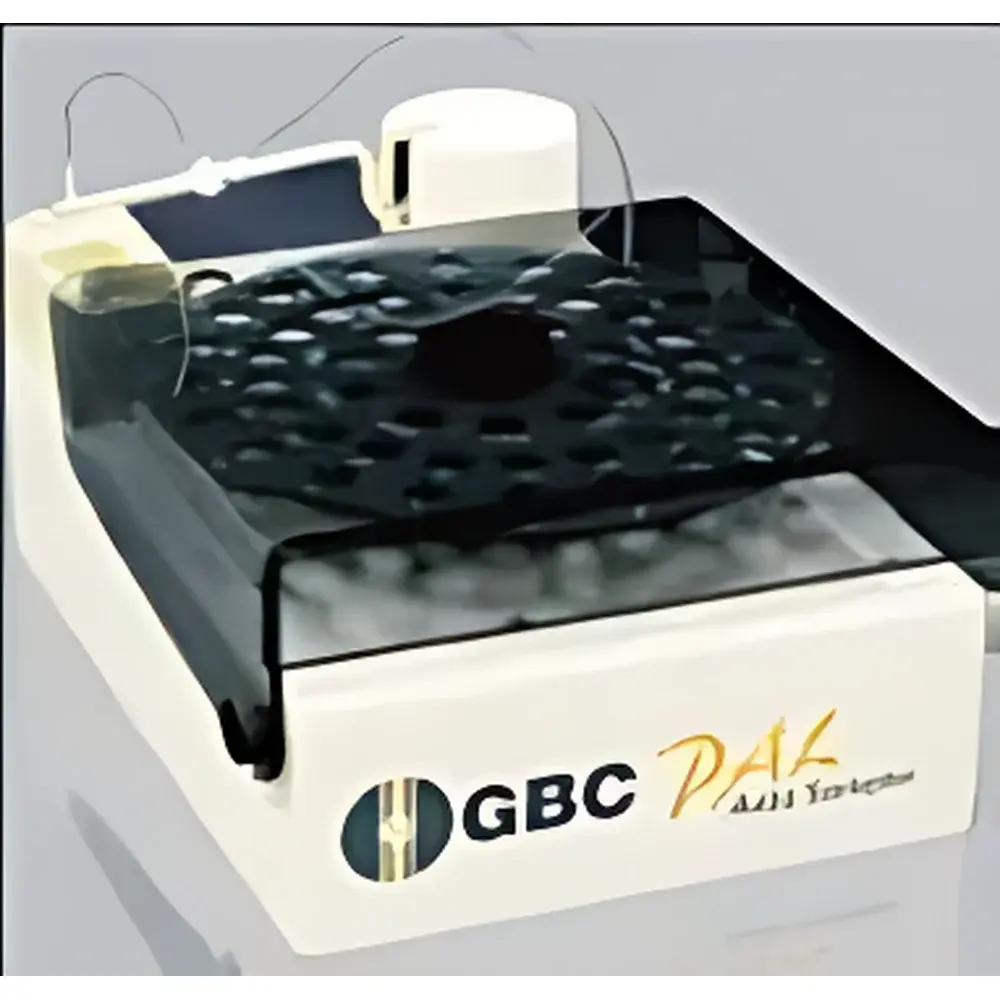
GBC System5000 Graphite Furnace Atomic Absorption Spectrometer with PAL Autosampler
| Brand | GBC |
|---|---|
| Origin | Australia |
| Model | System5000 |
| Detection Limit | Sub-ppb for ~50 elements |
| Temperature Range | Up to 3000 °C |
| Sample Volume | 1–100 µL (1 µL increment) |
| Autosampler Capacity | 40 samples + 10 standards |
| Vial Sizes | 2 mL (samples/standards), 5 mL (auto-dilution), 10 mL (reagents/blanks) |
| Graphite Tube | Platform-equipped high-performance tube |
| Gas Control | Programmable purge gas selection (Ar, N₂, or mixed) |
| Chemical Modifier Injection | Dual-channel, software-triggered |
| Syringe Material | Fully PTFE capillary |
| Wash Reservoir | 1 L |
Overview
The GBC System5000 Graphite Furnace Atomic Absorption Spectrometer (GF-AAS) is a fully automated, high-sensitivity trace metal analysis platform engineered for sub-part-per-trillion (sub-ppt) to low-part-per-trillion quantification across approximately 50 elements. It operates on the principle of electrothermal atomic vaporization followed by atomic absorption measurement at element-specific wavelengths—enabling precise, matrix-tolerant detection in complex environmental, clinical, food, and geological matrices. Integrated with the PAL (Programmable Autosampler Logic) autosampler, the System5000 eliminates manual pipetting, thermal carryover, and positional variability—critical factors affecting reproducibility in furnace-based AAS. The system comprises a high-stability graphite furnace head, dedicated power supply unit, temperature-programmable furnace controller, and SavantAA spectroscopy software suite—configured as a turnkey solution compliant with ISO/IEC 17025 method validation requirements.
Key Features
- Programmable sample introduction: 1–100 µL volume range with 1 µL resolution, supporting both aqueous and viscous matrices (e.g., oils, digested biological tissues)
- Temperature-controlled furnace operation up to 3000 °C with ramp-and-hold capability, enabling robust ashing and atomization protocols for refractory elements (e.g., V, Mo, W, rare earths)
- Platform-equipped graphite tubes minimize axial and radial thermal gradients, enhancing atom cloud homogeneity and signal stability
- Dual-channel chemical modifier delivery system permits sequential or simultaneous injection of up to two modifiers (e.g., Pd-Mg, NH₄H₂PO₄), reducing manual pretreatment and improving analyte stabilization
- Variable syringe speed control accommodates high-viscosity samples and mitigates splashing during high-temperature injection
- Multi-injection pre-concentration mode: up to 50 repeated dry/ash cycles per sample aliquot, effectively concentrating analytes prior to atomization—eliminating offline extraction or evaporation steps
- Software-defined PAL probe positioning (X/Y/Z coordinates) ensures repeatable tip placement across vial types and plate formats, critical for long-term method transferability
- Automated calibration workflows: standard addition, multi-point linear/non-linear calibration, auto-restandardization, and full recalibration—all executed without user intervention
Sample Compatibility & Compliance
The System5000 accepts liquid samples in standard 12–16 mm borosilicate vials (2 mL), dilution reservoirs (5 mL), and reagent bottles (10 mL). Its all-PTFE fluidic path resists corrosion from strong acids (HNO₃, HCl, HF up to 5%), alkalis, and organic solvents—ensuring compatibility with EPA Method 200.9, ISO 8288, and ASTM D1688 digestion protocols. The furnace architecture meets ICH Q2(R2) guidance for analytical procedure validation, and SavantAA software supports audit trails, electronic signatures, and 21 CFR Part 11-compliant data integrity controls when deployed in GLP/GMP-regulated laboratories. Traceability of calibration history, method parameters, and raw absorbance signals is maintained per ISO/IEC 17025 clause 7.7.
Software & Data Management
SavantAA software provides unified control of furnace temperature programming, autosampler motion logic, lamp current modulation, background correction (D₂ or Zeeman), and real-time peak integration. All methods—including multi-step temperature programs, modifier sequences, and injection patterns—are stored as encrypted XML files with version metadata. Raw time-resolved absorbance data are archived in vendor-neutral ASCII format (CSV-compatible), enabling third-party statistical analysis (e.g., PCA, multivariate calibration). The software includes built-in uncertainty estimation per EURACHEM/CITAC Guide, automatic outlier detection via Grubbs’ test, and QC charting (Levey-Jennings, Shewhart) aligned with CLIA and ISO 15197 requirements.
Applications
The System5000 delivers validated performance in regulated and research environments requiring ultra-trace quantification: Pb, Cd, As, and Hg in drinking water (EPA 200.9); Cr, Ni, Co in battery cathode slurries; Al, Fe, Cu in semiconductor-grade chemicals; Se, Zn, Mn in infant formula (AOAC 993.14); and Pt-group elements in catalytic converter leachates. Its multi-injection pre-concentration mode is routinely applied to seawater analysis (GEOTRACES protocols) and serum trace element profiling where sample volume is constrained.
FAQ
What is the typical detection limit for cadmium using the System5000 under optimized conditions?
Typical characteristic mass (m₀) for Cd is ≤0.3 pg, translating to sub-0.5 ppt detection limits in 20 µL injections with integrated background correction.
Can the PAL autosampler perform matrix-matched standard additions automatically?
Yes—SavantAA supports programmable standard addition sequences with variable spike volumes and post-spike mixing, including calibration curve generation directly from addition series.
Is the furnace compatible with oxygen ashing for organic-rich samples?
No—the System5000 uses inert gas (Ar/N₂) purging only; oxygen introduction is not supported due to graphite oxidation risk at elevated temperatures.
How is carryover minimized between high-concentration and trace-level samples?
The system employs multi-stage cleaning cycles (high-temperature air purge + internal tube conditioning), plus optional post-injection rinse with 2% HNO₃, all programmable within the method.
Does the software support LIMS integration?
Yes—via ASTM E1384-compliant ASCII export and optional ODBC driver for direct database ingestion into common LIMS platforms (e.g., LabVantage, Thermo SampleManager).
Related Products





