
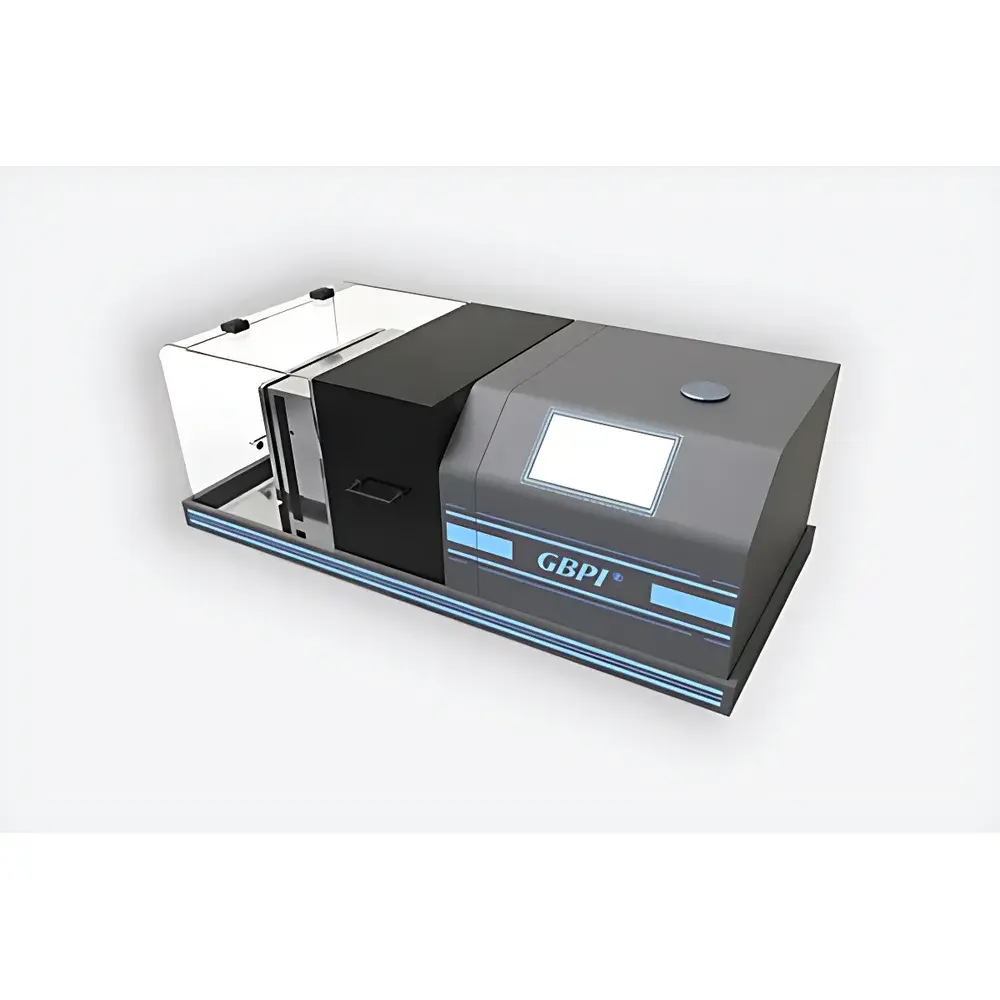
GBPI GB-BF20010M Synthetic Blood Penetration Tester for Medical Face Masks
| Brand | GBPI |
|---|---|
| Model | GB-BF20010M |
| Pressure Settings | 3, 5, 7, 14, 20 kPa |
| Test Area | 28.27 cm² (75 mm × 75 mm specimen) |
| Air Supply | Compressed air, regulated to (20 ± 1) kPa |
| Power | AC 220 V, 50 Hz, 100 W |
| Timer Resolution | ±1 s |
| Clamp Torque | 13.5 N·m |
| Retention Mesh | ≥50% open area, ≤5 mm deflection at 20 kPa |
| Construction | Stainless steel test chamber |
Overview
The GBPI GB-BF20010M Synthetic Blood Penetration Tester is an ISO- and GB-compliant benchtop instrument engineered for quantitative evaluation of the fluid barrier performance of medical face masks under controlled hydrostatic pressure. It operates on the principle of static pressure challenge: synthetic blood—formulated per ASTM F1670/F1671 protocols—is applied to the outer surface of a conditioned mask specimen at discrete, user-selectable pressure levels (3, 5, 7, 14, and 20 kPa), simulating realistic exposure scenarios such as splashes or sprays encountered during clinical procedures. The test endpoint is visual detection of penetration through the material, assessed against standardized pass/fail criteria defined in GB 19083–2010 and aligned with international benchmarks including EN 14683:2019 Annex B and ASTM F2100 Level 3 requirements. This device does not measure dynamic fluid flow or absorption kinetics; rather, it delivers reproducible, operator-independent pressure application to assess structural integrity and pore-level resistance to liquid ingress.
Key Features
- Regulated compressed-air pressure system delivering stable, traceable output across five calibrated setpoints (3–20 kPa), with real-time analog pressure gauge monitoring and fine-tuning capability.
- Stainless steel test chamber with integrated clamping mechanism, designed to fully seal the 75 mm × 75 mm specimen while containing synthetic blood within the test zone—eliminating cross-contamination risk and ensuring operator safety.
- High-strength retention mesh featuring ≥50% open area and validated mechanical stability (≤5 mm deflection under 20 kPa load), enabling uniform pressure distribution without localized stress concentration or premature failure.
- Digital timer with ±1-second resolution, synchronized with pressure application onset, supporting precise adherence to test duration requirements specified in GB 19083–2010 (e.g., 30-second dwell time at each pressure level).
- 13.5 N·m torque-rated clamping assembly ensures consistent compressive force across all specimen thicknesses—from lightweight nonwovens to multi-layer surgical masks—minimizing inter-test variability.
- Self-contained architecture requiring only standard AC power (220 V, 50 Hz); no external vacuum pumps, hydraulic units, or dedicated exhaust systems are needed, facilitating deployment in QC labs, regulatory testing facilities, and manufacturing cleanrooms.
Sample Compatibility & Compliance
The GB-BF20010M accommodates flat, non-stretchable textile specimens up to 75 mm × 75 mm, including melt-blown polypropylene layers, spunbond composites, and laminated barrier fabrics used in Type IIR and ASTM Level 3 masks. Specimens must be preconditioned per GB/T 6529 (standard atmosphere: 21 °C ± 1 °C, 65% ± 2% RH) prior to testing. The instrument conforms to mandatory Chinese national standard GB 19083–2010 “Technical Requirements for Medical Protective Masks”, specifically Clause 4.6 (Synthetic Blood Penetration Resistance). Its mechanical design and pressure delivery methodology also support verification against ISO 22609:2004 (Medical devices — Evaluation of medical face masks to determine resistance to penetration by synthetic blood) and provides technical alignment with FDA guidance documents for surgical mask clearance submissions. Data outputs meet GLP documentation requirements when paired with laboratory-controlled test logs.
Software & Data Management
The GB-BF20010M is a hardware-only platform with no embedded microprocessor or proprietary software interface. All operational parameters—including selected pressure point, start/stop timestamps, and visual pass/fail determination—are manually recorded by the operator in accordance with documented test protocols. This architecture ensures full transparency, eliminates firmware validation overhead, and supports audit readiness under GMP and ISO/IEC 17025 environments. Laboratories may integrate results into LIMS or ELN systems via structured manual entry or barcode-assisted logging. For regulatory submissions, raw test records—including signed technician logs, calibration certificates for the analog pressure gauge (traceable to NIM or equivalent national metrology institute), and specimen identification—constitute the complete evidentiary package.
Applications
- Final product release testing of disposable medical masks manufactured for domestic distribution under NMPA regulatory oversight.
- Pre-production validation of filter media batches prior to mask assembly, verifying consistency in barrier performance across supplier lots.
- Comparative analysis of alternative materials (e.g., electrospun nanofibers vs. conventional melt-blown) under identical pressure challenge conditions.
- Root-cause investigation of field-reported mask failures, correlating penetration events with specific pressure thresholds and material aging conditions.
- Internal training and competency assessment for QA technicians performing GB 19083 compliance testing.
FAQ
Does the GB-BF20010M comply with ASTM F1671 for viral penetration resistance?
No. ASTM F1671 specifies a dynamic, biologically active test using Phi-X174 bacteriophage suspended in synthetic blood under continuous flow. The GB-BF20010M performs static pressure challenge only and is intended for synthetic blood barrier assessment per GB 19083 and ISO 22609—not viral or microbial penetration quantification.
Can the instrument be calibrated in-house?
The analog pressure gauge must be externally calibrated annually by an accredited metrology provider traceable to national standards (e.g., CNAS-certified lab in China or A2LA-accredited lab internationally). No user-accessible internal calibration routine exists.
Is synthetic blood formulation included with the instrument?
No. Users must prepare synthetic blood per GB 19083–2010 Appendix A (based on bovine serum albumin, glycerol, and red dye in phosphate-buffered saline) or procure certified reference material from qualified vendors.
What maintenance is required?
Routine cleaning of the stainless steel chamber and mesh after each test cycle using isopropyl alcohol; periodic inspection of O-ring seals and air line integrity; annual verification of clamp torque and pressure gauge accuracy.





