
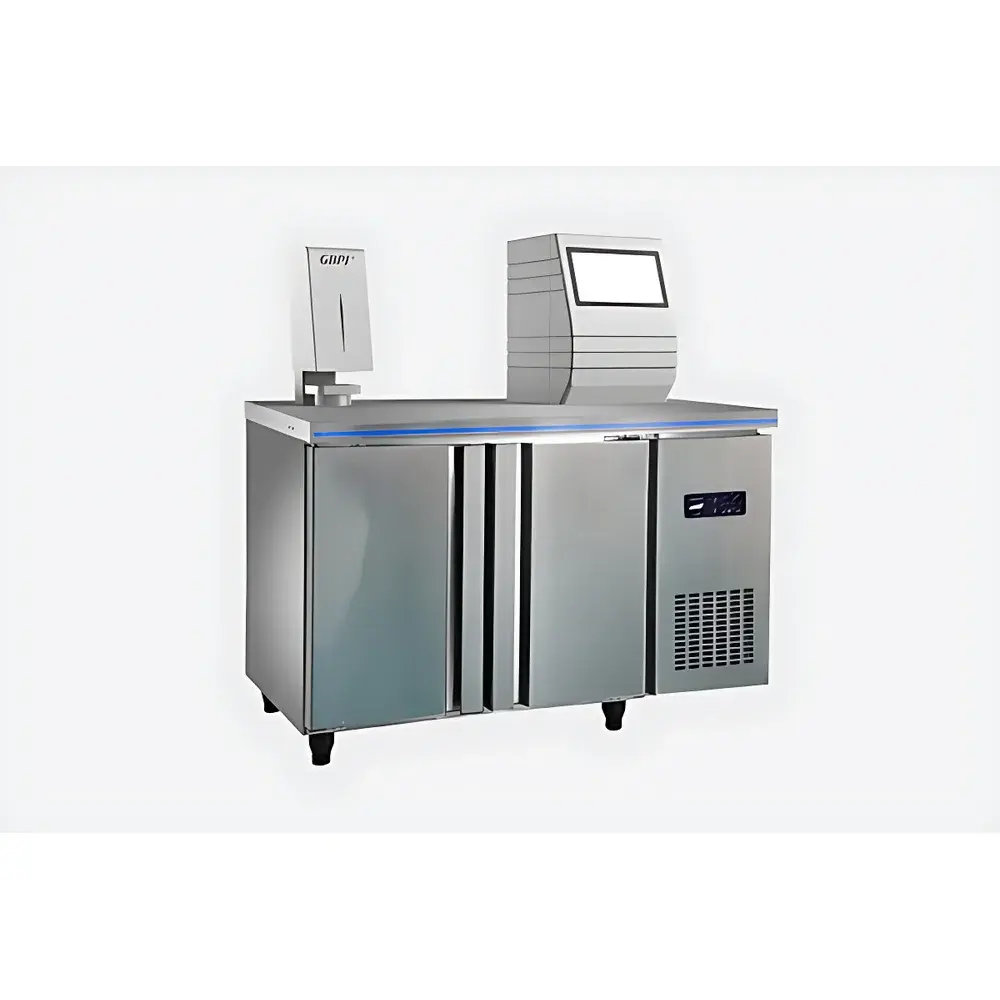
GBPI GB-KF30010ET Particle Filtration Efficiency Tester for Meltblown Nonwovens and Respiratory Protective Devices
| Brand | GBPI |
|---|---|
| Origin | Guangdong, China |
| Manufacturer Type | Direct Manufacturer |
| Country of Origin | China |
| Model | GB-KF30010ET |
| Price Range | USD 42,000 – 70,000 |
| Filtration Efficiency Range | 0–99.999% |
| Flow Rate Control Range | 20–100 L/min |
| Pressure Drop Measurement Range | 0–1000 Pa |
| Test Particle Sizes | 0.3 µm, 0.5 µm, 5.0 µm |
| Aerosol Sources | DEHS (oil-based) and 2% NaCl (salt-based) |
| Standard Test Area | 100 cm² (customizable per mask geometry) |
| Dimensions | 130 × 75 × 157 cm |
| Weight | 250 kg |
| Power Supply | AC 220 V, 50 Hz |
| Max Power Consumption | <1500 W |
Overview
The GBPI GB-KF30010ET Particle Filtration Efficiency Tester is an engineered platform designed for quantitative assessment of aerosol filtration performance in meltblown nonwoven media—particularly those used in surgical masks, N95/N99 respirators, and medical protective textiles. It operates on the principle of controlled aerosol challenge under constant airflow, measuring both particle penetration (via laser particle counting) and pressure drop (ΔP) across the test specimen. The system complies with core regulatory frameworks governing respiratory protection and medical device evaluation, including ISO 16890, EN 1822-3:1998 (for single-layer filter media), ASTM F2299 (for sodium chloride aerosol testing), and ISO 13370 (for air filtration terminology). Its dual-aerosol capability—supporting both oil-based (DEHS) and salt-based (2% NaCl) challenges—enables differentiation between mechanical and electrostatic capture mechanisms, critical for evaluating electret-charged meltblown polypropylene layers.
Key Features
- Cold-generation aerosol system producing stable, monodisperse or polydisperse aerosols without thermal degradation; compatible with both DEHS and aqueous NaCl solutions.
- Integrated bipolar ionizer for neutralizing electrostatic charge on test aerosols—ensuring measurement of intrinsic mechanical filtration efficiency independent of surface charge effects.
- Full containment design with sealed aerosol pathways and negative-pressure exhaust, meeting OSHA and ISO 15190 laboratory biosafety requirements for operator protection during high-concentration aerosol exposure.
- Pneumatic clamping mechanism with force-limiting safety interlock, ensuring consistent specimen mounting pressure (±2 kPa) and preventing edge leakage without manual torque calibration.
- Dual-channel real-time monitoring: laser particle counter (0.3–10 µm detection range, ±5% counting accuracy per ISO 21501-4) and digital differential pressure transducer (0–1000 Pa, ±0.5% FS).
- Automated test sequencing via embedded industrial PC with touch-enabled HMI interface; all control logic, data acquisition, and calculation algorithms comply with IEC 62304 Class B software lifecycle requirements.
Sample Compatibility & Compliance
The GB-KF30010ET accommodates flat-sheet specimens—including glass fiber filters, polypropylene meltblown nonwovens, and laminated composite media with hydrophobic membranes or electrospun nanofiber coatings. Mask-shaped samples are mounted using a standardized 100 cm² aperture fixture (ISO/IEC 17025-compliant dimensional tolerance ±0.5 mm); custom fixtures are available for irregular geometries per ISO 10993-10 biocompatibility validation protocols. The instrument meets essential requirements for GLP and GMP environments: audit-trail enabled software (21 CFR Part 11 compliant), electronic signature support, and traceable calibration records aligned with ISO/IEC 17025:2017 Clause 6.5. All test reports include metadata required by CNAS-CL01, FDA QSR 820, and EU MDR Annex XIII.
Software & Data Management
The proprietary GBPI FilterTest Suite v3.2 provides ISO 17025-aligned data handling: automatic calculation of filtration efficiency (FE = [1 − (Cdownstream/Cupstream)] × 100%), pressure drop, quality factor (QF = −ln(1−FE)/ΔP), and statistical confidence intervals (95% CI, n ≥ 3 replicates). Raw time-series particle counts and pressure readings are stored in HDF5 format with embedded metadata (operator ID, calibration certificate ID, environmental conditions). Export options include PDF test reports (with digital signature), CSV for LIMS integration, and XML for automated regulatory submission to NMPA, FDA eSTAR, or EMA CEP dossiers. Software validation documentation (IQ/OQ/PQ protocols) is provided upon installation.
Applications
- Quality control of meltblown web production lines: real-time FE monitoring at 0.3 µm for process parameter optimization (e.g., polymer viscosity, die temperature, corona charging voltage).
- Regulatory submission testing per GB/T 32610–2016 (daily-use masks), GB 2626–2019 (KN95 respirators), YY 0469–2011 (surgical masks), and EN 14683:2019+AC:2020.
- Material development research: comparative analysis of filtration mechanisms across PP, PET, PLA, and cellulose acetate nanofiber scaffolds.
- Aging studies: accelerated thermal/humidity conditioning followed by FE retesting to assess electret stability per ISO 13485 clause 7.5.10.
- Third-party certification labs: accredited testing for CE marking, NIOSH N95 approval, and China CCC mandatory certification.
FAQ
What aerosol generation methods does the GB-KF30010ET support?
It uses cold aerosol generators compliant with ISO 16890 Annex B: Collison nebulizers for NaCl and Laskin nozzles for DEHS, both integrated with humidity-controlled drying columns.
Is the system validated for 21 CFR Part 11 compliance?
Yes—the software includes role-based access control, electronic signatures with timestamped audit trails, and encrypted database storage meeting FDA ALCOA+ principles.
Can it test finished masks instead of flat sheets?
Yes, using optional anthropometric face-form fixtures that simulate realistic breathing resistance and seal leakage per ISO 16900-1:2016.
What calibration standards are traceable to?
All flow meters are calibrated against NIST-traceable rotameters; particle counters are verified using PSL reference spheres certified to ISO 21501-4.
Does the system support multi-size distribution testing beyond 0.3/0.5/5.0 µm?
Standard configuration covers three discrete sizes; optional upgrade includes scanning mobility particle sizer (SMPS) integration for full 10–1000 nm size-resolved efficiency curves.





