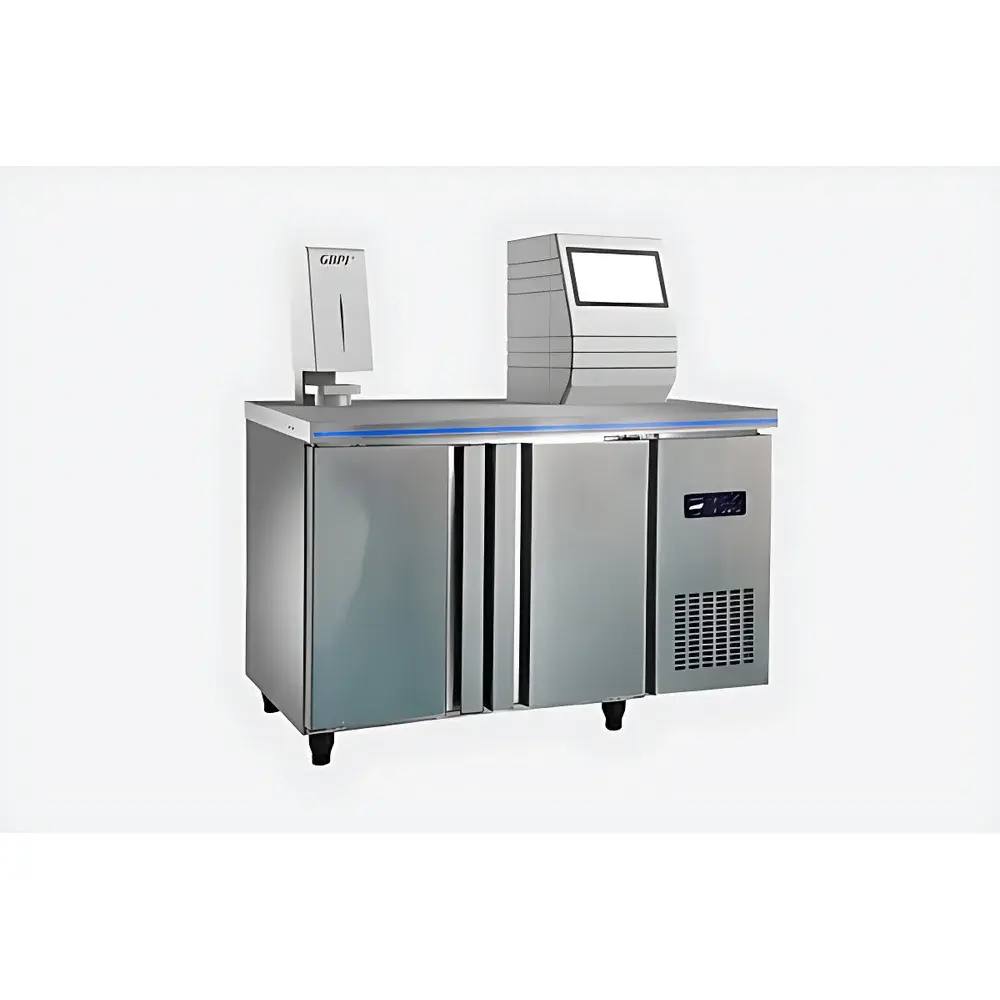
GBPI GB-KF30010KL Photometer-Based Particle Filtration Efficiency Tester
| Brand | GBPI |
|---|---|
| Origin | Guangdong, China |
| Manufacturer Type | Direct Manufacturer |
| Model | GB-KF30010KL |
| Filtration Efficiency Range | 0–99.999% |
| Flow Rate Range | 20–100 L/min |
| Pressure Drop Range | 0–1000 Pa |
| Test Particle Sizes | 0.3 µm, 0.5 µm, 5.0 µm |
| Aerosol Sources | DEHS (oil-based) and 2% NaCl (salt-based) |
| Standard Test Area | 100 cm² |
| Power Consumption | <1500 W |
| Dimensions | 130 × 75 × 157 cm |
| Weight | 250 kg |
| Power Supply | AC 220 V, 50 Hz |
Overview
The GBPI GB-KF30010KL Photometer-Based Particle Filtration Efficiency Tester is a precision-engineered instrument designed for quantitative evaluation of particulate filtration performance in respiratory protective devices and textile filter media. It operates on the principle of photometric detection—measuring the optical attenuation of aerosol-laden air streams before and after passage through a test specimen—to determine filtration efficiency with high reproducibility. Unlike particle-counting methods that rely on discrete counting statistics, photometry provides continuous, real-time signal integration ideal for evaluating high-efficiency filters where particle penetration is extremely low (<0.001%). The system complies with core regulatory frameworks governing personal protective equipment (PPE), including GB 2626–2006, GB/T 32610–2016, YY 0469–2011, and YY/T 0969–2013, while incorporating design elements aligned with EN 1822–3:1998 for single-layer filter testing. Its architecture supports both salt- and oil-based challenge aerosols, enabling dual-mode validation required under international respirator certification protocols.
Key Features
- Cold-generation aerosol generator capable of stable, continuous output of both NaCl (2% aqueous solution) and DEHS (diethylhexyl sebacate) aerosols—ensuring compliance with salt- and oil-aerosol test requirements per GB 2626–2006 and EN 149.
- Integrated electrostatic neutralizer (e.g., Kr-85 or soft X-ray source) to condition aerosol charge distribution prior to upstream measurement—critical for eliminating electrostatic enhancement effects and ensuring standardized particle deposition behavior.
- Hermetically sealed aerosol pathway with leak-tight gasketed chamber design and negative-pressure containment—meeting occupational safety requirements for operator protection during prolonged exposure testing.
- Pneumatic clamping mechanism with mechanical interlock and force-limiting actuation—guaranteeing consistent sample loading pressure (±2 kPa) across variable fabric thicknesses while preventing accidental release during pressurized flow conditions.
- Dual-channel photometric detection system calibrated traceably to NIST-traceable reference standards, delivering linear response across the full 0–99.999% efficiency range with <±0.05% repeatability at constant flow.
- Automated flow control via mass flow controller (MFC) with closed-loop regulation—maintaining setpoint accuracy within ±1% of target (20–100 L/min) despite backpressure fluctuations up to 1000 Pa.
- Integrated touchscreen HMI and dedicated Windows-based software with audit trail capability, supporting 21 CFR Part 11-compliant user access levels, electronic signatures, and immutable data logging.
Sample Compatibility & Compliance
The GB-KF30010KL accommodates flat-sheet specimens—including glass fiber, polypropylene (PP) melt-blown nonwovens, and laminated membrane composites—with standard test area of 100 cm² (custom fixtures available for irregular geometries such as cup-shaped or folded masks). It supports testing of surgical masks, KN95/N95-equivalent respirators, medical gowns, and industrial filter fabrics per ISO 16890, ASTM F2299, and EN 14683 Annex B methodologies. All hardware and software functions are validated against GLP and GMP-aligned quality systems; raw data files include embedded metadata (timestamp, operator ID, calibration certificate IDs, environmental readings) to satisfy FDA and CNAS inspection requirements.
Software & Data Management
The proprietary GBPI FilterTest Suite v3.2 enables fully automated test sequencing—from aerosol stabilization and zero-point calibration to multi-point efficiency sweeps at defined particle sizes and flow rates. Each test report includes calculated metrics: filtration efficiency (%), pressure drop (Pa), quality factor (QF = −ln(1−E)/ΔP), and normalized resistance (Pa·cm²/mg). Data export options include CSV, PDF (with digital signature), and XML formats compatible with LIMS integration. Audit logs record all parameter modifications, result overrides, and calibration events with time-stamped user attribution—fully compliant with ISO/IEC 17025:2017 clause 7.7 and FDA 21 CFR Part 11 Subpart B.
Applications
- Regulatory conformance testing of disposable medical masks and reusable respirators for CE marking, NMPA registration, and FDA 510(k) submissions.
- R&D screening of novel electret-treated nonwovens, nanofiber membranes, and antimicrobial-coated textiles under controlled aerosol challenge conditions.
- Batch release verification in PPE manufacturing facilities operating under ISO 13485 quality management systems.
- Comparative analysis of aging effects (thermal, humidity, UV exposure) on filtration stability using accelerated degradation protocols.
- Third-party certification support for national testing institutes including CNAS-accredited laboratories and WHO-prequalified PPE evaluation centers.
FAQ
What aerosol generation methods does the GB-KF30010KL support?
It employs cold nebulization for NaCl solution and thermal evaporation-condensation for DEHS—both generating monodisperse-dominant distributions centered at 0.3 µm, 0.5 µm, and 5.0 µm per user selection.
Is the system compatible with ISO 16890 particulate matter classification protocols?
Yes—the photometric channel can be configured to report PM1, PM2.5, and PM10-equivalent efficiencies when paired with optional size-selective virtual impactors and validated against ISO 29463 reference filters.
Does the software support multi-user role-based access control?
Yes—administrator, technician, and reviewer roles are enforced with password complexity policies, session timeouts, and granular permissions for data export, method editing, and calibration execution.
Can the instrument be integrated into an existing laboratory network for centralized data archiving?
Yes—it supports TCP/IP communication, OPC UA server interface, and scheduled FTP/SFTP uploads to enterprise NAS or cloud-based document management systems.
What maintenance intervals are recommended for long-term metrological stability?
Annual recalibration of photodetectors and flow sensors is advised; aerosol generator nozzles require cleaning every 200 operational hours, and electrostatic neutralizer activity must be verified quarterly per manufacturer’s traceable protocol.
Related Products