
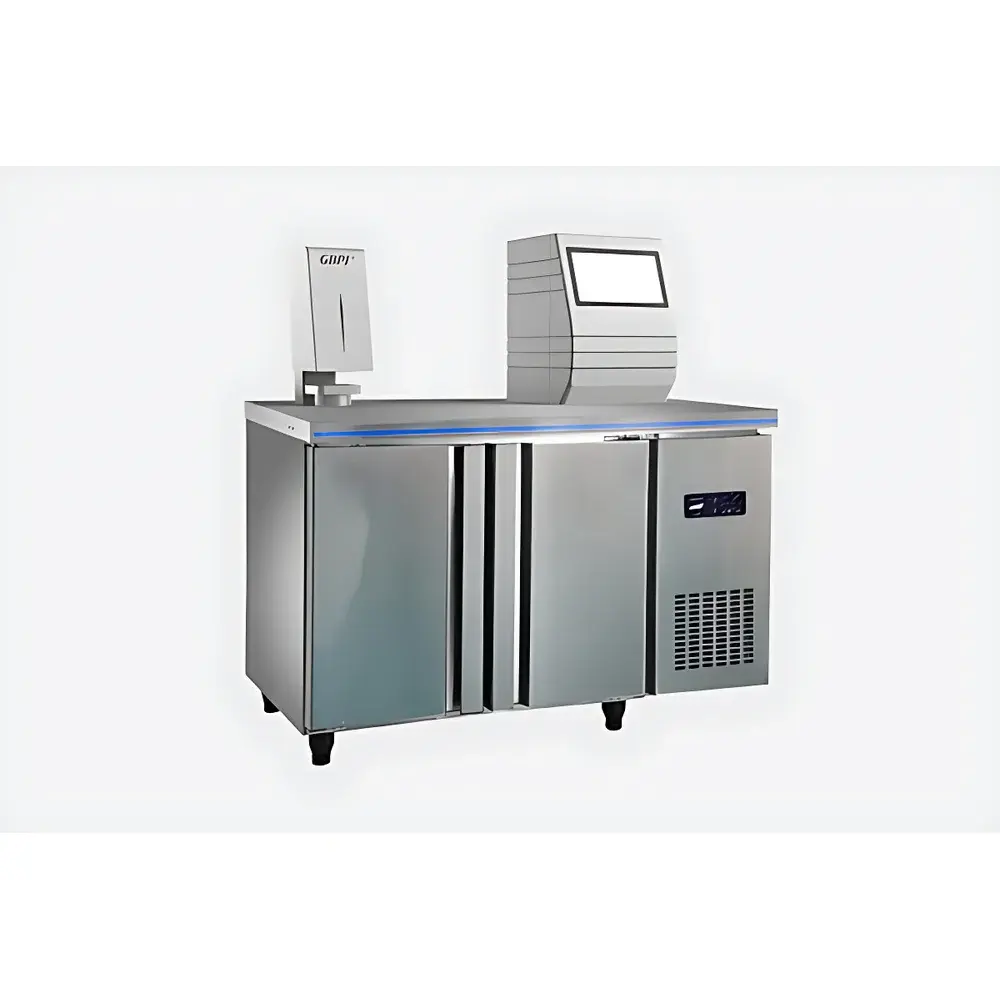
GBPI GB-KF30010S Oil-Based Aerosol Filtration Efficiency Tester for Nonwoven Meltblown Fabric
| Brand | GBPI |
|---|---|
| Origin | Guangdong, China |
| Manufacturer Type | Direct Manufacturer |
| Country of Origin | China |
| Model | GB-KF30010S |
| Price Range | USD 42,000 – 70,000 |
| Filtration Efficiency Range | 0–99.999% |
| Flow Rate Control | 20–100 L/min |
| Pressure Drop Range | 0–1000 Pa |
| Test Particle Sizes | 0.3 µm, 0.5 µm, 5.0 µm |
| Aerosol Sources | DEHS (Di-Ethyl-Hexyl-Sebacate) and 2% NaCl solution |
| Standard Test Area | 100 cm² (customizable per mask geometry) |
| Dimensions | 130 × 75 × 157 cm |
| Weight | 250 kg |
| Power Supply | AC 220 V, 50 Hz |
| Max Power Consumption | <1500 W |
Overview
The GBPI GB-KF30010S Oil-Based Aerosol Filtration Efficiency Tester is a precision-engineered instrument designed for quantitative assessment of particulate filtration performance in meltblown nonwoven fabrics—particularly those used in surgical masks, N95 respirators, and medical protective equipment. It operates on the principle of controlled aerosol challenge under constant airflow, measuring both filtration efficiency (%) and pressure drop (Pa) across the test specimen. The system complies with core regulatory frameworks governing respiratory protection and medical device evaluation, including YY 0469–2011 (Medical Surgical Masks), GB 2626–2006 (Self-Contained Filtering Respiratory Protective Devices), and GB/T 32610–2016 (Daily Protective Masks). Its dual-aerosol capability—supporting both oil-based (DEHS) and salt-based (NaCl) challenges—enables compliance with international classification schemes such as EN 149 (FFP class) and ISO 16890, while maintaining alignment with domestic Chinese testing infrastructure and validation requirements.
Key Features
- Cold-generation aerosol generator capable of stable, reproducible output of both DEHS (oil-based) and NaCl (salt-based) aerosols—critical for distinguishing electrostatically enhanced filtration mechanisms from mechanical capture.
- Integrated bipolar ionizer for neutralizing electrostatic charge on test aerosols, ensuring measurement fidelity per ISO 16890 Annex B and EN 1822–3:1998 protocols.
- Full containment design with leak-tight aerosol pathways and negative-pressure exhaust management, meeting OSHA and IEC 61000-4-2 safety expectations for operator exposure control.
- Pneumatic clamping system with force-limiting actuation and interlocked safety guards—preventing accidental contact during high-flow testing cycles.
- Real-time particle counting via calibrated laser particle counter (0.3–5.0 µm detection range), traceable to NIST SRM 1930a reference standards.
- Automated data acquisition and calculation engine compliant with FDA 21 CFR Part 11 requirements for electronic records and signatures—featuring audit trail logging, user access controls, and encrypted data storage.
- Touchscreen HMI paired with dedicated Windows-based software for method configuration, real-time visualization of differential pressure and upstream/downstream particle concentration, and automated report generation (PDF/CSV/XLSX).
Sample Compatibility & Compliance
The GB-KF30010S accommodates flat-sheet specimens—including glass fiber filters, polypropylene (PP) meltblown media, and laminated or coated filter composites—within a standardized 100 cm² test area (adjustable per customer-defined mask geometries). It supports material thicknesses up to 5 mm and withstands differential pressures up to 1000 Pa without deformation-induced flow deviation. Regulatory alignment includes full traceability to GB 19082–2009 (Medical Protective Gowns), GB 19083–2010 (Medical Protective Masks), GB 24539–2009 (Chemical Protective Clothing), and YY/T 0969–2013 (Single-Use Medical Masks). All calibration procedures follow ISO/IEC 17025–2017 guidelines for testing laboratories, with documented uncertainty budgets for flow rate (<±1.5% FS), pressure drop (<±2.0 Pa), and particle count (<±5% at 0.3 µm).
Software & Data Management
The embedded GBPI FilterTest Suite v3.2 provides GLP-compliant workflow automation: method templates preconfigured for YY 0469, GB 2626, and EN 149; dynamic pass/fail flagging against user-defined thresholds; time-synchronized logging of environmental parameters (temperature, RH); and export-ready reports containing raw particle counts, calculated efficiency curves, pressure-resistance profiles, and statistical summaries (mean, SD, CV%). Audit trails record all user actions—including parameter edits, calibration events, and report exports—with immutable timestamps and operator IDs. Data files are stored in AES-256 encrypted format and support integration with LIMS platforms via OPC UA or CSV batch import.
Applications
This instrument serves quality assurance and R&D laboratories engaged in filtration media development, regulatory submission preparation, and batch release testing. Primary use cases include: qualification of electrospun or electret-charged PP meltblown layers; comparative analysis of hydrophobic vs. hydrophilic surface treatments; validation of sterilization-induced charge decay effects; verification of filter layer integrity after mechanical stress (e.g., pleating, ultrasonic welding); and third-party certification testing for CNAS-accredited textile and medical device testing centers. It is routinely deployed in national institutes including CDC-affiliated laboratories, provincial drug inspection agencies, and Tier-1 PPE manufacturers operating under GMP Annex 1 environmental controls.
FAQ
Does the system support both oil-based and salt-based aerosol challenges in a single test sequence?
Yes—the dual-source aerosol generator allows sequential or parallel challenge modes, with programmable switching between DEHS and NaCl solutions without hardware reconfiguration.
Is the particle counter calibrated and traceable to national standards?
Yes—each unit ships with a certificate of calibration traceable to NIST SRM 1930a, with annual recalibration recommended per ISO/IEC 17025 Clause 6.5.
Can test methods be customized for non-standard specimen sizes or shapes?
Yes—software supports user-defined test areas and custom flow rates; fixture adapters are available for irregular mask forms upon request.
What cybersecurity measures are implemented in the control software?
The system enforces role-based access control (RBAC), TLS 1.2 encrypted communications, and automatic session timeout after 15 minutes of inactivity.
Is technical support available outside mainland China?
Yes—GBPI provides remote diagnostics, English-language documentation, and on-site service coordination through authorized regional partners in Southeast Asia, the Middle East, and Latin America.






