
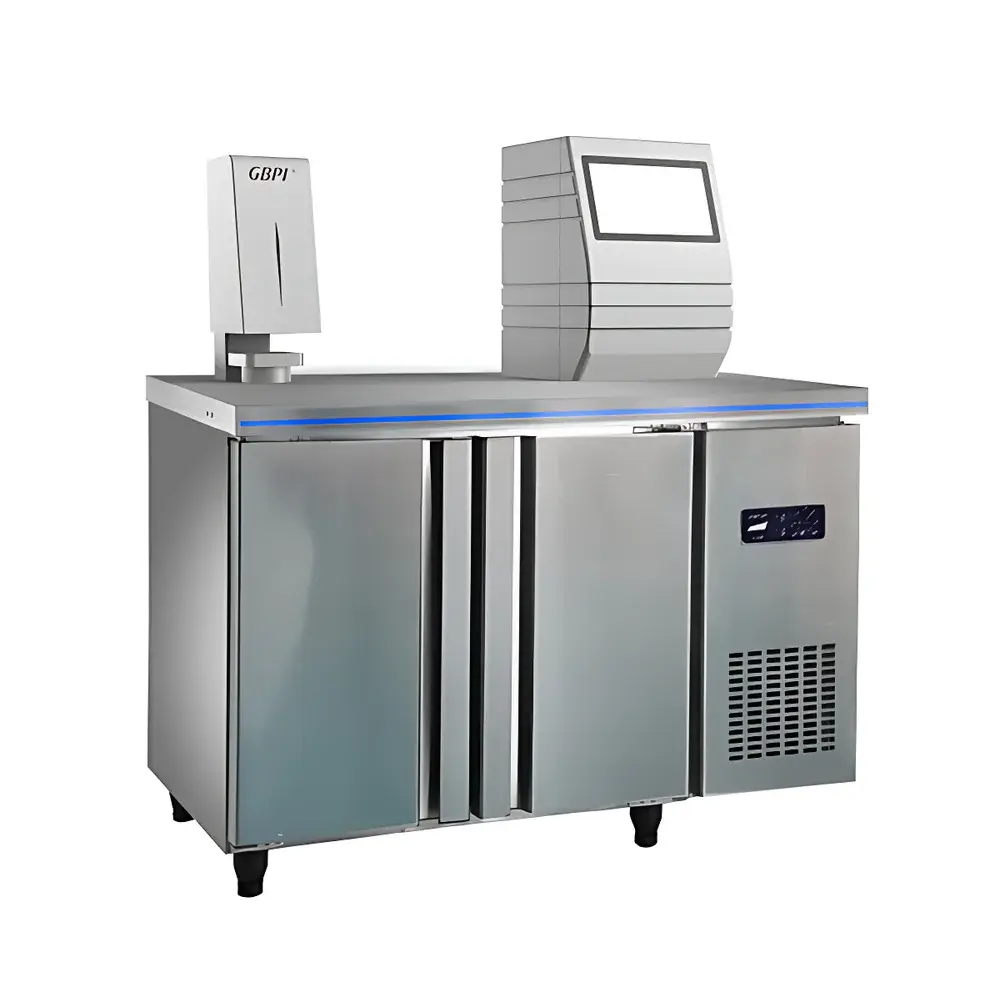
GBPI GB-PF500L1 Oil-Based Particulate Filtration Efficiency Tester for Meltblown Nonwovens
| Brand | GBPI |
|---|---|
| Origin | Guangdong, China |
| Manufacturer Type | Direct Manufacturer |
| Country of Origin | China |
| Model | GB-PF500L1 |
| Price Range | USD 14,000 – 42,000 |
| Filtration Efficiency Range | 0–99.999% |
| Flow Rate Control | 20–100 L/min |
| Pressure Drop Measurement Range | 0–1000 Pa |
| Test Particle Sizes | 0.3, 0.5, 1.0, 2.5, 5.0, 10.0 µm |
| Aerosol Type | Oil-based (DEHS or paraffin oil) |
| Standard Test Area | 100 cm² (mask fixture optional) |
| Dimensions | 1220 × 630 × 1225 mm |
| Weight | 250 kg |
| Power Supply | AC 220 V, 50 Hz |
| Max. Power Consumption | <1500 W |
Overview
The GBPI GB-PF500L1 Oil-Based Particulate Filtration Efficiency Tester is a precision-engineered instrument designed for quantitative assessment of filtration performance against oil-based aerosols—specifically targeting meltblown nonwoven materials used in respiratory protective devices. It operates on the principle of controlled aerosol challenge and real-time particle counting upstream and downstream of the test specimen, enabling calculation of fractional filtration efficiency across six discrete aerodynamic particle size bins (0.3, 0.5, 1.0, 2.5, 5.0, and 10.0 µm). The system complies with core regulatory frameworks governing medical and occupational respiratory protection, including YY 0469–2011 (Technical Requirements for Surgical Masks), GB 2626–2006 (Respiratory Protective Devices – Self-Contained Filtering Devices Against Particles), and GB/T 32610–2016 (Daily Protective Masks). Its design integrates internationally recognized methodologies—including those referenced in EN 1822–3:1998 (High-Efficiency Air Filters – Part 3: Testing of Single Filter Elements)—while maintaining compatibility with domestic testing infrastructure and workflow requirements.
Key Features
- Cold-generation oil-based aerosol source using DEHS (Di-Ethyl-Hexyl-Sebacate) or paraffin oil, delivering stable, monodisperse particle concentrations without thermal degradation.
- Integrated mixing chamber with active temperature and relative humidity monitoring to ensure consistent aerosol conditioning prior to filter challenge.
- Dual-channel particle counting architecture: upstream and downstream optical particle counters (OPCs) with automatic self-cleaning function to prevent sensor fouling and maintain measurement integrity over extended test cycles.
- Electrostatic neutralizer installed upstream of the test stage to eliminate charge effects that may artificially enhance or suppress filtration efficiency readings—critical for compliant evaluation per ISO 16890 and EN 1822.
- Hermetically sealed gas path with leak-tested connections and negative-pressure containment, minimizing operator exposure to aerosolized oil particles during operation.
- Pneumatic clamping mechanism with mechanical safety interlock, ensuring uniform specimen loading pressure (standardized at 100 cm² effective area) and preventing accidental release under vacuum conditions.
- Industrial-grade touch-screen HMI (Human-Machine Interface) coupled with embedded control software for fully automated test execution, real-time data acquisition, and immediate post-test efficiency calculation.
Sample Compatibility & Compliance
The GB-PF500L1 supports standardized evaluation of flat-sheet filter media—including glass fiber, polypropylene (PP) meltblown webs, and laminated or coated variants (e.g., PTFE-membrane composites). Optional mask fixtures enable direct testing of finished respirators per GB 2626–2006 Annex B and YY 0469–2011 Clause 5.6. All hardware and firmware configurations adhere to metrological traceability requirements outlined in JJF 1070–2005 (Regulations for Verification of Quantitative Packaging Metrology) and support GLP-compliant audit trails when paired with validated software versions. The instrument meets electromagnetic compatibility (EMC) Class B requirements per GB/T 18268.1–2010 and is suitable for installation in ISO/IEC 17025-accredited laboratories conducting routine conformity assessments for NMPA, CNAS, or SAMR-regulated submissions.
Software & Data Management
The integrated control software provides full lifecycle test management: method setup (flow rate, dwell time, particle size selection), automated calibration verification, raw count logging with timestamped metadata, and dynamic efficiency computation per ISO 16890–1:2016 Annex C. Export formats include CSV, PDF reports with digital signatures, and XML-compatible structured data for LIMS integration. Audit trail functionality records all user actions—including parameter modifications, calibration events, and result approvals—in accordance with FDA 21 CFR Part 11 principles (electronic records and signatures), supporting regulatory submissions where required. Data retention policies are configurable to align with institutional archiving standards (minimum 10-year retention recommended).
Applications
This instrument serves as a primary qualification tool in R&D, QC, and regulatory testing environments—including national medical device inspection centers (e.g., NIFDC), occupational safety laboratories (e.g., CNIOSH), textile testing institutes (e.g., STC), and vertically integrated PPE manufacturers. Typical use cases include: comparative evaluation of meltblown electret charging efficacy; validation of hydrophobic treatment durability under oil aerosol challenge; shelf-life stability studies of filtration performance; and batch release testing of surgical masks and KN95/N95-equivalent respirators. It further supports material development programs focused on optimizing basis weight, fiber diameter distribution, and surface energy characteristics for enhanced oil aerosol capture.
FAQ
What oil-based aerosols does the GB-PF500L1 support?
The system is calibrated and validated for DEHS (Di-Ethyl-Hexyl-Sebacate) and pharmaceutical-grade paraffin oil, both compliant with YY 0469–2011 and EN 1822–3 aerosol specifications.
Can the instrument test finished face masks—not just flat filter media?
Yes, optional mask fixtures are available to mount intact respirators for total inward leakage (TIL) and filter-only efficiency separation per GB 2626–2006 Annex B protocols.
Is the particle counter certified to ISO 21501-4?
The integrated OPC meets the optical sizing and counting accuracy requirements specified in ISO 21501–4:2018 for airborne particle counters used in filter testing applications.
Does the system support multi-size bin efficiency reporting?
Yes—it delivers simultaneous fractional efficiency results across all six standard size channels (0.3–10.0 µm) with synchronized pressure drop measurement at each flow setting.
How is data integrity ensured during long-duration tests?
Continuous environmental monitoring (temperature/humidity in mixing chamber), automatic zero-checks, and dual-channel redundancy minimize drift; all raw counts are logged with millisecond timestamps and checksum-verified storage.





