
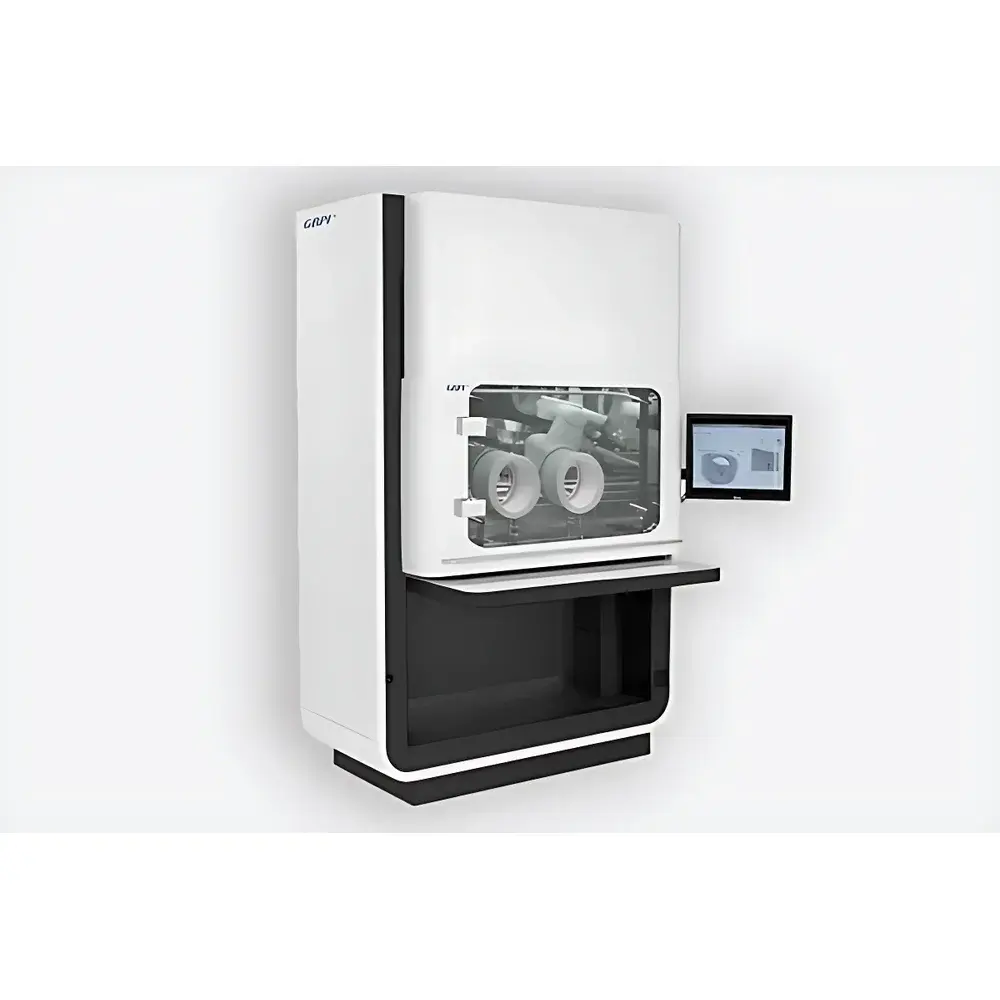
GBPI GB-XF2000 Bacterial Filtration Efficiency (BFE) Tester for Meltblown Fabric and Medical Face Masks
| Brand | GBPI |
|---|---|
| Origin | Guangdong, China |
| Manufacturer Type | Direct Manufacturer |
| Origin Category | Domestic (China) |
| Model | GB-XF2000 |
| Price Range | USD 42,000 – 70,000 |
| Sampling Flow Rate | 28.3 L/min ±2.5% |
| Aerosol Generation Flow Rate | 8–10 L/min ±2.5% |
| Peristaltic Pump Flow Range | 0.006–3.0 mL/min ±2.5% |
| Pre-Flowmeter Pressure | −20 to 0 kPa ±2.5% |
| Pre-Spray-Flowmeter Pressure | 0–300 kPa ±2.5% |
| Ambient Temperature Range | −40 to 99 °C ±2.5% |
| Aerosol Chamber Negative Pressure | −90 to −120 Pa ±2.0% |
| Cabinet Negative Pressure | −50 to −200 Pa |
| Data Storage Capacity | >100,000 test records |
| Vortex Mixer | 8 × Φ16×150 mm tubes |
| HEPA Filter Efficiency | ≥99.99% for particles ≥0.3 µm |
| Aerosol Mass Median Diameter (MMD) | 3.0 ± 0.3 µm, GSD ≤1.5 |
| Andersen Cascade Impactor Stages | 6-stage, aerodynamic cut-points: Stage I >7 µm, II 4.7–7 µm, III 3.3–4.7 µm, IV 2.1–3.3 µm, V 1.1–2.1 µm, VI 0.6–1.1 µm |
| Aerosol Chamber Dimensions | 600 mm (L) × 85 mm (D) × 30 mm (T) |
| Positive Control Target | 2200 ± 500 CFU per sample |
| Negative Pressure Cabinet Airflow | ≥5 m³/min |
| Cabinet Dimensions (W×D×H) | 755 × 400 × 990 mm |
| Main Unit Dimensions (W×D×H) | 1200 × 630 × 2100 mm |
| Acoustic Noise Level | <65 dB(A) |
| Net Weight | ~150 kg |
| Power Supply | AC 220 V ±10%, 50 Hz |
| Power Consumption | <1500 W |
Overview
The GBPI GB-XF2000 Bacterial Filtration Efficiency (BFE) Tester is a fully integrated, negative-pressure-controlled laboratory instrument engineered for standardized quantitative assessment of microbial particle retention in meltblown nonwovens, surgical masks, and other respiratory barrier materials. It operates on the principle of controlled aerosol challenge using viable Staphylococcus aureus (ATCC 6538) bioaerosols, followed by impaction-based collection and colony-forming unit (CFU) enumeration across six aerodynamically calibrated stages of an Andersen cascade impactor. The system conforms to internationally recognized regulatory and performance standards—including YY 0469–2004, YY/T 0969–2013, ASTM F2101, ASTM F2100, and EN 14683—making it suitable for GLP-compliant validation, quality control release testing, and regulatory submission support in medical device manufacturing and third-party certification laboratories.
Key Features
- Negative-pressure biosafety cabinet architecture with dual independent airflow paths: one for aerosol generation and delivery, the other for sampling and exhaust filtration—ensuring operator protection and environmental containment.
- Integrated six-stage Andersen cascade impactor mounted directly inside the aerosol chamber, enabling simultaneous size-resolved deposition of bioaerosols onto nutrient agar plates for downstream microbiological analysis.
- Precision peristaltic pump with programmable flow control (0.006–3.0 mL/min, resolution 0.001 mL/min) for consistent delivery of bacterial suspension to the nebulizer.
- Dedicated microbial aerosol generator producing monodisperse S. aureus bioaerosols with mass median diameter (MMD) of 3.0 ± 0.3 µm and geometric standard deviation (GSD) ≤1.5—validated per ASTM F2101 requirements.
- Embedded high-performance industrial microcomputer with 10.4-inch bright TFT-LCD capacitive touchscreen interface, supporting intuitive workflow navigation, real-time parameter monitoring, and on-device data review.
- Comprehensive pressure and flow regulation system featuring dual digital pressure transducers (±0.01 kPa and ±0.1 kPa resolution) and thermal mass flow meters (28.3 L/min nominal, ±2.5% accuracy), all continuously logged and traceable.
- Internal vortex mixer accommodating eight standard Φ16 × 150 mm culture tubes for uniform resuspension prior to plating.
- HEPA filtration (≥99.99% @ 0.3 µm) on all exhaust pathways, combined with fire-retardant insulation between inner and outer cabinet layers for structural safety compliance.
- Front-access laminated glass door with mechanical interlock, integrated LED task lighting, and built-in residual-current circuit breaker (RCCB) for electrical hazard mitigation.
Sample Compatibility & Compliance
The GB-XF2000 accommodates flat-sheet specimens up to 100 mm × 100 mm, including meltblown polypropylene nonwovens, electrospun nanofiber membranes, spunbond-meltblown-spunbond (SMS) laminates, and finished surgical mask panels. All test fixtures are ISO/IEC 17025-aligned for dimensional repeatability and clamping force consistency. Regulatory alignment includes full traceability to ASTM F2101 (standard test method for determining BFE of medical face mask materials utilizing a biological aerosol of Staphylococcus aureus), YY/T 0969–2013 (single-use medical surgical masks), and EN 14683:2019 (medical face masks—requirements and test methods). Instrument calibration protocols support audit readiness for FDA 21 CFR Part 11, ISO 13485, and MDR Annex II technical documentation requirements.
Software & Data Management
The embedded control software provides complete test lifecycle management: method setup (including user-defined exposure duration, flow setpoints, and positive/negative control configuration), real-time acquisition of pressure, flow, temperature, and vacuum signals, automatic calculation of BFE (%) as (1 − Cs/Cu) × 100 where Cs = CFU recovered downstream and Cu = upstream challenge concentration, and export of raw and processed datasets via USB 2.0 to FAT32-formatted drives. All data entries include timestamp, operator ID, sample ID, and instrument serial number. Audit trail functionality logs every parameter change, test initiation, and result finalization—supporting ALCOA+ principles (Attributable, Legible, Contemporaneous, Original, Accurate, Complete, Consistent, Enduring, Available) required under GMP/GLP frameworks.
Applications
- Quantitative BFE evaluation of meltblown filter media during R&D and process optimization.
- Batch release testing of surgical masks and N95-equivalent respirators per ISO 13485 production controls.
- Comparative filtration performance studies across fiber morphology, basis weight, electret charge decay, and humidity-conditioned aging protocols.
- Validation of sterilization compatibility and post-sterilization BFE retention for gamma- or EtO-treated masks.
- Third-party conformity assessment for CE marking, FDA 510(k), and NIOSH pre-certification submissions.
- Academic research into structure–function relationships in fibrous filtration mechanisms at submicron scales.
FAQ
What biological agent is used for BFE testing on the GB-XF2000?
Staphylococcus aureus ATCC 6538 is the reference microorganism specified in ASTM F2101 and YY/T 0969–2013. The system supports strict aseptic handling protocols and optional biosafety level 2 (BSL-2) integration.
Can the GB-XF2000 perform viral filtration efficiency (VFE) testing?
No—the GB-XF2000 is designed and validated exclusively for bacterial aerosol challenges. VFE requires separate instrumentation compliant with ISO 18184 or ASTM F3502, involving bacteriophage surrogates and nucleic acid quantification.
Is the Andersen impactor calibrated and certified?
Yes—each six-stage impactor is supplied with a NIST-traceable calibration certificate verifying stage-specific cut-point diameters and collection efficiencies per ISO 14644-3 Annex B and USP <797> aerosol characterization guidelines.
Does the system meet FDA 21 CFR Part 11 requirements?
The software implements electronic signature capability, role-based access control, and immutable audit trails—fully configurable to satisfy Part 11 Subpart B technical controls when deployed in validated environments.
What maintenance intervals are recommended for the HEPA filters and nebulizer components?
HEPA filters require replacement every 12 months or after 2,000 operational hours; nebulizer tips should be inspected daily and replaced after 500 challenge cycles or visible clogging—logbook templates are included in the user manual.



