
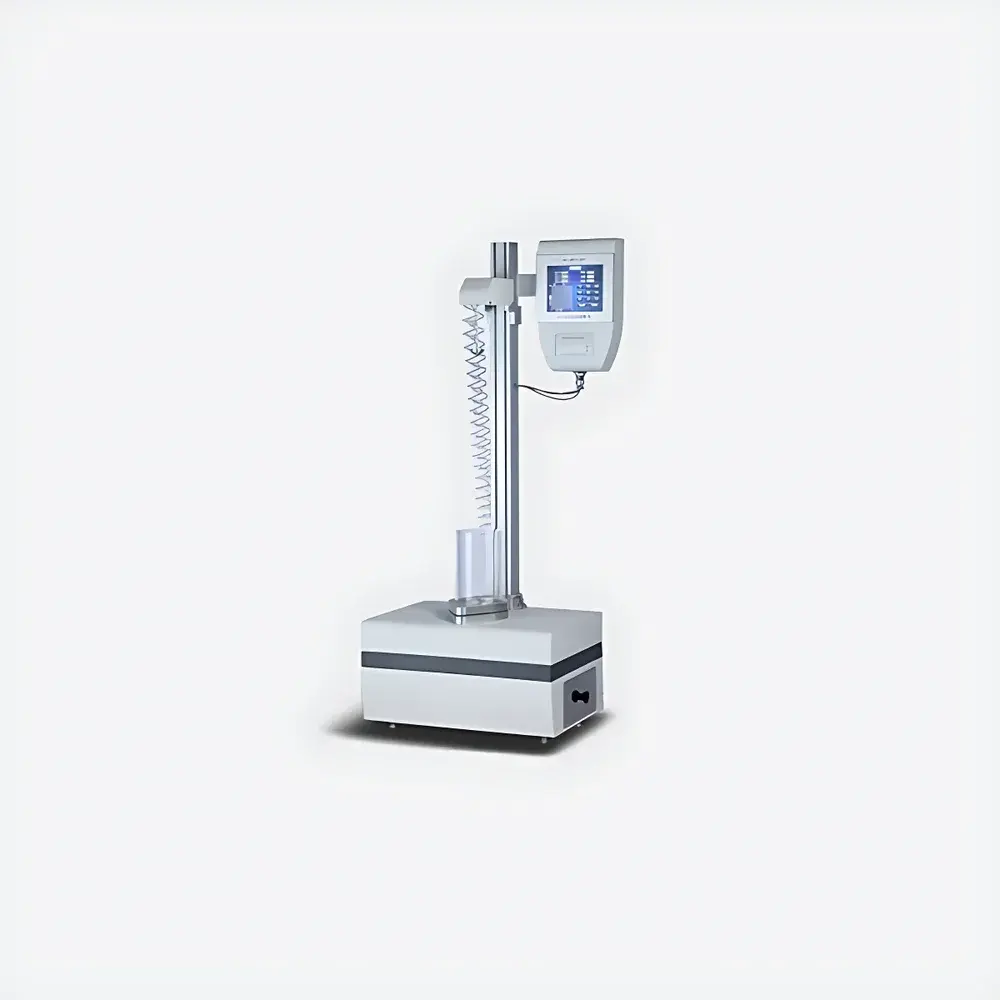
GBPI GBD-L Dart Impact Tester
| Brand | GBPI |
|---|---|
| Origin | Guangdong, China |
| Manufacturer Type | Manufacturer |
| Origin Category | Domestic |
| Model | GBD-L |
| Pricing | Upon Request |
| Test Range (Method A) | 50–2000 g |
| Test Range (Method B) | 300–2000 g |
| Resolution | 1 g |
| Dart Mass Accuracy | ≤0.5% |
| Dart Tip Diameter (Method A) | Φ38 ± 1 mm |
| Dart Tip Diameter (Method B) | Φ50 ± 1 mm |
| Standard Weights | 5 g, 15 g, 30 g, 45 g, 80 g, 90 g (8 pcs each) |
| Weight Step Increment | 5 g |
| Drop Height Options | 1500 mm / 660 mm |
| Specimen Clamp | Pneumatic, OD 150 mm / ID 125 mm |
| Specimen Size | 180 × 180 mm |
| Air Supply | Compressed air, 0.6–0.8 MPa |
| Air Inlet | Φ8 mm |
| Dimensions (W×D×H) | 550 × 380 × 2300 mm |
| Net Weight | 70 kg |
| Power Supply | AC 220 V, 50 Hz |
| Rated Power | 1000 W |
Overview
The GBPI GBD-L Dart Impact Tester is a precision-engineered instrument designed for quantifying the impact resistance of thin polymeric films, foils, and coated substrates—particularly those with thicknesses under 1 mm. It operates on the principle of free-fall impact energy determination: a standardized dart mass is dropped from a fixed height onto a horizontally clamped specimen; the minimum mass required to produce a specified failure rate (typically 50% penetration probability) is determined through statistical staircase or up-and-down methods. This gravimetric approach directly correlates impact energy to mass under constant gravitational acceleration, enabling reproducible comparative evaluation across material batches and formulations. The instrument complies fully with internationally recognized mechanical testing standards—including ISO 7765-1, ASTM D1709 (Methods A and B), GB/T 9639.1, GB/T 15267, and JIS K7124—making it suitable for quality assurance in regulated environments such as food packaging, medical device packaging, and pharmaceutical primary packaging validation.
Key Features
- Two standardized test configurations: Method A (Φ38 mm dart tip, 50–2000 g range) and Method B (Φ50 mm dart tip, 300–2000 g range), selectable via intuitive interface
- Pneumatically actuated specimen clamp with precise 150 mm outer diameter and 125 mm inner diameter aperture ensures uniform tension and minimal edge distortion during impact
- High-accuracy calibrated weights (5 g to 90 g, 5 g increments) traceable to national metrological standards; mass tolerance ≤0.5% per weight set
- Dual-height drop tower (660 mm and 1500 mm) accommodates both low-energy and high-energy impact regimes without mechanical reconfiguration
- Integrated LCD display with real-time data visualization: current mass, drop count, pass/fail status, and cumulative statistics
- Automated dart release mechanism synchronized with pneumatic clamping cycle to eliminate operator-induced timing variability
- Built-in thermal printer supporting immediate hardcopy output of test reports compliant with GLP documentation requirements
- Robust structural frame (70 kg total mass) minimizes vibration transmission and ensures long-term alignment stability
Sample Compatibility & Compliance
The GBD-L accepts flat, non-porous specimens measuring 180 × 180 mm, compatible with single-layer and coextruded plastic films (e.g., LDPE, PET, OPP, nylon), metallized coatings, laminates, and thin metallic foils. Its pneumatic clamping system maintains consistent clamping force (adjustable within 0.6–0.8 MPa air pressure range), critical for eliminating slippage artifacts in low-modulus materials. All mechanical components—including dart tips, weight sets, and specimen holders—are manufactured to dimensional tolerances specified in ASTM D1709 and ISO 7765-1. The instrument’s design supports full auditability: test logs include timestamped operator ID, method selection, environmental conditions (optional external sensor integration), and raw pass/fail outcomes—enabling traceability for ISO/IEC 17025-accredited laboratories and FDA 21 CFR Part 11–aligned workflows when paired with validated software.
Software & Data Management
While the base GBD-L operates as a standalone unit with embedded firmware, optional PC-based software (GBPI LabLink™) enables advanced data management. The software supports automated statistical analysis per ASTM D1709 Annex A1 (staircase method), generates Weibull distribution plots, exports CSV/Excel-compatible datasets, and maintains encrypted audit trails with user-level access control. All test records include metadata such as calibration certificate IDs, environmental monitoring inputs (temperature/humidity), and electronic signatures—fully aligned with GLP, GMP, and ICH Q5C documentation expectations. Firmware updates are delivered via secure USB protocol and retain full backward compatibility with historical test archives.
Applications
This tester serves critical roles across packaging R&D, production QC, and third-party certification labs. Typical use cases include: evaluating seal integrity of pouch laminates subjected to palletized transport shock; validating puncture resistance of barrier films used in sterile medical packaging; benchmarking impact performance of compostable films against petroleum-based alternatives; verifying consistency of extrusion-coated paperboard in beverage cartons; and supporting root-cause analysis of field failures in flexible food packaging. Its compliance with GB/T 9639.1 also makes it applicable in Chinese national inspection protocols for packaging safety assessment under SAMR oversight.
FAQ
What standards does the GBD-L comply with?
ISO 7765-1, ASTM D1709 (Methods A and B), GB/T 9639.1, GB/T 15267, and JIS K7124.
Is calibration verification supported?
Yes—weight sets are supplied with individual calibration certificates traceable to CNAS-accredited reference standards; optional annual recalibration services available.
Can test data be exported for LIMS integration?
When used with GBPI LabLink™ software, data export formats include CSV, XML, and PDF with embedded digital signatures for LIMS ingestion.
What maintenance is required for long-term accuracy?
Routine checks include dart tip wear inspection (recommending replacement after 5,000 drops), pneumatic line moisture filtration, and annual verification of drop height repeatability using laser distance sensors.
Is the instrument suitable for ISO/IEC 17025 accredited testing?
Yes—its documented uncertainty budget, traceable calibration chain, and configurable audit trail functionality meet Clause 6.4 and 6.6 requirements for mechanical testing equipment.







