
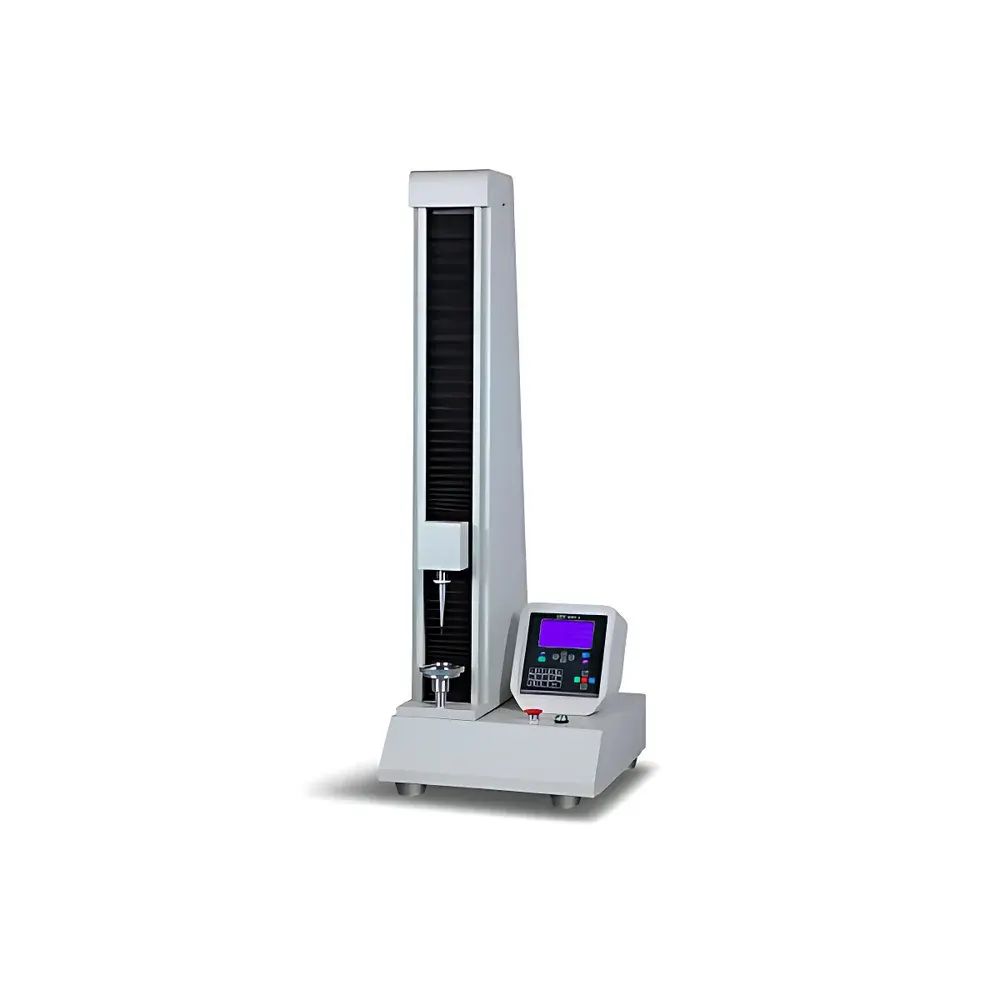
GBPI GBH-1Y Pharmaceutical Packaging Mechanical Property Tester
| Brand | GBPI |
|---|---|
| Origin | Guangdong, China |
| Manufacturer Type | Direct Manufacturer |
| Product Category | Domestic |
| Model | GBH-1Y |
| Instrument Type | Electronic Tensile Testing Machine |
| Maximum Test Force | 1.5 kN |
| Force Range | 0–500 N (optional 0–1500 N) |
| Elongation Capacity | up to 1400% |
| Force Accuracy | ±0.5% of reading (Grade 0.5) |
| Test Stroke | 750 mm |
| Displacement Resolution | ±1% of reading |
| Test Speed | 0–500 mm/min, continuously variable |
| Effective Specimen Width | 30 mm (customizable to 50 mm) |
| Load Frame Dimensions | 600 × 600 × 1300 mm |
| Weight | 70 kg |
| Power Supply | AC 220 V, 50 Hz, 1000 W |
Overview
The GBPI GBH-1Y Pharmaceutical Packaging Mechanical Property Tester is a precision-engineered electronic tensile testing machine designed specifically for the mechanical characterization of primary and secondary packaging materials used in pharmaceutical, biotechnology, and medical device manufacturing. It operates on the fundamental principle of uniaxial force application under controlled displacement and speed, enabling quantitative measurement of tensile strength, elongation at break, peel adhesion, heat seal strength, puncture resistance, tear propagation, compression modulus, and flexural rigidity. The system complies with internationally recognized static mechanical testing standards—including ISO 37 (rubber vulcanized), ASTM D882 (thin plastic sheeting), ASTM F88 (heat seal strength), ASTM D1938 (tear propagation), and key Chinese pharmacopoeial and packaging standards such as YBB00112003 (aluminum-plastic blister packaging), YBB00102003 (plastic infusion bottles), and GB/T 1040 (plastics tensile properties). Its modular architecture supports multi-mode mechanical testing within a single platform, eliminating the need for dedicated instruments per test type—thereby reducing laboratory footprint, calibration overhead, and inter-instrument variability.
Key Features
- High-precision dual-column desktop frame engineered for rigidity and long-term dimensional stability; constructed with high-strength aluminum alloy and precision-machined steel components.
- Imported AC servo motor and high-accuracy ball-screw drive system ensure smooth loading, zero positional drift, and consistent force transmission across the full stroke range (750 mm).
- Digital load cell with ±0.5% full-scale accuracy (Grade 0.5 per JJG 139), calibrated traceable to national metrological standards; supports optional dual-range configuration (0–500 N / 0–1500 N) via software-switchable sensor channels.
- Real-time data acquisition at 100 Hz sampling rate, capturing transient mechanical responses during rapid deformation events (e.g., seal failure, film puncture).
- Multi-functional test mode library pre-configured for ISO/ASTM/GB/YBB-compliant protocols: tensile, 180° peel, heat seal strength (T-peel & clamp-type), trouser tear, dart impact (via optional fixture), compression, three-point bend, and shear.
- Modular control unit available in integrated (compact internal mounting) or external (standalone operation, field-upgradable) configurations—enabling flexible integration into GLP/GMP-controlled environments.
- Comprehensive safety architecture including mechanical limit switches, overload cutoff, emergency stop circuitry, and software-enforced operational boundaries.
Sample Compatibility & Compliance
The GBH-1Y accommodates a broad spectrum of pharmaceutical packaging substrates: laminated films (e.g., PET/AL/PE, OPP/CPP), thermoformed trays, blister foils, pouch seals, rubber stoppers, silicone tubing, Tyvek® lids, and sterile barrier materials. Its 30 mm standard jaw width (expandable to 50 mm) and adjustable gauge length (25–500 mm) support standardized specimen geometries per GB/T 1040.1, ASTM D882, and ISO 527-3. All hardware and firmware comply with electromagnetic compatibility (EMC) requirements per GB/T 18268.1 and electrical safety standards per GB 4793.1. Optional NIST-traceable calibration certificates and metrological verification documentation are available for audit readiness under FDA 21 CFR Part 11 and EU Annex 11 regulatory frameworks.
Software & Data Management
The embedded Windows-based control software provides full test lifecycle management: method creation with parameter locking (speed, preload, dwell time, break detection threshold), real-time force–displacement curve visualization, automatic peak/valley detection, and statistical reporting (mean, SD, CV%, pass/fail flagging against user-defined limits). Raw data export is supported in CSV, XML, and native binary formats; all datasets include embedded metadata (operator ID, timestamp, environmental conditions, calibration ID). Audit trail functionality logs all user actions—including method edits, result deletions, and calibration events—with immutable timestamps. Data structures are fully open and programmatically accessible via COM/ActiveX interfaces, facilitating integration with LIMS, MES, or custom QA dashboards. Excel-compatible templates allow direct import for trending analysis, SPC charting, and CAPA documentation.
Applications
- Quality control of cold-form foil blister packs per YBB00132002 and ASTM F2715.
- Validation of peel strength for child-resistant closures (ASTM D3475) and tamper-evident seals (GB/T 2792).
- Assessment of puncture resistance in rubber stoppers (YBB00052005) and silicone septa used in vials and syringes.
- Tensile property mapping of multilayer pouch films subjected to accelerated aging (ICH Q1A).
- Heat seal integrity evaluation of form-fill-seal (FFS) packaging under varying dwell time/temperature profiles (ASTM F2054).
- Mechanical benchmarking of sustainable mono-material alternatives (e.g., PP-based laminates) against legacy PE/AL structures.
- Academic research on polymer viscoelasticity, creep behavior, and fatigue life modeling of packaging composites.
FAQ
Does the GBH-1Y meet FDA 21 CFR Part 11 requirements for electronic records and signatures?
Yes—the software includes role-based access control, electronic signature capture, and an immutable audit trail compliant with Part 11 Annex A expectations for regulated pharmaceutical laboratories.
Can the system be validated for GMP use?
Absolutely. IQ/OQ documentation packages are provided, and the instrument supports third-party PQ execution per ASTM E2500 and ISPE GAMP5 guidelines.
Is thermal control available for temperature-dependent mechanical testing?
Not natively—but environmental chambers (–40°C to +85°C) can be externally interfaced via analog I/O and synchronized through the software’s event-trigger protocol.
What calibration standards are used for force and displacement verification?
Force calibration employs certified deadweight standards traceable to NIM (China National Institute of Metrology); displacement verification uses laser interferometry per JJG 475.
Are custom fixtures for non-standard packaging geometries supported?
Yes—GBPI offers engineering consultation and CNC fabrication of application-specific grips, jigs, and mandrels, with mechanical drawings supplied for internal QA review.



