
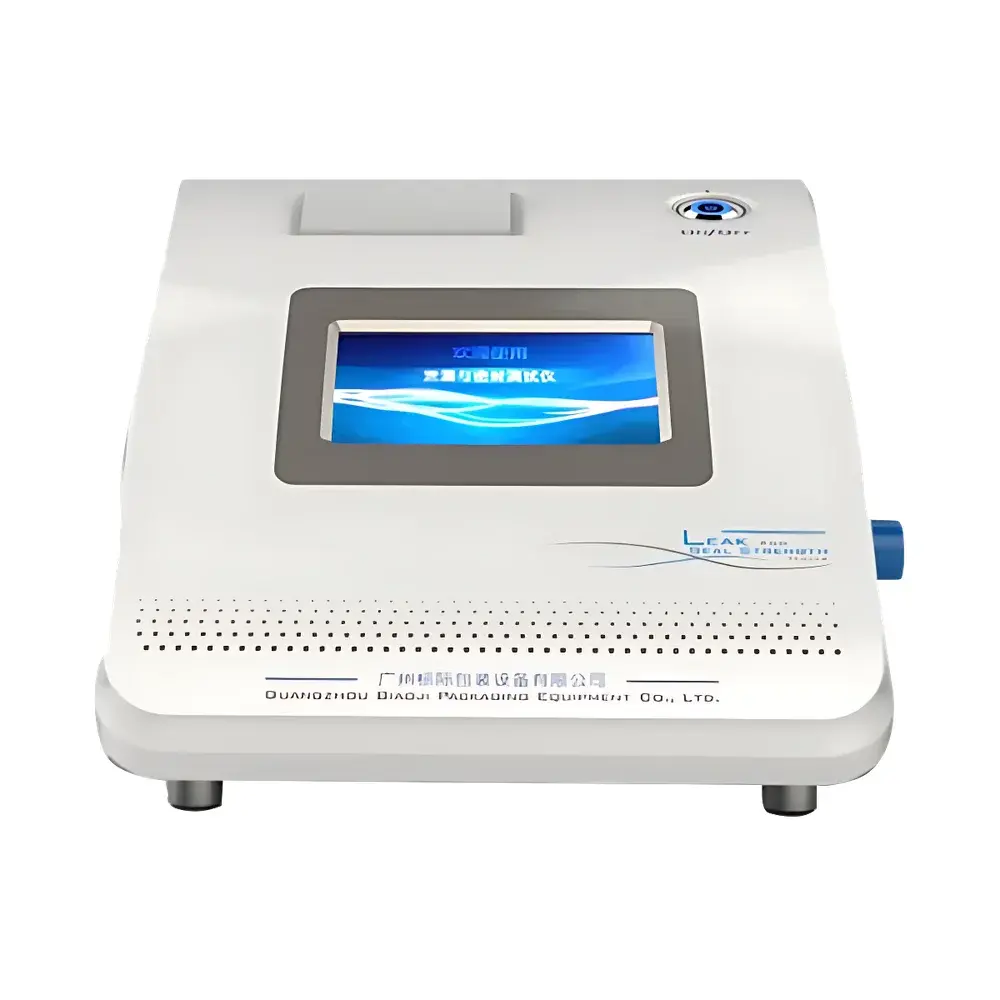
GBPI GBM-D1C Intelligent Seal Integrity Tester
| Brand | GBPI |
|---|---|
| Origin | Guangdong, China |
| Manufacturer Type | Manufacturer |
| Country of Origin | China |
| Model | GBM-D1C |
| Price | Upon Request |
| Test Volume Range | 0–90,000 mL |
| Test Duration | 1–1000 s |
| Pressure Range | 1–1000 kPa |
| Pressure Resolution | 0.1 kPa |
| Pressure Accuracy | ±0.5% FS |
| Dimensions (L×W×H) | 400 × 415 × 272 mm |
| Weight | ≤5 kg |
| Operating Temperature | +2°C to +25°C |
| Storage Temperature | −20°C to +60°C |
| Relative Humidity (Operating) | 10–90% RH (+2°C to +25°C, non-condensing) |
| Ambient Pressure Range | 90.0–105.0 kPa |
| Power Supply | 100–240 VAC, 47–63 Hz |
| Max. Power Consumption | 140 W |
| Input Gas Pressure | 50–1000 kPa |
| Gas Inlet Connection | 6/4 mm OD |
| Main Gas Flow Control | 0–10 L/min (automated) |
| Bypass Flow Control | 0–100 L/min (manual) |
| USB Interface | 1 × USB 2.0 Type-A |
| Compliance | ASTM F1140, ASTM F2054, ASTM F2095, ASTM F2096, ISO 11607-1, YY/T 0681.3, YY/T 0681.5, YY/T 0681.9, GB/T 17876 |
Overview
The GBPI GBM-D1C Intelligent Seal Integrity Tester is an engineered solution for quantitative, standardized assessment of package seal integrity and burst resistance across flexible, semi-rigid, laminated, and porous packaging structures. It operates on the principle of controlled pressurization—applying regulated internal air pressure to sealed packages while monitoring pressure decay, time-to-failure, or visual leakage indicators under defined mechanical constraints. Unlike qualitative dye penetration or vacuum decay methods, this instrument delivers traceable, repeatable, and audit-ready quantitative data aligned with international regulatory expectations for sterile barrier systems and shelf-life-critical packaging. Its architecture supports both destructive (burst, creep-to-failure) and non-destructive (pressure decay, bubble emission) test modalities—each governed by specific boundary conditions (e.g., unconstrained vs. restrained geometry, immersion medium, dwell time, and pressure ramp profiles).
Key Features
- Multi-modal testing capability: Burst (ASTM F1140/F2054), pressure decay leak detection (ASTM F2095), creep evaluation (ASTM F1140/YY/T 0681.3), creep-to-failure, and submerged bubble emission (ASTM F2096/YY/T 0681.5)
- Extended volumetric capacity: Validated for packages up to 90,000 mL (90 L), accommodating large-format pouches, trays, and sterilization wraps without geometric compromise
- High-resolution pressure control: 0.1 kPa resolution with ±0.5% full-scale accuracy across 1–1000 kPa range, enabling precise threshold definition for marginal seals
- Dual gas flow architecture: Automated main flow (0–10 L/min) for rapid pressurization; manual bypass (0–100 L/min) for fine-tuning or low-flow applications such as micro-leak screening
- Modular test head options: Interchangeable needle-probe and handheld applicator heads for diverse package geometries—including blister cards, sachets, foil-laminated pouches, and rigid containers
- Embedded environmental monitoring: Real-time logging of ambient temperature, humidity, and barometric pressure to support GLP-compliant test documentation and uncertainty analysis
- USB 2.0 interface for direct data export, firmware updates, and integration with external barcode scanners or thermal label printers for sample traceability
Sample Compatibility & Compliance
The GBM-D1C accommodates a broad spectrum of primary and secondary packaging materials used in regulated industries: aluminum-laminated films, co-extruded polyolefin pouches, Tyvek®-based medical device wraps, thermoformed PET trays, and multi-layer barrier foils. Its mechanical design permits testing of both flat-sealed and 3D-formed packages—including side-sealed, fin-sealed, and peel-open configurations. All test protocols are implemented in strict conformance with globally recognized standards: ASTM F1140 (unconstrained burst and creep), ASTM F2054 (restrained burst), ASTM F2095 (pressure decay), ASTM F2096 (bubble emission), ISO 11607-1 (packaging for terminally sterilized medical devices), YY/T 0681.3–0681.9 (Chinese national standards for sterile packaging validation), and GB/T 17876 (plastic tamper-evident closures). The system’s pressure calibration traceability follows ISO/IEC 17025 requirements, supporting FDA 21 CFR Part 11 readiness when paired with validated electronic record workflows.
Software & Data Management
The instrument runs embedded firmware with a menu-driven touchscreen interface optimized for operator efficiency and procedural consistency. Test parameters—including target pressure, dwell time, ramp rate, pass/fail thresholds, and environmental compensation settings—are configured per method and saved as reusable test templates. All raw data (pressure vs. time curves, event timestamps, failure modes, and operator annotations) are stored locally with automatic timestamping and user ID tagging. Export formats include CSV for statistical process control (SPC) analysis and PDF reports compliant with ISO 13485 and ICH Q5C documentation requirements. Optional software modules enable automated audit trail generation, electronic signature capture, and integration with LIMS or MES platforms via configurable API endpoints. Data integrity safeguards include write-protected storage, immutable log files, and configurable retention policies aligned with GMP data archival mandates.
Applications
- Medical Device Packaging: Validation of sterile barrier integrity for Class II/III devices packaged in Tyvek®/PET pouches or rigid trays per ISO 11607-1 and AAMI ST77
- Pharmaceutical Primary Packaging: Assessment of blister cavity seal strength, HDPE bottle cap torque-seal correlation, and strip-pack edge seal performance per USP <1207>
- FDA-Regulated Food Packaging: Shelf-life verification of retort pouches, modified atmosphere packaging (MAP), and vacuum-sealed entrées using pressure decay and bubble emission protocols
- Cosmetic & Nutraceutical Pouches: Evaluation of heat-seal integrity for aluminum-laminated面膜 bags, collagen sachets, and single-dose vitamin packets
- Quality Assurance Labs: Routine incoming inspection of contract packaging vendor output, stability study support, and root-cause analysis of field complaints related to seal failure
FAQ
What regulatory standards does the GBM-D1C directly support?
The instrument implements test sequences fully aligned with ASTM F1140, F2054, F2095, F2096; ISO 11607-1; YY/T 0681.3, .5, and .9; and GB/T 17876. Calibration certificates reference NIST-traceable pressure standards.
Can the system differentiate between micro-leaks and gross leaks?
Yes—via selection of appropriate test mode: pressure decay (F2095) detects sub-10−3 mbar·L/s leaks under controlled dwell, while bubble emission (F2096) visually identifies leaks ≥10−2 mbar·L/s. Burst and creep tests assess structural margin rather than leak rate.
Is the instrument suitable for use in cleanroom environments?
It meets ISO 14644-1 Class 8 (100,000) particle limits when operated with filtered compressed air and housed in a laminar flow cabinet. Surface materials comply with ISO 10993-5 cytotoxicity requirements.
How is test repeatability ensured across operators?
Through standardized test templates, automated pressure ramping, fixed fixture geometry, and integrated environmental compensation—reducing operator-dependent variables per ISO 5725-2 precision guidelines.
Does the system support 21 CFR Part 11 compliance?
Out-of-the-box, it provides audit trails, electronic signatures, and data immutability. Full Part 11 implementation requires validated third-party software and documented SOPs per your organization’s quality system.






