
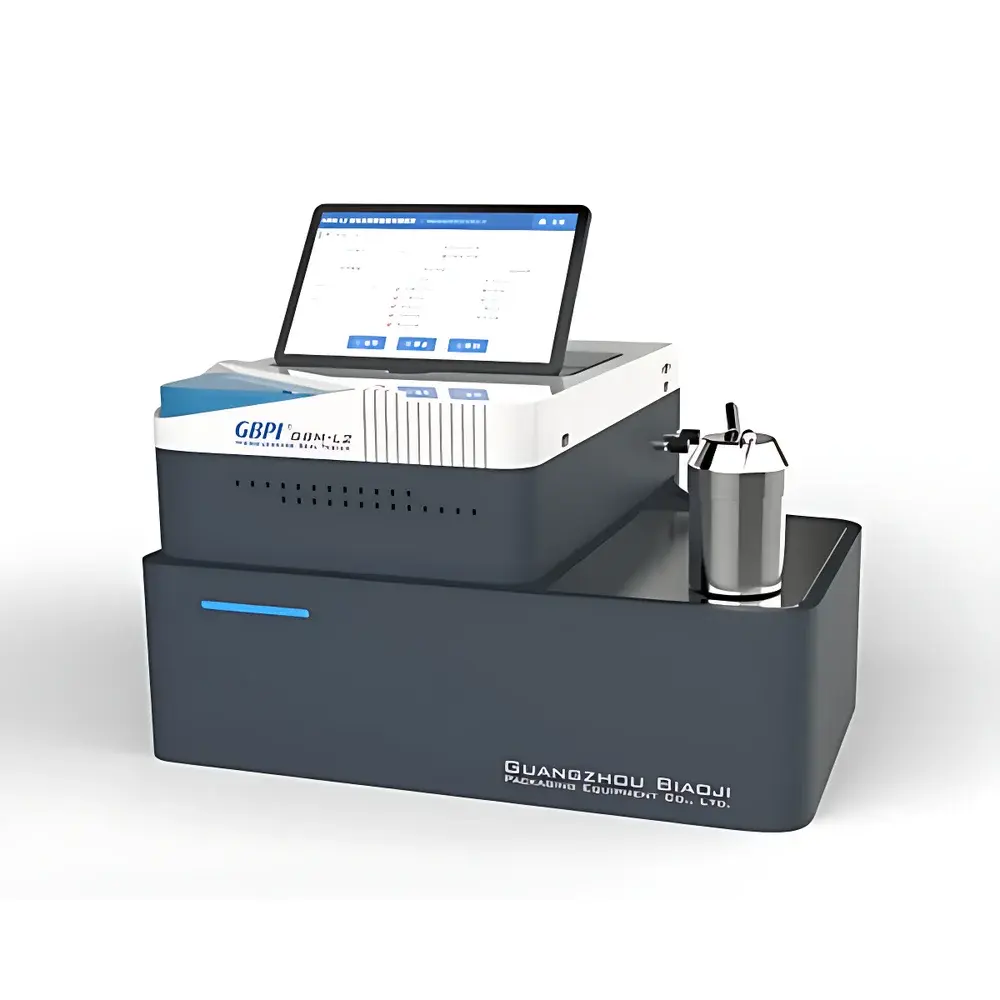
GBPI GBM-L2V Dual-Pressure Micro-Leak Integrity Tester for Ophthalmic Bottles
| Brand | GBPI |
|---|---|
| Origin | Guangdong, China |
| Manufacturer Type | Manufacturer |
| Origin Category | Domestic |
| Model | GBM-L2V |
| Price | USD 53,000 (FOB) |
| Test Principle | Vacuum Decay & Pressure Decay Methods |
| Compliance | ASTM F2338-2009(2013), YY/T 0681.18–2020, USP <1207.2>, ASTM F2095 |
| Absolute Pressure Range | 0–300 kPa |
| Differential Pressure Range | −2 to +2 kPa |
| Detection Sensitivity | 1–3 µm |
| Equilibration/Testing Time | 1–3600 s |
| Vacuum Purge Time | 1–3600 s |
| Set Flow Rate | 0–3 mL/min |
| Sensor Accuracy | ±0.1% FS |
| Vacuum Pump | Imported, 3 L/s, ≤50 dB(A), High Ultimate Vacuum |
| Mass Flow Controller | UK-made, Resolution 0.001 mL/min |
| Control Interface | 11″ Color Touchscreen |
| Data Integrity | Audit Trail, Multi-level User Permissions, 21 CFR Part 11–Ready |
| Chamber | Customizable per Sample Geometry |
| Dimensions (W×D×H) | 495 × 455 × 280 mm |
| Ambient Temp | 20–30 °C |
| RH | ≤80%, Non-condensing |
| Power | AC 220 V, 50 Hz |
Overview
The GBPI GBM-L2V Dual-Pressure Micro-Leak Integrity Tester is an engineered solution for deterministic, non-destructive container closure integrity testing (CCIT) of rigid and semi-rigid pharmaceutical packaging—specifically validated for ophthalmic bottles, vials (lyophilized and liquid-filled), ampoules, pre-filled syringes, HDPE containers, IV bags, and other primary packaging formats subject to regulatory scrutiny under USP and ISO 15378. Unlike probabilistic dye ingress or bubble emission methods, the GBM-L2V implements two complementary physical principles—vacuum decay and pressure decay—in a single platform, enabling robust detection of micro-leaks ranging from 1 µm to ≥3 µm equivalent hole diameter. Its dual-sensor architecture (absolute and differential pressure transducers) captures minute pressure differentials with ±0.1% full-scale accuracy, allowing quantitative correlation between pressure drift rate and leak size—critical for risk-based validation, process qualification, and stability study support.
Key Features
- Dual-Method CCIT Architecture: Simultaneous vacuum decay and pressure decay testing eliminates ambiguity in evaluating vacuum-containing systems (e.g., lyophilized vials), where traditional vacuum-only methods may yield false negatives due to internal headspace dynamics.
- High-Fidelity Dual-Sensor System: Integrated absolute pressure sensor (0–300 kPa) and high-resolution differential pressure sensor (±2 kPa) operate in tandem within a thermally stabilized test chamber, delivering reproducible signal capture across environmental fluctuations.
- Calibration-Traceable Leak Simulation: UK-sourced mass flow controller (0.001 mL/min resolution) enables precise generation of known leak rates for method suitability assessment, SOP verification, and routine performance qualification per ASTM F2095 Annex A2.
- GMP-Compliant Human-Machine Interface: 11-inch industrial touchscreen runs embedded Linux OS with built-in audit trail, electronic signatures, role-based access control (Administrator, Supervisor, Operator), and data export in CSV/PDF—fully aligned with FDA 21 CFR Part 11 and EU Annex 11 requirements.
- Modular Chamber Design: Test fixtures are custom-engineered per container geometry (e.g., 5 mL ophthalmic bottle with flip-top cap, 10 mL HDPE dropper bottle), including nested fixtures for multi-size batch testing without hardware reconfiguration.
Sample Compatibility & Compliance
The GBM-L2V supports CCIT of all rigid and semi-rigid sterile packaging used in aseptic manufacturing, including but not limited to: ophthalmic solution bottles (polypropylene or PETG with elastomeric dispensers), glass and polymer vials (2–30 mL), Type I/II glass ampoules, pre-filled syringes (1–5 mL), and flexible IV bags (up to 2 L). All test protocols comply with compendial standards governing deterministic leak detection—including ASTM F2338-2009(2013) for vacuum decay, ASTM F2095 for pressure decay, YY/T 0681.18–2020 (Chinese pharmacopoeia equivalent), and USP ’s tiered approach to CCIT method selection. The system meets GLP/GMP data integrity expectations through immutable timestamped records, user action logging, and encrypted local database storage.
Software & Data Management
Firmware v3.2 includes integrated method editor, automated pass/fail logic based on user-defined drift thresholds (ΔP/sec), and real-time trend visualization of pressure decay curves. Raw sensor data (absolute and differential) is archived at 10 Hz sampling frequency with metadata (operator ID, lot number, test date/time, chamber ID, environmental conditions). Export options include CSV (for statistical process control analysis in JMP or Minitab), PDF reports with digital signature fields, and XML for LIMS integration. All changes to configuration parameters trigger audit trail entries compliant with ALCOA+ principles—attributable, legible, contemporaneous, original, accurate, complete, consistent, enduring, and available.
Applications
- Final container release testing of ophthalmic solutions prior to distribution
- Comparative CCIT studies during container-closure system change control (e.g., stopper supplier switch)
- Stability protocol support: periodic leakage assessment across shelf-life intervals
- Process validation: correlation of seal quality with crimping force, autoclave cycle parameters, or lyophilization ramp profiles
- Root cause investigation of sterility failures via leak localization and sizing
- Regulatory submission support: generation of method qualification reports per PDA TR27 and ISO 11607-2
FAQ
What is the smallest detectable leak size for ophthalmic bottles using the GBM-L2V?
The instrument achieves a verified detection limit of 1 µm equivalent spherical hole diameter for rigid containers under controlled temperature and humidity conditions, as confirmed per ASTM F2338 Annex B.
Can the GBM-L2V be qualified for use in a regulated GMP environment?
Yes—the system supports IQ/OQ/PQ documentation packages, includes factory calibration certificates traceable to NIST, and provides configurable electronic records meeting 21 CFR Part 11 Subpart B requirements.
Is chamber customization required for each new bottle format?
Chamber design is sample-specific; GBPI provides engineering drawings and fixture validation protocols prior to delivery to ensure mechanical compatibility and test repeatability.
Does the system support automated reporting for regulatory submissions?
All test reports include header metadata, raw pressure curves, calculated leak rate, pass/fail status, operator authentication, and digital signature fields—exportable in FDA-submission-ready formats.
How is sensor drift compensated during long-duration tests (e.g., 3600 s)?
The firmware applies real-time thermal compensation algorithms and references baseline pressure stabilization periods before initiating decay measurement, minimizing ambient-induced drift artifacts.




