
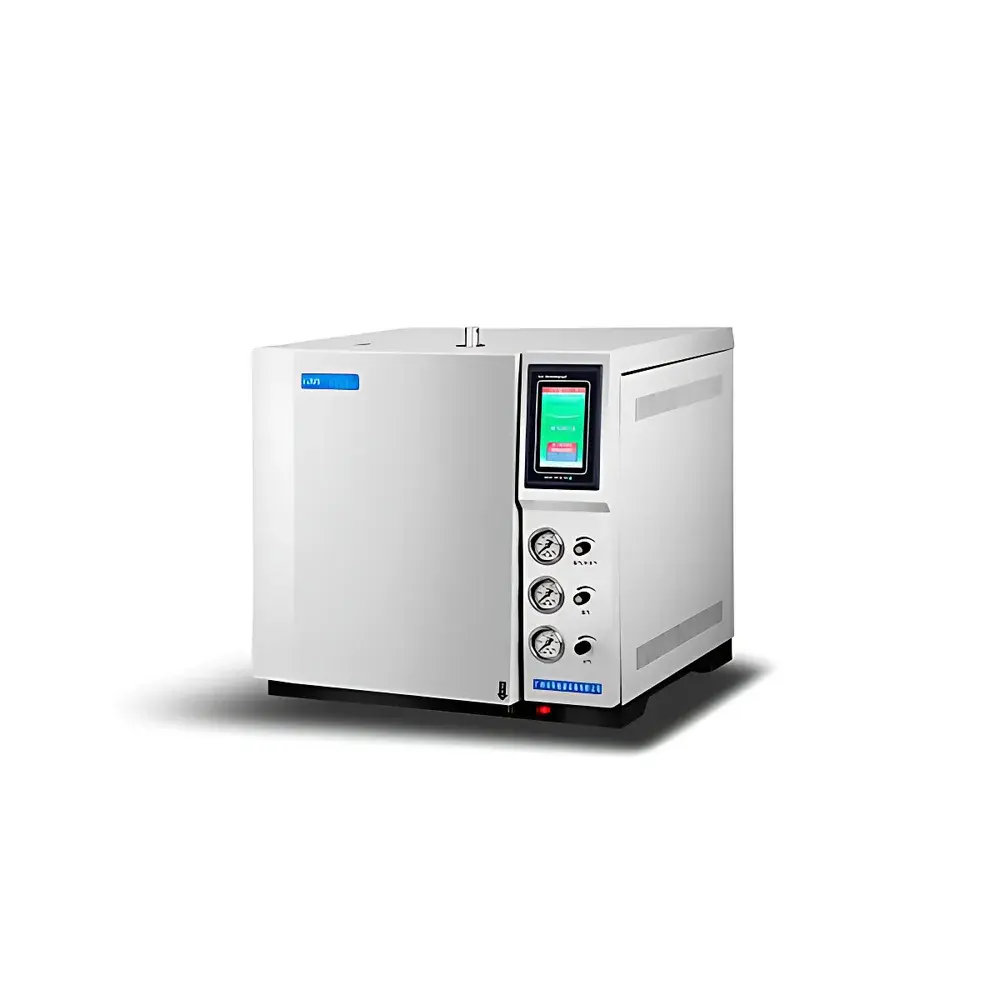
GBPI GC-9802-A Laboratory Gas Chromatograph
| Brand | GBPI |
|---|---|
| Origin | Guangdong, China |
| Manufacturer Type | Direct Manufacturer |
| Origin Category | Domestic (China) |
| Model | GC-9802-A |
| Price Range | USD 14,000–21,000 |
| Instrument Type | Benchtop Laboratory Gas Chromatograph |
| Application Field | Food Industry-Specific Analysis |
| Oven Temperature Range | Up to 400 °C |
| Ramp Rate | 0–40 °C/min |
| Injector Maximum Operating Temperature | 400 °C |
| Detector | FID (Hydrogen Flame Ionization Detector), Optional TCD/ECD/NPD |
| FID Sensitivity | Mt ≤ 1 × 10⁻¹¹ g/s (n-Hexadecane) |
| Baseline Drift | ≤ 0.02 mV/h |
| Noise | ≤ 0.02 mV |
| Column | OV-1701 Capillary Column (50 m × 0.32 mm × 0.5 µm), Max Temp 400 °C |
| Injector Type | Split/Splitless Capillary Injector (Optional Packed Column Injector) |
| Oven Dimensions | 240 × 210 × 240 mm |
| Temperature Resolution | 0.1 °C |
| Temperature Control Accuracy | ±0.1% of setpoint |
| Carrier Gas | High-Purity N₂ (99.99%, 0.4 MPa, dry), H₂ (99.99%, 0.4 MPa, dry), Clean Air (0.4 MPa, oil-free, particle-free) |
| Gas Line Connection | Φ3 mm tubing |
| External Dimensions | 500 × 550 × 500 mm (H × W × D) |
Overview
The GBPI GC-9802-A is a benchtop laboratory gas chromatograph engineered for precision separation and quantitative analysis of volatile and semi-volatile organic compounds. Based on the fundamental principle of differential partitioning between a mobile phase (inert carrier gas) and a stationary phase (capillary column coating), the instrument achieves high-resolution separation through controlled thermal programming of the column oven. Its design emphasizes operational reliability, thermal stability, and compliance with routine analytical workflows in regulated environments—particularly food safety laboratories performing residual solvent testing, purity verification of single-component solvents, and packaging migration analysis per internationally referenced standards such as ISO 11843, ASTM D3960, and USP <467>. The system integrates a hydrogen flame ionization detector (FID) as standard, delivering low detection limits and linear dynamic range suitable for trace-level quantitation across diverse sample matrices.
Key Features
- Thermally stable column oven with programmable temperature ramping (0–40 °C/min) and precise control (±0.1% of setpoint, 0.1 °C resolution) up to 400 °C—enabling robust method development for high-boiling analytes.
- Dual-stage gas regulation system ensuring consistent carrier, fuel, and make-up gas flow rates; all gas lines feature dedicated pressure adjustment valves and desiccated, oil-free inlet conditioning.
- Modular injector architecture supporting both capillary split/splitless operation and optional packed column configuration—facilitating method transfer and legacy method compatibility.
- Integrated noise-suppression circuitry and thermal shielding to minimize electronic and thermal interference, contributing to baseline stability (drift ≤ 0.02 mV/h) and low detector noise (≤ 0.02 mV).
- Over-temperature protection with dual-layer safeguards: firmware-based thermal cut-off and independent hardware circuit monitoring—ensuring instrument integrity during extended unattended runs.
- Front-panel LCD interface with real-time display of oven, injector, and detector temperatures; manual start/stop controls synchronized with software acquisition triggers for reproducible injection timing.
Sample Compatibility & Compliance
The GC-9802-A is validated for use in food contact material testing—including solvent residue analysis in flexible packaging films (per GB/T 10004-2008 and YBB 00132002), pesticide residue screening in agricultural commodities, and volatile impurity profiling in pharmaceutical excipients. Its FID detection system meets sensitivity requirements outlined in Q/BT 2929 for residual solvent quantification. While not pre-certified to FDA 21 CFR Part 11 out-of-the-box, the instrument’s data acquisition architecture supports audit-trail-enabled software configurations compliant with GLP and GMP documentation requirements when deployed with validated third-party chromatography data systems (CDS). All thermal and flow parameters are traceable via internal logging, and column temperature calibration is verifiable using NIST-traceable reference standards.
Software & Data Management
The GC-9802-A operates with GBPI’s proprietary chromatography workstation software, designed for Windows-based laboratory environments. It provides real-time chromatogram visualization with interactive zoom, pan, and overlay functions; peak integration using multiple algorithms (tangent skim, perpendicular drop, valley-to-valley); and customizable report templates exportable to PDF, CSV, and XML formats. Raw data files retain full acquisition metadata—including method parameters, instrument status logs, and detector voltage traces—for retrospective review. The software supports user-defined calibration curves (linear, quadratic, or multi-point weighted), QC flagging based on retention time and area % thresholds, and batch processing for high-throughput screening. For regulated labs, the software can be configured with role-based access control, electronic signatures, and audit trail generation—aligning with ALCOA+ data integrity principles when implemented under documented validation protocols.
Applications
- Residual solvent quantification in food packaging materials (e.g., benzene, toluene, ethyl acetate, isopropanol).
- Purity assessment of industrial solvents used in food-grade cleaning agents or extraction processes.
- Volatile organic compound (VOC) profiling in edible oils, flavorings, and alcoholic beverages.
- Environmental monitoring of chlorinated hydrocarbons and aromatic compounds in water extracts (post-liquid–liquid extraction).
- Quality control of raw materials and intermediates in fine chemical synthesis where boiling point distribution and impurity identity are critical.
FAQ
Is the GC-9802-A compatible with regulatory submissions for food safety testing?
Yes—when operated with validated methods and documented system suitability checks, its performance aligns with criteria specified in GB/T 10004-2008, ISO 11843-2, and USP <467> for residual solvent analysis.
Can I upgrade the detector after purchase?
The instrument chassis supports field-installation of optional detectors including TCD, ECD, and NPD—subject to electrical interface verification and firmware update.
What column dimensions and phases are supported?
Standard configuration includes an OV-1701 capillary column (50 m × 0.32 mm × 0.5 µm); alternative lengths, diameters, and stationary phases (e.g., DB-5, HP-INNOWAX) may be installed following manufacturer-recommended thermal and flow parameter adjustments.
Does the system support automated liquid sampling?
The base model features manual injection only; autosampler integration requires optional hardware retrofit and software license extension.
How is temperature calibration verified?
Calibration is performed using certified reference standards (e.g., melting points of pure compounds or NIST-traceable temperature probes) at three points across the operating range (50 °C, 250 °C, 400 °C), with deviation recorded in the instrument logbook.
Related Products





