
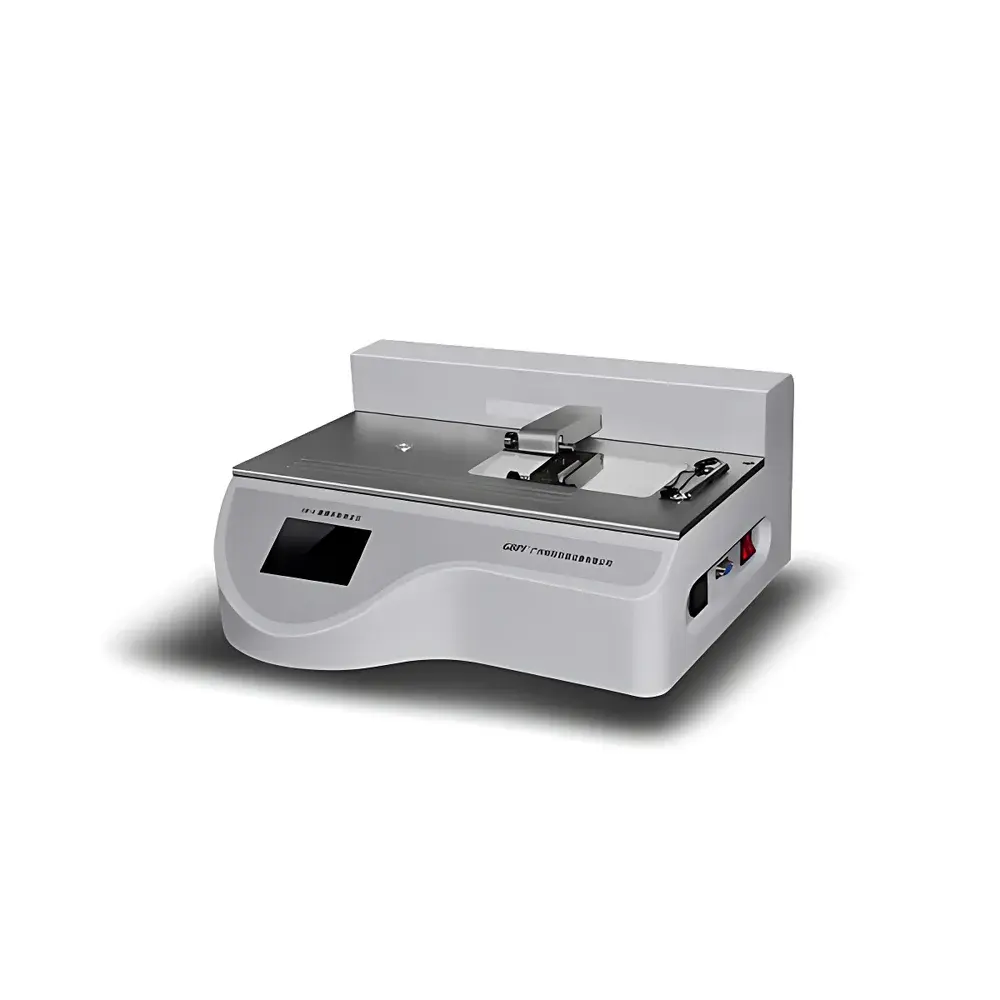
GBPI GM-4D Coefficient of Friction Tester for Packaging Films and Flexible Materials
| Brand | GBPI |
|---|---|
| Origin | Guangdong, China |
| Manufacturer Type | Direct Manufacturer |
| Country of Origin | China |
| Model | GM-4D |
| Price Range | USD 7,000 – 14,000 |
| Friction Coefficient Range | 0.01–0.999 |
| Measurement Accuracy | ±2% |
| Force Sensor Range | 0–10 N |
| Slider Speed | 100 mm/min (infinitely variable) |
| Slider Dimensions | 63 × 63 mm |
| Slider Mass | 200 ± 2 g |
| Temperature Control Range | Ambient to 75 °C (optional) |
| Test Platform Size | 200 × 470 mm |
| Max Sample Thickness | ≤2 mm |
| Dimensions (W×D×H) | 470 × 330 × 210 mm |
| Weight | 37 kg |
| Power | 100 W |
| Supply | AC 220 V ±10%, 50 Hz |
Overview
The GBPI GM-4D Coefficient of Friction Tester is an engineered solution for precise static and kinetic coefficient of friction (COF) measurement in flexible packaging materials—including plastic films, laminates, foils, paper, and coated substrates. Designed in strict compliance with internationally recognized test standards—namely GB/T 10006–1988, ASTM D1894–2014, ISO 8295–2004, and TAPPI T816—the instrument implements the horizontal plane sliding method based on ASTM-defined principles: a standardized slider is pulled at constant velocity across a fixed specimen surface while force transduction captures both breakaway (static) and sustained (kinetic) resistance. This methodology ensures traceable, repeatable results essential for QC release testing, formulation development, and regulatory documentation in pharmaceutical, food, personal care, and industrial packaging environments.
Key Features
- High-accuracy dual-range force sensing system with ±2% full-scale error tolerance, calibrated using certified reference weights and traceable to national metrological standards
- Integrated LCD interface enabling standalone operation: real-time display of static COF, kinetic COF, test speed, and elapsed time without external PC dependency
- Infinitely variable motor-driven crosshead with programmable speed control (default 100 mm/min, adjustable within operational envelope)
- Modular mechanical architecture featuring quick-access service panels, tool-free sensor replacement, and built-in overload protection to safeguard the 0–10 N load cell from overextension or impact damage
- Standardized 63 mm × 63 mm slider with nominal mass of 200 ± 2 g, conforming to ASTM D1894 geometry and inertia requirements
- Optional temperature-controlled test chamber (ambient to +75 °C), enabling COF evaluation under accelerated aging or thermal conditioning protocols
Sample Compatibility & Compliance
The GM-4D accommodates specimens up to 2 mm thick and 200 mm wide × 470 mm long, supporting flat, non-porous, and moderately textured surfaces typical of extruded polyolefins, PET, BOPP, metallized films, kraft paper, and barrier-coated substrates. Its mechanical design and test protocol align with Good Laboratory Practice (GLP) and support audit-ready documentation when used with optional PC-based software. Full traceability is maintained through automatic timestamping, user ID logging, and raw force-vs.-displacement data export—facilitating alignment with FDA 21 CFR Part 11 requirements when paired with validated software and access controls. All hardware components meet CE electromagnetic compatibility (EMC) directives and RoHS material restrictions.
Software & Data Management
The optional Windows-based control software provides intuitive workflow navigation, real-time force curve visualization with zoom/pan functionality, and automated calculation of COF values per ASTM D1894 Annex A1. Each test record includes metadata (operator ID, date/time, sample ID, environmental conditions), digital signature fields, and export options for CSV, PDF, and XML formats. Audit trails capture all parameter modifications, calibration events, and report generation actions—critical for ISO/IEC 17025-accredited laboratories. Software validation packages—including IQ/OQ documentation templates—are available upon request to support GMP-regulated environments.
Applications
- Quality assurance of sealant layer performance in heat-sealable films
- Evaluation of anti-blocking agent efficacy during film extrusion process optimization
- Comparative COF screening of inked vs. uncoated substrates in flexographic and gravure printing workflows
- Regulatory submission support for USP and EP 2.9.36 compliant packaging dossiers
- Root-cause analysis of packaging line jamming or misfeed incidents linked to abnormal surface friction
- Stability studies assessing COF drift after accelerated aging (e.g., 40 °C/75% RH for 30 days)
FAQ
Does the GM-4D comply with FDA 21 CFR Part 11 for electronic records?
Yes—when operated with the validated software package, configurable user roles, electronic signatures, and enabled audit trail logging, the system meets core Part 11 requirements for closed systems.
Can the instrument measure both static and kinetic COF in a single run?
Yes—the integrated force acquisition system captures initial peak force (static COF) and average plateau force (kinetic COF) automatically, per ASTM D1894 Section 8.3.
Is calibration traceable to national standards?
Yes—force sensor calibration utilizes NIST-traceable reference masses; GBPI provides a calibration certificate with each unit, valid for 12 months under normal use conditions.
What maintenance is required for long-term accuracy?
Annual verification of slider mass and platform flatness is recommended; routine cleaning of guide rails and inspection of drive belt tension ensure mechanical consistency.
Is the temperature-controlled option suitable for dynamic COF profiling across a thermal gradient?
No—the optional chamber maintains a single setpoint temperature; for gradient studies, external environmental chambers must be used in conjunction with manual test sequencing.





