
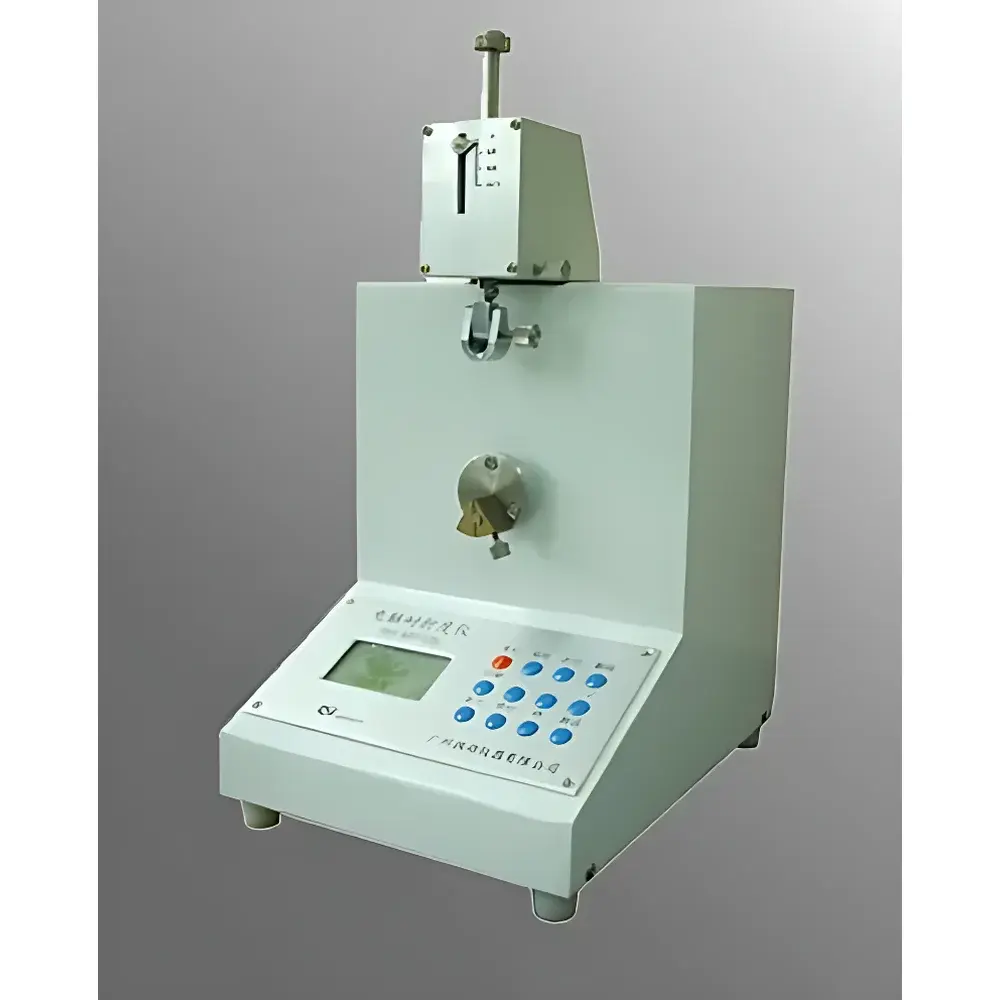
GBPI MIT-Style Paper Fold Endurance Tester
| Brand | GBPI |
|---|---|
| Origin | Guangdong, China |
| Manufacturer Type | Direct Manufacturer |
| Country of Origin | China |
| Model | MIT-Fold |
| Pricing | Available Upon Request |
| Measurement Range | 1–60,000 folds |
| Fold Count Log Scale | 0–4.78 (log₁₀) |
| Tension Adjustment Range | 4.9–14.7 N |
| Folding Angle | ±135° ±2° (left/right) |
| Folding Frequency | 175 ±10 cycles/min |
| Fold Head Slit Widths | 0.25 mm, 0.50 mm, 0.75 mm, 1.00 mm (standard: 0.50 mm & 0.75 mm supplied |
| Power Supply | AC 220 V, 50 Hz |
| Dimensions (L×W×H) | 330 × 250 × 400 mm |
| Net Weight | ~37 kg |
Overview
The GBPI MIT-Style Paper Fold Endurance Tester is a precision-engineered instrument designed to quantify the fold fatigue resistance of thin flexible sheet materials—primarily paper, paperboard, and analogous planar substrates with thickness ≤1 mm. It operates on the classical MIT (Massachusetts Institute of Technology) folding principle: a fixed-length specimen is clamped at both ends and subjected to repeated 135° reciprocating folds under controlled tension and angular displacement until failure. This deterministic mechanical fatigue test yields the total number of double folds (i.e., one forward + one reverse motion = one cycle) required to induce visible cracking or complete rupture. The instrument complies fully with ISO 5626:1993 “Paper — Determination of fold endurance” and GB/T 2679.5–2022 “Paper and board — Determination of fold endurance (MIT method)”, ensuring metrological traceability and interlaboratory comparability for quality assurance, process validation, and regulatory submissions.
Key Features
- Microcontroller-based closed-loop control system ensures precise regulation of folding frequency (175 ±10 cycles/min), tension (4.9–14.7 N adjustable via calibrated spring mechanism), and angular repeatability (±135° ±2° per fold).
- Integrated high-resolution LCD display with Chinese-language interface provides real-time fold count, accumulated cycles, and system status—designed for intuitive operation in QC laboratories with mixed technical staffing.
- Dual-slit fold head configuration: standard delivery includes interchangeable 0.50 mm and 0.75 mm slit inserts; optional 0.25 mm and 1.00 mm inserts available upon specification to accommodate specialty grades (e.g., banknote paper or corrugated linerboard).
- Automatic fold head centering and return-to-zero positioning post-test eliminates manual re-alignment, reducing operator-induced variability and improving throughput in high-volume testing environments.
- Thermal line printer outputs hard-copy reports containing test ID, date/time stamp, specimen identification, tension setting, slit width, final fold count, and statistical summary—supporting GLP-compliant documentation workflows.
- Robust aluminum alloy front panel and reinforced steel chassis ensure long-term dimensional stability and vibration damping during repetitive high-cycle operation.
Sample Compatibility & Compliance
The tester accommodates specimens measuring 15 mm × 100 mm (standard) or custom dimensions within mechanical constraints of the clamping system. It is validated for use with uncoated and coated papers, kraft board, carton board, filter paper, tissue, and synthetic polymer films meeting thickness criteria (<1 mm). All operational parameters—including tension calibration, angle verification, and cycle timing—are subject to routine internal verification per ISO/IEC 17025:2017 clause 7.7 (Uncertainty of measurement) and align with ASTM D2176 requirements for instrument qualification. Test reports generated meet minimum audit-trail requirements for ISO 9001-certified packaging manufacturers and CNAS-accredited inspection labs.
Software & Data Management
While the embedded firmware does not require external PC connectivity for basic operation, GBPI provides optional RS-232 serial output (standard) and USB-to-serial adapter compatibility for integration into centralized LIMS or MES platforms. Raw fold count data, timestamp, tension value, and slit ID are transmitted as ASCII-encoded strings, enabling automated parsing into relational databases. The built-in memory retains up to 99 test records with timestamped metadata—sufficient for shift-level batch tracking without external storage. For regulated environments, the system supports 21 CFR Part 11–compliant electronic record archiving when paired with validated third-party data acquisition software (e.g., LabArchives or Thermo Fisher SampleManager).
Applications
- Quality control of printing papers, writing papers, and packaging board in pulp & paper mills.
- Comparative evaluation of fiber furnish composition, refining degree, and wet-end additive performance (e.g., starch retention, dry strength resins).
- Validation of coating integrity and calendering effects on fold resistance in coated duplex board.
- Accelerated aging studies correlating fold endurance loss with humidity cycling or thermal exposure.
- Regulatory conformance testing for food-grade packaging (FDA 21 CFR 176.170), pharmaceutical cartons (USP <661.1>), and archival document standards (ISO 11108).
FAQ
What standards does this instrument directly support?
It is factory-configured and verified to meet ISO 5626:1993 and GB/T 2679.5–2022 requirements, including specified tension range, folding geometry, and counting methodology.
Can the instrument be calibrated using certified reference materials?
Yes—GBPI supplies NIST-traceable calibration kits comprising pre-tested reference paper strips with certified fold endurance values (±5% uncertainty), enabling periodic performance verification per ISO/IEC 17025 clause 6.6.
Is the thermal printer compatible with continuous label stock?
The integrated printer accepts standard 57 mm wide thermal paper rolls only; custom label integration requires external thermal label printers interfaced via RS-232.
How is tension calibrated and verified?
Tension is adjusted mechanically via a calibrated torsion spring assembly; verification is performed using a digital force gauge (e.g., Mark-10 Series 5) applied at the fold head pivot point per ISO 5626 Annex B.
Does the instrument support multi-specimen sequential testing without manual intervention?
No—it requires manual specimen loading between tests; however, the auto-return function and rapid-clamp design reduce average setup time to <45 seconds per specimen.
Related Products




