
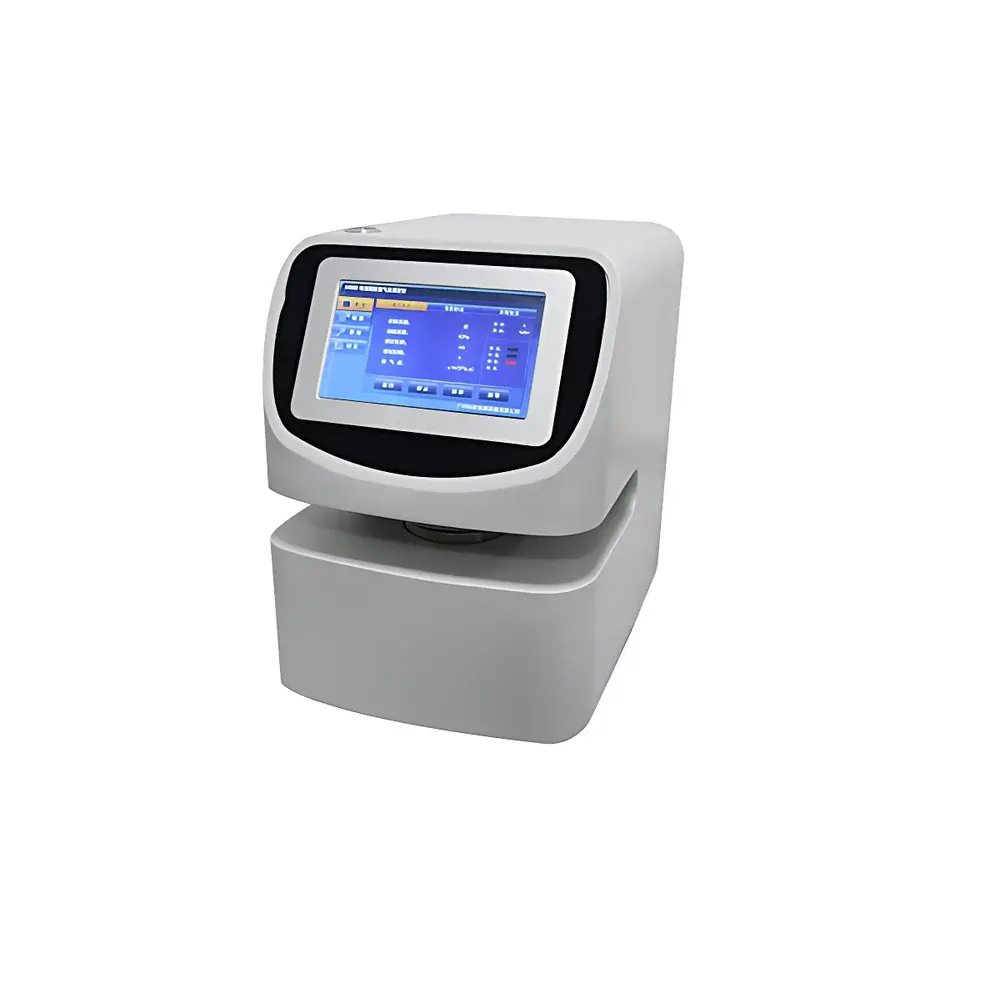
GBPI N600-2 Schopper-type Air Permeability Tester
| Brand | GBPI |
|---|---|
| Origin | Guangdong, China |
| Manufacturer Type | Direct Manufacturer |
| Model | N600-2 |
| Testing Methods | Gurley, Schopper, Bendtsen |
| Pressure Differential Range | 0–3 kPa (±0.01 kPa accuracy) |
| Adjustable Test Areas | 6.42 cm² or 10.0 ± 0.2 cm² |
| Sample Size | 50 mm × 50 mm or 60 mm × 100 mm |
| Permeability Range | 0.01–2.5 µm/(Pa·s) |
| Air Flow Rate | 0.01–120 mL/min |
| Resolution | 0.001 µm/(Pa·s) |
| Test Duration | 10–6000.0 s |
| Temperature & RH Monitoring | Integrated sensor |
| Seal Integrity | ≤1.0 mL/h leakage |
| Power | 100 W, 220 V, 50 Hz |
| Dimensions (L×W×H) | 500 mm × 400 mm × 300 mm |
| Compliance | SJ/T 10171–2016, GB/T 458–2008, GB/T 36363–2018 |
Overview
The GBPI N600-2 Schopper-type Air Permeability Tester is a precision-engineered instrument designed for quantitative evaluation of gas permeability in thin, porous functional materials—particularly lithium-ion battery separators, alkaline battery membranes, and specialty papers. It operates on three internationally recognized pneumatic resistance principles: the Gurley method (constant pressure differential of 1.23 kPa), the Schopper method (selectable 1.00 kPa ± 0.01 kPa or 2.50 kPa ± 0.01 kPa), and the Bendtsen method (1.47 kPa ± 0.02 kPa with 5 s clamping). Each mode delivers traceable, reproducible air flow measurements under rigorously controlled pressure differentials, enabling direct correlation to material pore structure, tortuosity, and effective thickness. The instrument’s architecture integrates a high-stability pressure regulation system, calibrated volumetric timing circuitry, and real-time environmental monitoring—ensuring measurement integrity across variable ambient conditions. Its dual-test-area configuration (6.42 cm² and 10.0 ± 0.2 cm²) supports method-specific sample mounting while maintaining ISO/IEC 17025-aligned repeatability.
Key Features
- Triple-method capability: Seamless switching between Gurley, Schopper, and Bendtsen test protocols via intuitive interface—no hardware reconfiguration required.
- High-precision pressure control: Digital servo-regulated differential pressure system with ±0.01 kPa accuracy over 0–3 kPa range, meeting strict tolerances defined in SJ/T 10171–2016 and GB/T 458–2008.
- Modular test area selection: Interchangeable masks enable rapid transition between 6.42 cm² (for Gurley-compliant testing) and 10.0 ± 0.2 cm² (standard for Schopper and Bendtsen), each validated per ASTM D726 Annex A1.
- Integrated environmental monitoring: Onboard temperature and relative humidity sensors continuously log chamber conditions during test execution—critical for GLP-compliant reporting and moisture-sensitive separator characterization.
- Leak-tight design: Hermetically sealed test chamber verified to ≤1.0 mL/h leakage rate under vacuum, eliminating background drift and ensuring baseline stability over extended test durations.
- Dual-mode operation: Standalone operation via built-in LCD touchscreen or synchronized data acquisition via USB-connected PC using GBPI proprietary software with audit-trail functionality compliant with FDA 21 CFR Part 11 requirements.
Sample Compatibility & Compliance
The N600-2 accommodates rigid and flexible microporous films up to 100 µm thick, including polyolefin (PP/PE) battery separators, cellulose-based filter papers, nonwovens, and coated barrier substrates. Sample handling follows standardized conditioning per GB/T 10739: samples are equilibrated at ≤40 °C and 10–35 %RH for ≥24 h; mass stabilization is confirmed by ≤0.25 % weight change over 1 h intervals. All test modes conform to mandatory clauses in SJ/T 10171–2016 (Section 5.3, “Air Permeability Test”), GB/T 458–2008 (Clause 6, “Gurley Method”), and GB/T 36363–2018 (Annex B, “Permeability Requirements for Li-ion Separator”). Instrument calibration is traceable to national metrological standards (CNAS-accredited reference gases and pressure transducers).
Software & Data Management
The included GBPI PermeaSoft v3.2 provides full test sequence programming, real-time curve visualization, and automated calculation of permeability coefficient (in µm/(Pa·s)), Gurley seconds, and air flow rate (mL/min). Raw data—including timestamped pressure, elapsed time, volume displacement, and environmental logs—are stored in encrypted .csv and .xlsx formats with immutable metadata. Audit trail features record user login, method selection, parameter edits, and export actions—supporting internal quality audits and regulatory submissions under ISO 9001, IATF 16949, and GMP frameworks. Optional integration with LIMS via OPC UA enables centralized data aggregation across multi-instrument packaging QC labs.
Applications
- Lithium-ion battery R&D: Quantifying separator breathability to correlate with ionic conductivity, thermal shutdown behavior, and dendrite suppression efficacy.
- Alkaline battery manufacturing: Routine QC verification of cellulose diaphragm permeability per SJ/T 10171–2016 to ensure electrolyte wicking consistency.
- Paper & board quality control: Measuring air resistance of filtration papers, tea bag substrates, and pharmaceutical packaging liners per ISO 5636-3.
- Automotive filtration media: Benchmarking nonwoven meltblown layers for cabin air filters against OEM-defined permeability envelopes.
- Medical device packaging validation: Assessing Tyvek® and SMS laminates for sterility maintenance per ISO 11607-1 Annex C.
FAQ
What standards does the N600-2 support out-of-the-box?
It natively implements test logic and pass/fail criteria for SJ/T 10171–2016, GB/T 458–2008, and GB/T 36363–2018—including automatic pressure ramping, dwell timing, and unit conversion per standard annexes.
Can the instrument be used for non-battery materials?
Yes—it is routinely deployed for paper, nonwovens, membranes, and polymer films where air permeance governs functional performance, provided sample thickness and rigidity fall within mechanical clamping limits (≤0.5 mm max).
Is external compressed air required?
An oil-free air source (≥0.6 MPa, clean and dry) is required for pressure generation; the optional GBPI AC-1000 oil-free compressor meets ISO 8573-1 Class 1 purity requirements.
How is calibration maintained?
Annual recalibration is recommended using GBPI-certified pressure and volumetric standards; onboard self-diagnostic routines verify seal integrity and timer accuracy before each test session.
Does the software support multi-user role-based access?
Yes—administrator, operator, and reviewer profiles enforce parameter lockout, electronic signature prompts, and export restrictions aligned with 21 CFR Part 11 Subpart B.






