
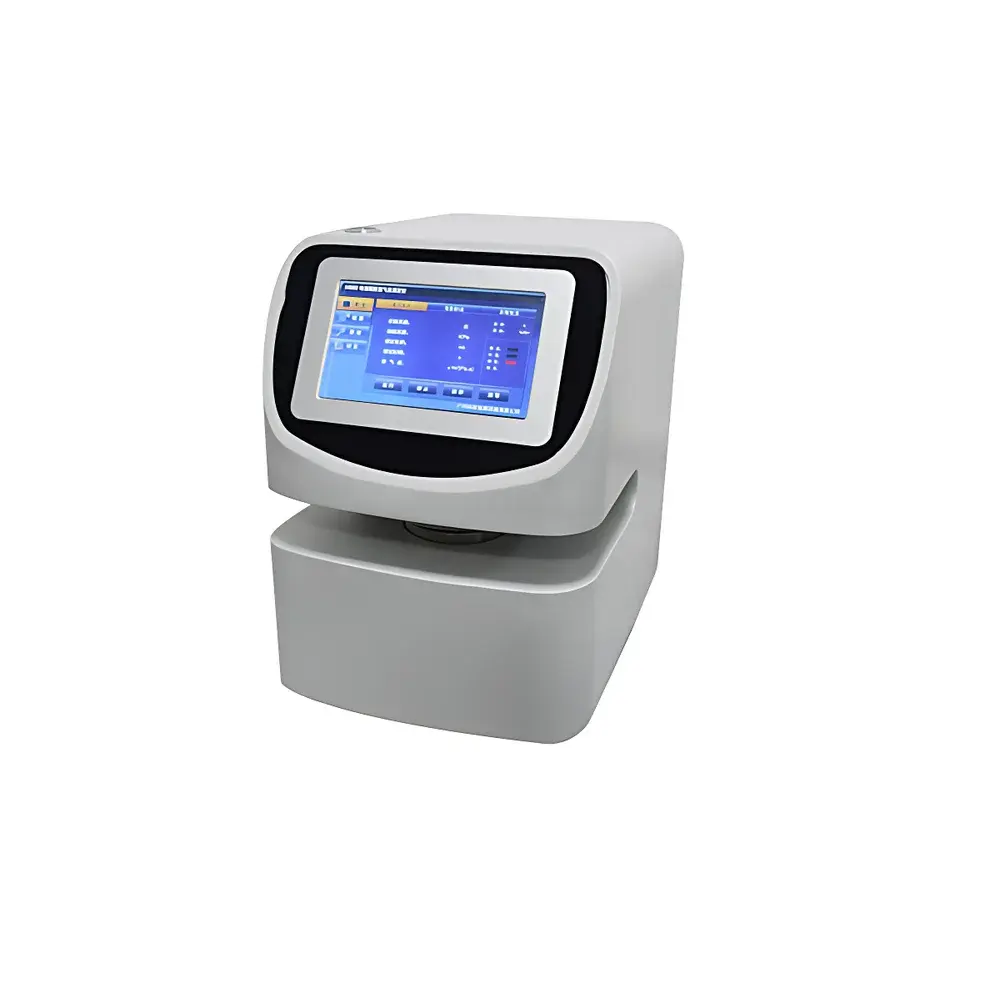
GBPI N600-L Lithium Battery Separator Air Permeability Tester
| Brand | GBPI |
|---|---|
| Origin | Guangdong, China |
| Manufacturer Type | Manufacturer |
| Origin Category | Domestic |
| Model | N600-L |
| Pricing | Upon Request |
| Testing Principles | Gurley (1.23 kPa ± 0.01 kPa), Schopper (1.00 kPa ± 0.01 kPa or 2.50 kPa ± 0.01 kPa), Bentzen (1.47 kPa ± 0.02 kPa) |
| Standards Compliance | SJ/T 10171–2016, GB/T 458–2008, GB/T 36363–2018 |
| Measurement Range | 0.01–2.5 µm/(Pa·s) |
| Air Flow Rate | 0.01–120 mL/min (customizable ranges available) |
| Resolution | 0.001 µm/(Pa·s) |
| Differential Pressure Range | 0–3 kPa |
| Pressure Accuracy | ±0.01 kPa |
| Test Area Options | 6.42 cm² (50 mm × 50 mm) or 10.0 ± 0.2 cm² (60 mm × 100 mm or 50 mm × 50 mm) |
| Test Duration | 10–6000.0 s |
| Sample Conditioning | 24 h at <40 °C and 10–35% RH |
| Chamber Environmental Monitoring | Integrated temperature & humidity sensors |
| Seal Integrity | ≤1.0 mL/h leakage rate |
| Test Volume Capacity | 1 L |
| Dimensions (L×W×H) | 500 mm × 400 mm × 300 mm |
| Power | 100 W |
| Supply | 220 V, 50 Hz |
Overview
The GBPI N600-L Lithium Battery Separator Air Permeability Tester is an engineered precision instrument designed specifically for the quantitative evaluation of gas permeability in microporous polyolefin separators used in lithium-ion battery manufacturing. It operates on three internationally recognized pneumatic resistance principles—Gurley, Schopper, and Bentzen—each implemented under rigorously controlled differential pressure conditions. The device measures air flow through standardized test areas under defined pressure differentials, delivering results expressed in Gurley seconds (s/100 mL) or air permeance (µm/(Pa·s)), both critical parameters for predicting separator performance in electrochemical cell assembly, thermal shutdown behavior, and ionic transport efficiency. Its architecture supports traceable, repeatable measurements aligned with quality control protocols required by Tier-1 battery material suppliers and OEM cell producers.
Key Features
- Triple-method integration: Simultaneous support for Gurley (1.23 kPa ± 0.01 kPa), Schopper (1.00 kPa or 2.50 kPa ± 0.01 kPa), and Bentzen (1.47 kPa ± 0.02 kPa) testing modes—enabling method-specific validation per material grade or customer specification.
- High-fidelity pressure regulation: Digital closed-loop control maintains differential pressure within ±0.01 kPa across the full 0–3 kPa range, ensuring compliance with ASTM D726, ISO 5636-3, and GB/T 458–2008 tolerances.
- Modular test area configuration: Quick-change mask system enables seamless switching between 6.42 cm² (50 mm × 50 mm) and 10.0 ± 0.2 cm² (60 mm × 100 mm or 50 mm × 50 mm) effective test areas without recalibration.
- Integrated environmental monitoring: Onboard temperature and relative humidity sensors continuously log chamber conditions during testing—essential for GLP-compliant documentation and moisture-sensitive separator evaluation.
- Low-leakage mechanical design: Hermetically sealed test chamber with verified leakage rate ≤1.0 mL/h ensures measurement integrity across low-permeability samples (e.g., ceramic-coated PE/PP trilayer membranes).
- Dual-operation capability: Standalone operation via 7-inch capacitive touchscreen interface; synchronized data acquisition and remote control via USB-connected PC software with audit-trail logging.
Sample Compatibility & Compliance
The N600-L accommodates standard lithium battery separator formats—including mono-layer polyethylene (PE), polypropylene (PP), biaxially oriented PP/PE laminates, and surface-modified or ceramic-coated variants—within defined dimensional constraints (max. 100 mm × 100 mm). All test procedures adhere to the metrological requirements of SJ/T 10171–2016 (Alkaline Battery Separator Performance Testing), GB/T 36363–2018 (Technical Specifications for Polyolefin Separators in Lithium-Ion Batteries), and GB/T 458–2008 (Determination of Air Permeability of Paper and Board). Instrument calibration is traceable to national standards, and pressure transducers are certified to ISO/IEC 17025-accredited laboratories. The system supports IQ/OQ documentation packages for GMP environments and meets baseline requirements for FDA 21 CFR Part 11 electronic record controls when deployed with validated software configurations.
Software & Data Management
The accompanying Windows-based application provides real-time graphing of flow vs. time curves, automatic calculation of permeance (µm/(Pa·s)) and Gurley values, and export of raw data in CSV and PDF formats. Each test record includes timestamped metadata: operator ID, sample ID, ambient T/RH, selected method, pressure setpoint, test area, duration, and pass/fail flags against user-defined limits. Audit trails capture all parameter changes, software updates, and report generation events—supporting internal QA reviews and external regulatory inspections. Data encryption, role-based access control, and electronic signature functionality are configurable to align with laboratory information management system (LIMS) integration workflows.
Applications
- Quality assurance of incoming separator rolls prior to electrode slitting and winding.
- Process development for dry/wet process extrusion lines—correlating porosity distribution with air permeance profiles.
- Comparative analysis of aging effects (thermal, oxidative, electrolyte immersion) on pore structure integrity.
- Validation of coating uniformity for Al₂O₃ or SiO₂ functional layers using differential permeance mapping.
- Supporting DOE studies for separator thickness optimization in high-energy-density pouch cells.
- Generating technical dossiers for IEC 62619 and UL 1642 certification submissions.
FAQ
Does the N600-L comply with ISO 5636-3 for paper and board testing?
Yes—the instrument implements the Schopper method under 1.00 kPa or 2.50 kPa differential pressure as specified in ISO 5636-3, and its pressure control accuracy (±0.01 kPa) and test area tolerance (±0.2 cm²) meet the standard’s metrological requirements.
Can the system be calibrated for non-standard test areas?
Custom test fixtures and area-specific calibration coefficients can be generated upon request, subject to physical feasibility verification and documented revalidation per ISO/IEC 17025 guidelines.
Is humidity control active or passive during conditioning?
The N600-L monitors ambient humidity but does not regulate it; sample preconditioning must be performed externally in a climate-controlled chamber per GB/T 36363–2018 Clause 6.2.
What maintenance intervals are recommended for long-term accuracy?
Pressure transducer verification every 6 months, seal inspection before each shift, and annual full-system calibration using NIST-traceable reference standards are advised.
Does the software support automated report generation for ISO 17025 audits?
Yes—templates for test reports, calibration certificates, and uncertainty budgets are included; all generated outputs include digital signatures, version stamps, and immutable audit logs.







