
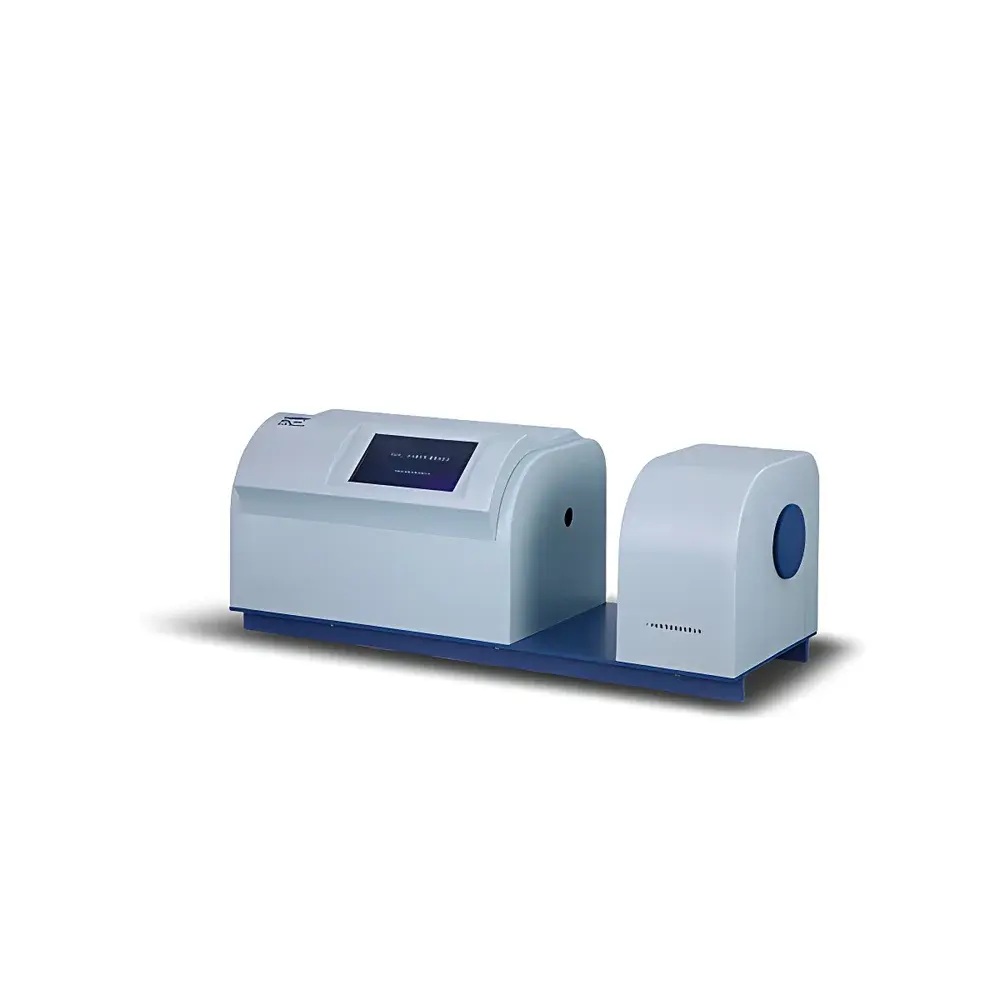
GBPI SGW-810D Automatic Haze and Luminous Transmittance Meter
| Brand | GBPI |
|---|---|
| Model | SGW-810D |
| Origin | Guangdong, China |
| Manufacturer Type | Direct Manufacturer |
| Instrument Type | Fully Automatic Optical Analyzer |
| Haze Range | 0–30.0% |
| Luminous Transmittance Range | 0–100.0% |
| Haze Repeatability | ≤±0.1% (for haze ≤0.5%), ≤±0.3% (for haze >0.5%) |
| Transmittance Repeatability | ±0.5% |
| Preheat Time | 30 min |
| Transmittance Accuracy | ≤±1.0% |
| Haze Accuracy | ≤±0.1% (≤0.5%), ≤±0.3% (>0.5%) |
| Minimum Resolution | 0.01% (both haze and transmittance) |
| Light Source | C-illuminant (6774 K) |
| Detector | Silicon Photocell |
| Optical Configuration | Collimated Illumination + Diffuse Viewing + Integrating Sphere Detection |
| Sample Port Aperture | Input Ø25 mm, Output Ø21 mm |
| Solid Sample Size | 50 mm × 50 mm |
| Liquid Cell Dimensions | 50 mm × 50 mm × 10 mm |
| Film Sample Size | 50 mm × 50 mm |
| Power Supply | 220 V, 50 Hz |
| Net Weight | 21 kg |
| Compliance Standards | GB/T 2410–2008, ASTM D1003–2007, JIS K7105–1981 |
Overview
The GBPI SGW-810D Automatic Haze and Luminous Transmittance Meter is an ISO/ASTM-compliant optical analyzer engineered for precise, repeatable quantification of light transmission and scattering behavior in planar transparent and translucent materials. It operates on the principle of collimated beam illumination coupled with diffuse-viewing detection via a calibrated integrating sphere—ensuring adherence to the geometric conditions specified in ASTM D1003 and GB/T 2410 for total luminous transmittance (Tt) and haze (H) measurement. The instrument employs a C-illuminant (6774 K) source and silicon photocell detector system, optimized for spectral response aligned with the CIE photopic luminosity function. Designed for laboratory-grade stability, it achieves <±1.0% transmittance accuracy and sub-0.1% haze accuracy at low-level scattering—critical for QC validation of optical polymers, barrier films, and medical packaging where clarity and diffusion control directly impact functional performance.
Key Features
- Fully automatic operation with embedded touchscreen interface (large-format LCD), eliminating manual alignment or calibration drift during routine testing.
- Integrating sphere geometry (diameter ≥150 mm) with baffle-free internal coating ensures high signal-to-noise ratio and minimal stray-light interference across the full 0–30.0% haze range.
- Dual-channel real-time signal processing enables simultaneous acquisition and independent validation of transmittance and haze values—reducing operator-induced variance.
- Pre-programmed compliance modes for ASTM D1003–2007 (Method A), GB/T 2410–2008, and JIS K7105–1981 ensure out-of-the-box regulatory readiness for audit trails and method verification.
- Thermally stabilized optical path and 30-minute preheat protocol minimize thermal drift, supporting GLP-aligned measurement repeatability (±0.5% for transmittance; ±0.1% for haze ≤0.5%).
- Modular sample stage accommodates rigid plates (50 mm × 50 mm), thin films (same footprint), and liquid cuvettes (50 mm × 50 mm × 10 mm) without mechanical recalibration.
Sample Compatibility & Compliance
The SGW-810D accepts flat, parallel-surface specimens meeting ASTM D1003 dimensional tolerances (thickness ≤12 mm; surface flatness ≤0.1 mm/m). Validated use cases include PETG, PC, PMMA sheets; BOPP, PE, and PVDC-coated films; optical adhesives; pharmaceutical blister lidding; and aqueous solutions (e.g., saline, syrup formulations) assessed for turbidity per USP . All measurements conform to the definition of haze as the ratio of diffusely transmitted flux to total transmitted flux, and transmittance as total transmitted luminous flux relative to incident flux—per ISO 13468-1 and ISO 14782. Device firmware supports audit-log generation compliant with FDA 21 CFR Part 11 requirements when integrated with networked lab data systems.
Software & Data Management
The embedded operating system records raw photodetector voltages, normalized integrator outputs, and environmental metadata (ambient temperature, operational hour count) for each test cycle. Data export is supported via USB 2.0 to CSV or XML formats—including full traceability of calibration certificate IDs, operator login stamps, and pass/fail flags against user-defined specification limits. Optional PC-based software (GBPI OptiLink v3.2) provides statistical process control (SPC) charting, multi-instrument fleet monitoring, and automated report generation aligned with ISO/IEC 17025 documentation templates.
Applications
- Quality control of extruded plastic sheets used in automotive glazing, display covers, and architectural glazing—where haze must remain below 0.8% for AR-coated substrates.
- Development of anti-fog polymer films for food packaging, requiring quantitative correlation between surface morphology (AFM) and measured haze drift over humidity cycling.
- Stability assessment of ophthalmic solutions under ICH Q5C photostability protocols, using transmittance decay kinetics as a surrogate for particulate formation.
- Validation of cleanroom-compatible transparent enclosures per ISO 14644-1 Class 5 criteria, where light scatter must not exceed 1.2% at 550 nm.
- Research into nanocomposite transparency: correlating TiO₂ nanoparticle dispersion homogeneity (via TEM) with bulk haze profiles measured across 10–30% loading ranges.
FAQ
Does the SGW-810D comply with FDA 21 CFR Part 11 for electronic records?
Yes—when operated with GBPI OptiLink v3.2 and configured with role-based user authentication, audit trail logging, and digital signature support.
Can it measure curved or non-planar samples?
No—only flat, parallel-surface specimens meeting ASTM D1003 thickness and flatness criteria are supported.
What is the recommended calibration frequency?
Annual factory recalibration is advised; daily verification using supplied certified reference standards (NIST-traceable haze plate and neutral density filter) is required for GLP/GMP environments.
Is the C-illuminant source replaceable in-field?
Yes—the tungsten-halogen lamp module is user-replaceable with tool-free access and auto-recognized via embedded EEPROM calibration profile.
How does the instrument handle ambient light interference?
The fully enclosed optical chamber, combined with synchronized pulsed illumination and lock-in amplifier detection, rejects ambient irradiance exceeding 500 lux without measurable impact on baseline stability.



