
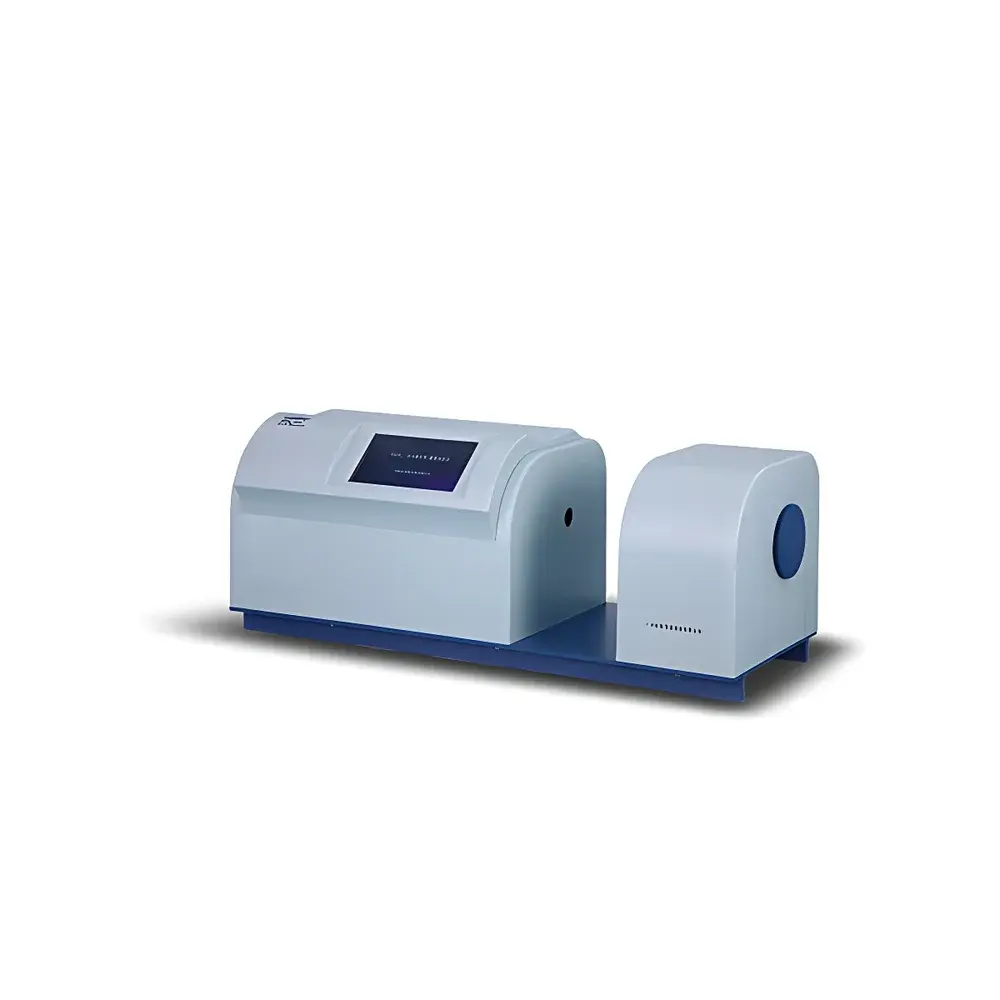
GBPI SGW810-Q Automatic Transmittance and Haze Meter
| Brand | GBPI |
|---|---|
| Origin | Guangdong, China |
| Manufacturer Type | Direct Manufacturer |
| Product Type | Fully Automatic |
| Haze Range | 0–30.0% |
| Transmittance Range | 0–100.0% |
| Haze Repeatability | ≤0.05% (for haze ≤0.5%) |
| Transmittance Repeatability | ±0.5% |
| Preheat Time | 30 min |
| Transmittance Accuracy | ±1.0% |
| Haze Accuracy | ±0.1% (haze ≤0.5%) |
| Minimum Resolution | 0.01% (both transmittance and haze) |
| Light Source | C-illuminant (6774 K) |
| Detector | Silicon Photocell |
| Optical Configuration | Collimated Illumination, Diffuse Viewing, Integrating Sphere Detection |
| Sample Port Aperture | Input Ø25 mm, Output Ø21 mm |
| Solid Sample Size | 50 mm × 50 mm |
| Liquid Cell Dimensions | 50 mm × 50 mm × 10 mm |
| Film Sample Size | 50 mm × 50 mm |
| Power Supply | 220 V, 50 Hz |
| Net Weight | 21 kg |
| Compliance Standards | GB/T 2410–2008, ASTM D1003–2007, JIS K7105–1981 |
Overview
The GBPI SGW810-Q Automatic Transmittance and Haze Meter is a precision optical instrument engineered for quantitative evaluation of light transmission and scattering behavior in transparent and semi-transparent planar materials. It operates on the principle of collimated beam illumination combined with an integrating sphere detection system—fully compliant with ASTM D1003–2007 (Standard Test Method for Haze and Luminous Transmittance of Transparent Plastics), GB/T 2410–2008 (Plastics—Determination of Haze and Transmittance), and JIS K7105–1981 (Testing Methods for Transparency and Haze of Plastic Sheets). The instrument employs a standardized C-illuminant (6774 K) to replicate daylight spectral distribution, ensuring metrological consistency across global laboratories. Its dual-channel photometric architecture—using calibrated silicon photocells—enables simultaneous acquisition of total transmittance (Tt) and diffuse transmittance (Td), from which haze (%) is calculated as (Td/Tt) × 100. Designed for high reproducibility in routine QC environments, the SGW810-Q delivers traceable measurements essential for material qualification in regulated sectors including medical packaging, optical film manufacturing, and pharmaceutical container testing.
Key Features
- Fully automatic measurement cycle with integrated touchscreen interface (large-format LCD) eliminating manual alignment or calibration steps between samples
- Integrating sphere optical path (inner diameter ≥150 mm) with BaSO4-coated interior for uniform diffuse reflectance and minimal stray light error
- Dual-aperture sample chamber accommodating rigid plates (50 mm × 50 mm), thin films (same footprint), and liquid cuvettes (50 mm × 50 mm × 10 mm depth)
- Thermally stabilized C-illuminant source with spectral output certified per CIE Publication No. 51, enabling long-term photometric stability
- Preheat time optimized to 30 minutes—validated via internal thermal drift monitoring—to meet ISO/IEC 17025 pre-measurement stabilization requirements
- Resolution of 0.01% for both transmittance and haze, supporting statistical process control (SPC) at sub-percentage variation levels
Sample Compatibility & Compliance
The SGW810-Q supports solid, liquid, and flexible film specimens meeting standard geometrical constraints defined in ASTM D1003 Annex A1. Rigid plastic sheets (e.g., PET, PC, PMMA), coated glass substrates, and laminated safety glazing are measured in flat orientation against the 50 mm × 50 mm aperture. For liquid turbidity assessment (e.g., pharmaceutical injectables, beverage clarity), the supplied quartz-equivalent liquid cell ensures refractive index neutrality and minimizes Fresnel losses. All reported values conform to the “total transmittance” and “haze” definitions specified in ISO 13468-1 and ISO 14782, and support audit-ready documentation required under GLP and GMP frameworks. Instrument validation protocols—including dark current verification, reference standard calibration (certified NIST-traceable haze standards SRM 1979 & SRM 2009), and linearity checks across full dynamic range—are embedded in firmware and exportable as PDF reports.
Software & Data Management
Data acquisition, analysis, and reporting are managed through the built-in embedded OS—no external PC dependency required. Measurement records include timestamp, operator ID (user login), environmental temperature/humidity (optional sensor input), and raw photodetector voltage traces. Export formats include CSV (for Excel-based SPC charting) and XML (compatible with LIMS platforms such as LabWare and Thermo Fisher SampleManager). Audit trail functionality logs all parameter changes, calibration events, and result modifications—satisfying FDA 21 CFR Part 11 electronic record integrity requirements when paired with role-based access control. Firmware updates are delivered via USB flash drive with cryptographic signature verification to ensure chain-of-custody integrity.
Applications
- Quality control of optical-grade polymer films used in display cover lenses, AR/VR waveguides, and solar panel encapsulants
- Regulatory compliance testing of parenteral drug containers per USP particulate matter limits and visual clarity assessments
- R&D evaluation of anti-fog coatings, nanostructured anti-reflective layers, and micro-roughened diffuser films
- Process validation of extrusion, casting, and coating lines where haze drift correlates with melt homogeneity or additive dispersion
- Academic research in soft matter physics involving phase-separated polymer blends and colloidal suspensions
FAQ
Does the SGW810-Q comply with FDA 21 CFR Part 11 for electronic records?
Yes—the instrument’s firmware implements secure user authentication, immutable audit trails, and electronic signature capability for critical actions including calibration and report generation.
Can it measure curved or non-planar samples?
No—it is designed exclusively for flat, parallel-surface specimens per ASTM D1003 geometry requirements; curvature introduces uncorrectable path-length and scatter-angle deviations.
What traceable standards are recommended for daily verification?
NIST SRM 1979 (low-haze polycarbonate) and SRM 2009 (high-haze diffuser) are advised; GBPI provides optional calibration kits with certificate of conformance.
Is temperature compensation available during measurement?
The unit monitors ambient temperature continuously and applies correction coefficients derived from ISO 9001-validated thermal response models—no manual input required.
How often does the integrating sphere require cleaning or recoating?
Under normal lab conditions (ISO Class 8 environment), BaSO4 coating maintenance is recommended every 24 months; GBPI offers on-site refurbishment services with post-service certification.





