
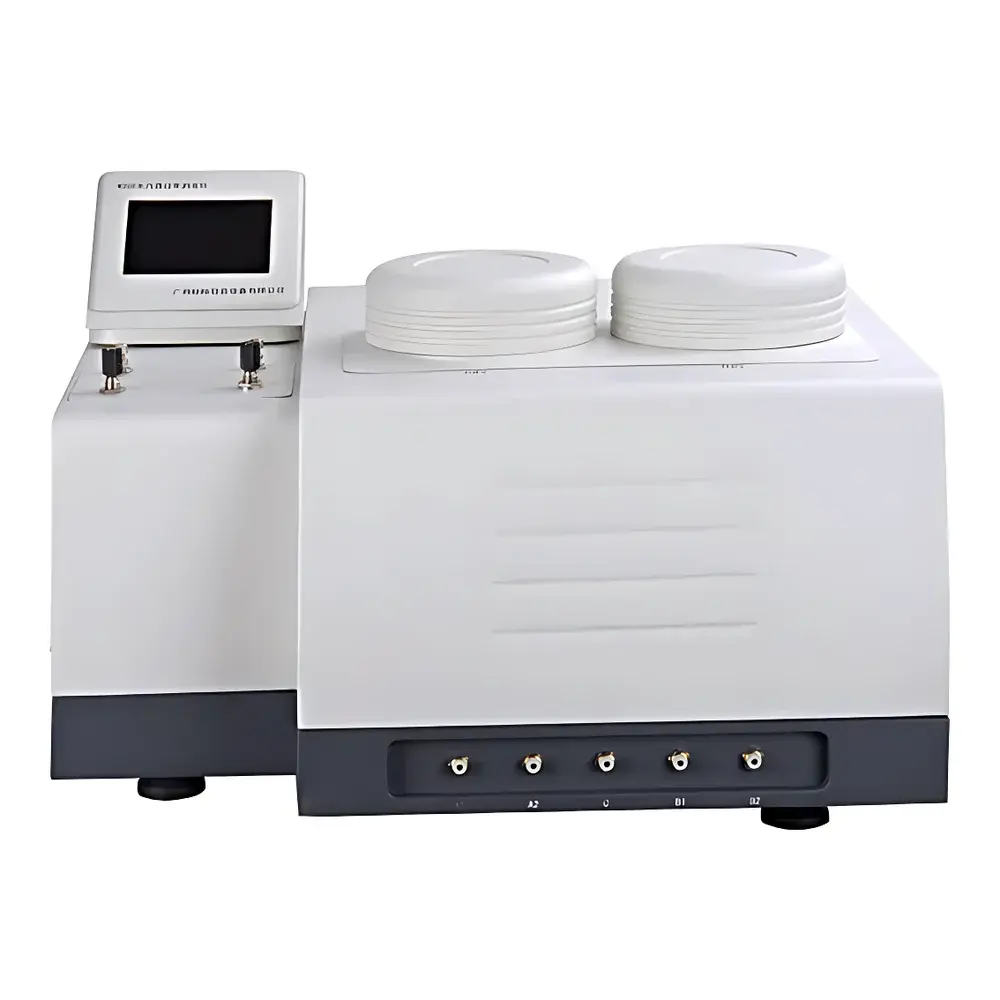
GBPI W202-1 Water Vapor Transmission Rate (WVTR) Analyzer
| Brand | GBPI |
|---|---|
| Origin | Guangdong, China |
| Manufacturer Type | Manufacturer |
| Country of Origin | China |
| Model | W202-1 |
| Application | Multi-purpose WVTR analyzer for films, sheets, and packaging containers |
| Test Range | 0.001–100 g/(m²·24h) |
| Test Resolution | 0.001 g/(m²·24h) |
| Temperature Control Range | 15–45°C (optional 5–55°C) |
| Temperature Control Accuracy | ±0.1°C |
| Humidity Control Range | 0%RH, 30–95%RH |
| Humidity Control Accuracy | ±1%RH |
| Test Area | 50.24 cm² |
| Specimen Diameter | Φ100 mm |
| Max Specimen Thickness | ≤2 mm |
| Sample Capacity | 2 chambers (independent operation) |
| Carrier Gas | ≥99.999% N₂, pressure ≥0.1 MPa, flow rate 5–100 mL/min |
| Gas Inlet | 1/8″ stainless steel tubing |
| Dimensions | 700 × 585 × 485 mm |
| Weight | 80 kg |
| Power | 750 W, AC 220 V / 50 Hz |
| Compliance | GB/T 21529-2008, YBB 00092003-2015, BS EN ISO 15106-3:2005, ASTM E398-2013, DIN 53122-2 |
Overview
The GBPI W202-1 Water Vapor Transmission Rate (WVTR) Analyzer is a gravimetric-coupled electrolytic sensor-based instrument engineered for precise, reproducible measurement of water vapor permeation through polymeric films, laminates, rigid sheets, and packaged containers. It operates on the principle of dynamic humidity gradient generation across a test specimen, with real-time quantification of transmitted moisture via high-stability dual electrolytic sensors. Unlike desiccant-based or infrared detection methods, the W202-1 employs a calibrated carrier gas stream (ultra-high-purity nitrogen) to sweep permeated water vapor from the downstream side of the specimen into an integrated Coulometric moisture sensor—ensuring trace-level sensitivity, minimal baseline drift, and compliance with international gravimetric reference standards. Designed for laboratories requiring regulatory-grade data integrity, the system meets core requirements of pharmaceutical packaging validation (e.g., USP <671>, ICH Q5C), medical device barrier assessment (ISO 11607-1), and food packaging shelf-life modeling per FDA and EFSA guidance.
Key Features
- Dual independent test chambers with fully autonomous control—enabling concurrent analysis of two dissimilar specimens (e.g., PET/AlOx vs. PE-laminated foil) under identical or divergent T/RH conditions.
- Electrolytic moisture sensors certified to NIST-traceable national standard substances (GBW(E)130543/4), with documented calibration traceability to China’s National Institute of Metrology (NIM).
- Advanced dual-gas-stream humidity control: separate dry and saturated humid gas lines precisely blended to achieve stable, programmable RH setpoints from 0% to 95% RH at ±1% RH accuracy.
- Electromagnetic step-programmable temperature regulation (15–45°C standard; 5–55°C optional), eliminating mechanical refrigeration/heating units and delivering ±0.1°C thermal stability without overshoot or hysteresis.
- ARM-based embedded controller with 7-inch color capacitive touchscreen—supports standalone operation, method storage, real-time curve overlay (temperature, RH, WVTR, concentration), and auto-diagnostic alerts.
- GMP-compliant software architecture compliant with Annex 11 and 21 CFR Part 11: role-based user access (administrator, operator, reviewer), full audit trail (system, method, result level), electronic signatures, and immutable database logging.
Sample Compatibility & Compliance
The W202-1 accommodates flat specimens up to Φ100 mm and ≤2 mm thickness—including monolayer plastics (PET, PP, LDPE), metallized films (Al-coated PET, SiOx), ceramic-coated substrates, rubber elastomers, and rigid boards. Optional accessories extend capability to 3D packaging: cylindrical bottle adapters (for HDPE/PP bottles), pouch clamping fixtures (for stand-up pouches), and concave dish holders (for blister cavity testing). All test configurations adhere to validated protocols referenced in GB/T 21529-2008 (Chinese national standard for plastic film WVTR), ASTM E398-2013 (standard test method for water vapor transmission of sheet materials), and ISO 15106-3:2005 (plastic film and sheeting—determination of water vapour transmission rate—part 3: electrolytic detection sensor method). Instrument qualification includes IQ/OQ documentation templates aligned with ISO/IEC 17025 and GLP principles.
Software & Data Management
The proprietary GBPI LabSuite™ software provides full lifecycle data governance: method creation with configurable ramp profiles (T/RH ramps, dwell times, sensor stabilization thresholds), automated pass/fail evaluation against user-defined specification limits, and export of raw datasets in CSV, PDF, and Office-compatible formats (DOCX, XLSX). All reports embed metadata including instrument ID, operator login, environmental logs, sensor calibration dates, and digital signature timestamps. Database encryption (AES-256) and optional network backup ensure data sovereignty. Audit trails record every action—from parameter modification and result deletion to firmware updates—with immutable hash-verified entries stored in a segregated relational database (SQLite with WAL journaling).
Applications
- Pharmaceutical packaging: Quantifying WVTR of cold-form blisters, Alu-Alu laminates, and desiccant-containing sachets per YBB 00092003-2015 and USP <671>.
- Flexible electronics: Barrier performance validation of encapsulation films for OLED displays, solar backsheet laminates (e.g., ETFE/EVA structures), and thin-film transistor substrates.
- Medical devices: Moisture ingress testing of sterile barrier systems (SBS) per ISO 11607-1 and wound dressing hydrogel adhesion layers.
- Food packaging R&D: Accelerated shelf-life modeling for retort pouches, vacuum-sealed meat trays, and modified-atmosphere packaging (MAP) films.
- Quality control labs: Routine release testing of incoming polymer resins, masterbatch additives, and extruded film rolls per AQL sampling plans.
FAQ
What calibration standards are supported for sensor verification?
The W202-1 accepts GBW(E)130543/4 certified national standard moisture permeation reference materials, enabling in-house verification without external service intervention.
Can the instrument perform accelerated aging tests with elevated temperature/humidity?
Yes—the optional 5–55°C temperature range and 95%RH upper limit support ASTM F1249-based accelerated barrier assessments for predictive modeling.
Is remote monitoring or integration with LIMS possible?
The system supports TCP/IP communication via Modbus TCP and OPC UA protocols, enabling bidirectional data exchange with laboratory information management systems (LIMS) and MES platforms.
How is sensor longevity maintained during high-humidity or condensing conditions?
Integrated condensate traps, automatic sensor purge cycles, and over-range protection logic prevent electrolyte saturation and extend sensor service life beyond 24 months under routine use.
Does the software meet FDA 21 CFR Part 11 requirements for electronic records?
Yes—role-based authentication, electronic signatures, audit trail retention (>10 years), and data immutability mechanisms are pre-validated and documented in the system compliance dossier.
Related Products




