
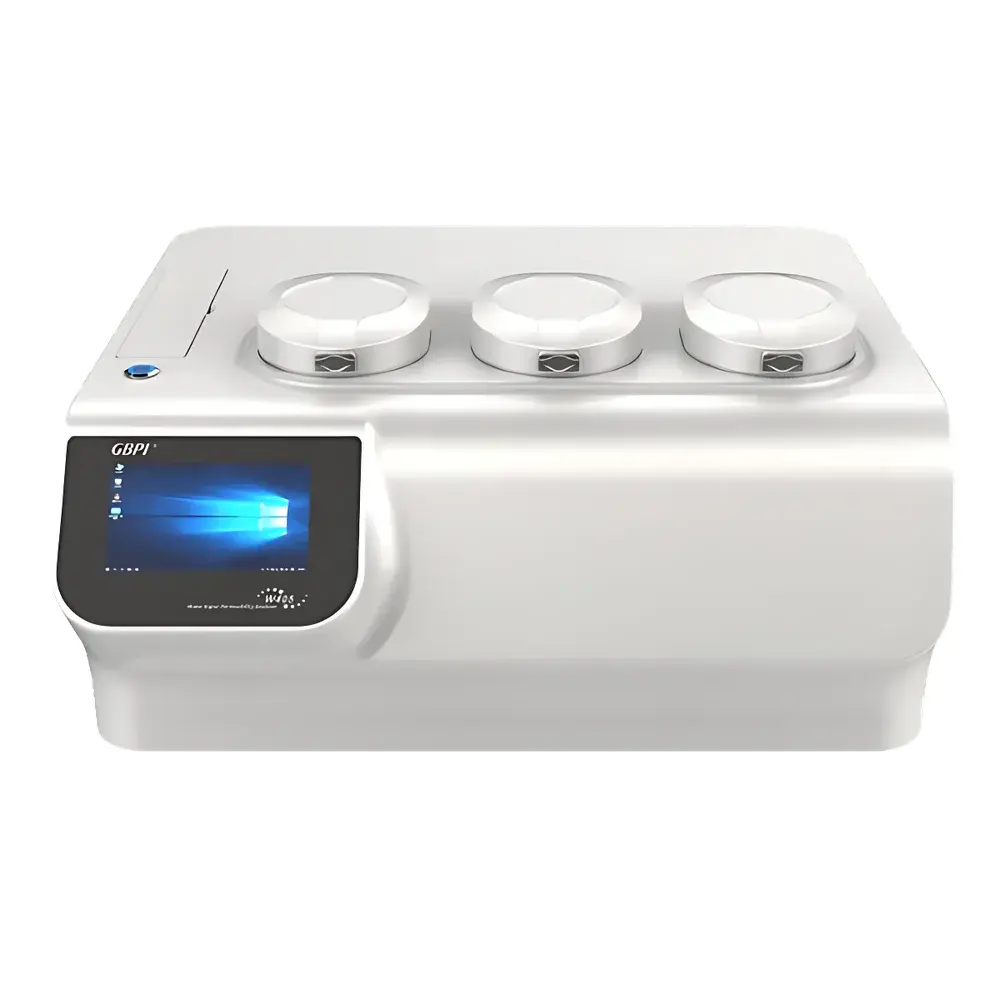
GBPI Y310 2.0 Oxygen Permeability Tester (Coulometric Sensor Method)
| Brand | GBPI |
|---|---|
| Origin | Guangdong, China |
| Manufacturer Type | OEM Manufacturer |
| Region of Origin | Domestic (China) |
| Model | GBPI Y310 2.0 |
| Price | USD 54,500 (FOB Guangzhou) |
| Test Principle | Coulometric Oxygen Sensor Method |
| Standards Compliance | GB/T 19789, ASTM D3985, ASTM F2622, ASTM F1927, ASTM F1307, ISO 15105-2, DIN 53380-3, JIS K-7126-B, YBB 00082003 |
| Measurement Range | 0.05–1000 cm³/(m²·24 h) (up to 260,000 cm³/(m²·24 h) with auxiliary mask) |
| Resolution | 0.001 cm³/(m²·24 h) |
| Temperature Control Range | 15–45 °C |
| Temperature Stability | ±0.1 °C |
| Test Area | 50.24 cm² (customizable down to 0.785 cm²) |
| Specimen Diameter | Φ100 mm |
| Max Specimen Thickness | ≤3 mm |
| Sample Capacity | 3 independent test chambers |
| Carrier Gas Pressure | ≥0.1 MPa |
| Pneumatic Clamping Pressure | ≥0.3 MPa |
| Power Consumption | 750 W |
| Electrical Supply | AC 220 V, 50 Hz |
Overview
The GBPI Y310 2.0 Oxygen Permeability Tester is an engineered analytical instrument designed for precise, trace-level quantification of oxygen transmission through polymeric and laminated barrier materials. It operates on the coulometric sensor principle—a gravimetrically traceable electrochemical method in which oxygen molecules permeating across a conditioned specimen are swept by high-purity nitrogen carrier gas into a sealed coulometric cell. There, oxygen is reduced at the cathode, generating a current proportional to molar flux. This current is integrated over time to yield oxygen transmission rate (OTR) in standardized units (cm³/(m²·24 h·0.1 MPa)). The system conforms to internationally harmonized test protocols including ASTM D3985 (oxygen transmission through plastic film using coulometric detection), ISO 15105-2 (gas transmission—part 2: coulometric method), and GB/T 19789 (Chinese national standard for plastic film OTR testing). Its architecture supports both routine QC screening and regulatory-grade validation in GMP/GLP environments.
Key Features
- Triple independent test chambers enable parallel, statistically robust measurements—reducing per-sample cycle time by up to 67% versus single-chamber systems.
- High-stability imported coulometric oxygen sensor with <0.001 cm³/(m²·24 h) resolution and long-term baseline drift <±0.5% over 30 days under continuous operation.
- Pneumatically actuated clamping system ensures uniform sealing pressure (>0.3 MPa) across variable specimen geometries, minimizing edge leakage and enhancing reproducibility (RSD <1.2% for intra-batch replicates).
- Electromagnetic temperature control module delivers ±0.1 °C stability across the 15–45 °C operating range, validated per ASTM E2234 calibration procedures.
- Integrated 11.6-inch capacitive touchscreen HMI running a deterministic real-time OS compliant with IEC 62304 Class B software safety requirements.
- Full audit trail functionality—including user login history, parameter change logs, test initiation/termination timestamps, and electronic signature capture—fully aligned with FDA 21 CFR Part 11 and EU Annex 11 data integrity expectations.
Sample Compatibility & Compliance
The Y310 2.0 accommodates flat specimens (films, sheets, foils, papers) up to Φ100 mm and 3 mm thick, with optional adapters enabling OTR measurement of formed packages (e.g., blister packs, pouches, cups, bottles) per ASTM F1307 and ISO 15105-2 Annex C. Validated material classes include multilayer coextrusions (e.g., PET/PE, PA/EVOH/PP), metallized substrates (AlOx, SiOx), biodegradable films (PLA, PBAT), pharmaceutical cold-form blisters (PVC/PVDC), and photovoltaic backsheet laminates. All hardware and firmware comply with CE marking directives (2014/30/EU EMC, 2014/35/EU LVD), RoHS 2011/65/EU, and GB 4793.1–2019 (safety requirements for electrical equipment for measurement).
Software & Data Management
The embedded GBPI SmartTest OS v3.2 provides modular workflow configuration—supporting user-defined test sequences, multi-standard mode switching (e.g., GB/T vs. ASTM), and dynamic parameter override without code modification. Raw sensor current, temperature, carrier flow, and calculated OTR values are logged at 1 Hz and stored in encrypted SQLite databases with SHA-256 checksum verification. Data export supports CSV, PDF (with embedded digital signatures), and XML formats compliant with ASTM E2500-22 for analytical instrument qualification. Optional LIMS integration is achieved via RESTful API or HL7 v2.5 messaging; remote diagnostics and firmware updates are supported over TLS 1.2-secured HTTPS connections. Calibration records—including NIST-traceable reference standards GBW(E)130497 and GBW(E)130498—are digitally linked to each test report.
Applications
This instrument serves critical quality control and R&D functions across regulated industries: In pharmaceutical packaging, it verifies OTR compliance for primary containers (e.g., HDPE bottles, Alu-PVC blisters) against USP <671> and YBB 00082003 specifications. In food packaging, it validates shelf-life models for modified atmosphere packaging (MAP) films used in meat, dairy, and ready-to-eat meals. For photovoltaic manufacturers, it quantifies ingress resistance of encapsulant/backsheet laminates per IEC 61215-2 MQT18. In medical device packaging, it supports ISO 11607-1 validation of sterile barrier systems. Additional use cases include shelf-life prediction modeling, accelerated aging correlation studies, and comparative barrier performance evaluation during polymer formulation development.
FAQ
What gas purity is required for carrier and challenge gases?
High-purity nitrogen (≥99.999% N₂) and oxygen (≥99.999% O₂) are mandatory; impurities >1 ppm hydrocarbons or moisture will poison the coulometric sensor and invalidate calibration.
Can the instrument measure OTR under controlled humidity?
No—the Y310 2.0 operates under dry gas conditions per ASTM D3985; for water vapor-coupled OTR assessment, a separate MOCON PERMATRAN-W or equivalent is required.
Is third-party IQ/OQ/PQ documentation available?
Yes—GBPI provides vendor-qualified protocol templates and on-site execution support for installation qualification (IQ), operational qualification (OQ), and performance qualification (PQ) per ASTM E2500 and GAMP5 guidelines.
How often must the coulometric sensor be recalibrated?
Annual recalibration is recommended; however, daily zero-point verification using certified low-permeability reference films (e.g., GBPI SRM-OTR-01) is required prior to each test batch.
Does the system support 21 CFR Part 11-compliant electronic signatures?
Yes—role-based signature workflows with biometric or token-based authentication are fully implemented and auditable within the system log.





