
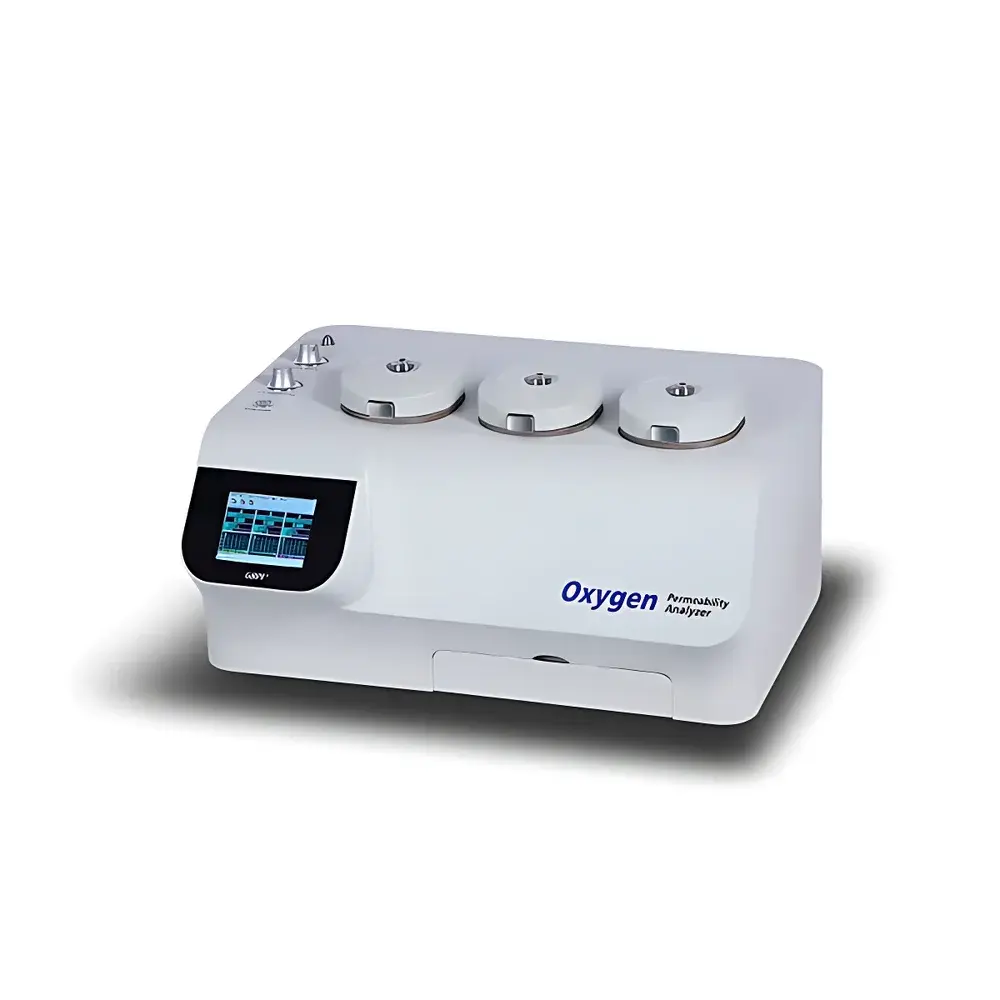
GBPI Y310-3 Oxygen Transmission Rate (OTR) Analyzer for Flexible Packaging Films and Rigid Containers
| Brand | GBPI |
|---|---|
| Origin | Guangdong, China |
| Manufacturer Type | OEM/ODM Manufacturer |
| Country of Origin | China |
| Model | Y310-3 |
| Price Range | USD 14,000 – 72,000 |
| Test Range | 0.02–16,500 cm³/(m²·24h) (film) |
| O₂ Detection Resolution | 0.001 cm³/(m²·24h) |
| Temperature Control | 15–45°C (5–50°C optional) |
| Humidity Control | 0%RH (dry), 30–90%RH, 100%RH |
| Test Area | 50.24 cm² |
| Specimen Size | Ø100 mm |
| Max Thickness | ≤3 mm |
| Sample Capacity | 1–3 independent chambers |
| Carrier Gas Pressure | 0.1–0.2 MPa |
| Gas Inlet | 1/8″ stainless steel tubing |
| Dimensions (W×D×H) | 700×560×370 mm |
| Weight | 100 kg |
| Power | 750 W |
| Supply | AC 220 V, 50 Hz |
Overview
The GBPI Y310-3 Oxygen Transmission Rate (OTR) Analyzer is a gravimetrically and coulometrically validated, dual-mode permeation measurement system engineered for high-precision quantification of oxygen permeability in flexible packaging films, laminates, rigid containers, and advanced functional barriers. It operates on the principle of dynamic coulometric detection—where oxygen molecules permeating through a conditioned test specimen are swept by a nitrogen carrier gas stream into a high-sensitivity electrochemical oxygen sensor. The resulting current output is linearly proportional to O₂ partial pressure, enabling trace-level quantification down to 0.001 cm³/(m²·24h). Designed to meet stringent regulatory requirements for barrier performance validation, the Y310-3 supports both steady-state diffusion analysis and time-lag kinetic modeling per ISO 15105-2 and ASTM F1307 methodologies. Its modular three-chamber architecture allows concurrent, statistically independent measurements—critical for QC laboratories performing comparative batch release testing or accelerated aging studies under controlled T/RH conditions.
Key Features
- Triple independent test chambers with individual pressure regulation, real-time O₂ concentration monitoring, and autonomous termination—enabling parallel evaluation of heterogeneous materials (e.g., PET/AlOx vs. PE/EVOH vs. metallized CPP) without cross-contamination.
- ARM-based embedded control system with local LCD interface and Windows-style GUI—fully operational without host PC connection; supports offline data logging, method recall, and firmware updates via USB.
- Electromagnetic stepwise temperature control with PID feedback loop ensures thermal stability within ±0.1°C across 15–45°C operating range; optional extended range (5–50°C) available for low-Tg polymer characterization.
- Dual-stream humidity generation (dry N₂ + saturated humidified N₂) enables precise RH setpoint delivery from 0% to 100% at ±1%RH accuracy—essential for evaluating moisture-sensitive barrier structures such as PVOH-coated films or hydrophilic medical device pouches.
- Coulometric oxygen sensor (imported, long-life electrochemical cell) with automatic over-range protection and self-diagnostic calibration flagging—minimizes downtime and eliminates drift-related recalibration cycles.
- GMP-compliant software architecture compliant with FDA 21 CFR Part 11 and EU Annex 11: role-based access control (Administrator, Operator, Reviewer), full audit trail (system, method, result level), electronic signatures, and immutable database logging with timestamped revision history.
Sample Compatibility & Compliance
The Y310-3 accommodates flat specimens up to Ø100 mm and 3 mm thickness—including monolayer plastics (LDPE, PP), coextruded structures (PA/PE, EVOH/PP), metallized films (AlOx, SiOx), aluminum foils, paperboard laminates, and ceramic-coated substrates. With optional container adapters and custom OTR face masks, it extends to rigid and semi-rigid formats: HDPE bottles, PET trays, aluminum blister packs, and molded silicone elastomer housings. All hardware and software workflows align with international standard test protocols including ASTM D3985 (coulometric sensor), ASTM F1927 (moisture-corrected OTR), ASTM F2622 (high-flow mode), ISO 15105-2 (mathematical modeling), GB/T 19789-2005 (Chinese national standard), YBB00082003-2015 (Chinese pharmaceutical packaging), and DIN 53380-3. Certificate of Calibration traceable to NIM (National Institute of Metrology, China) and certified reference materials (GBW(E)130497/8) are supplied with each instrument shipment.
Software & Data Management
GBPI OTR Studio v4.2 is a validated, standalone application supporting multi-user environments on Windows 7/10/11. It features fully configurable test templates (temperature ramping, RH cycling, multi-point equilibration), real-time overlay of OTR, T, RH, and O₂ concentration curves with zoom/pan functionality, and automated report generation compliant with GLP/GMP documentation standards. Raw data is stored in encrypted SQLite format with SHA-256 hash integrity verification. Export options include PDF (with digital signature watermark), Excel (.xlsx), CSV, and XML for LIMS integration. Audit trail records include operator ID, timestamp, parameter changes, manual interventions, and final approval status—retained for ≥36 months per internal SOP and external regulatory expectations.
Applications
- Pharmaceutical packaging validation: blister foil integrity, cold-forming aluminum lidding, desiccant-containing sachets, and sterile barrier systems per ISO 11607.
- Food packaging shelf-life modeling: MAP (modified atmosphere packaging) film selection, retort pouch barrier degradation assessment, and accelerated aging correlation studies.
- Electronics encapsulation: moisture/oxygen ingress analysis for OLED display backplanes, flexible PCB conformal coatings, and MEMS cavity sealing layers.
- Medical device packaging: ISO 11607-1 compliance testing for Tyvek®/PET laminates, peelable pouches, and thermoformed trays used in Class II/III devices.
- Advanced material R&D: nanocomposite film development, graphene oxide barrier coatings, bio-based PLA/PBAT blends, and stimuli-responsive smart packaging films.
FAQ
What calibration standards are supported?
The Y310-3 accepts both certified reference films (e.g., 125 µm polyethylene standard, GBW(E)130497) and certified O₂/N₂ gas mixtures (99.999% purity) for dual-mode verification per ISO/IEC 17025 guidelines.
Is nitrogen and oxygen gas supply mandatory?
Yes—high-purity (≥99.999%) N₂ serves as carrier gas; O₂ is required only for sensor zeroing and periodic span checks. A dedicated dual-gas manifold with calibrated regulators is recommended.
Can the system be integrated into an existing LIMS?
Yes—via ODBC-compliant database export or REST API (optional module) supporting HL7 and ASTM E1384 message formatting for bidirectional data exchange.
What maintenance intervals are recommended?
Sensor replacement every 18–24 months under continuous operation; annual verification of temperature/humidity sensors using NIST-traceable probes; quarterly leak-check of gas pathways using helium mass spectrometry.
Does the instrument support IQ/OQ/PQ documentation packages?
Yes—GBPI provides pre-validated URS, FAT/SAT protocols, and GAMP5-aligned qualification templates aligned with ICH Q5, Q9, and Q10 principles; on-site IQ/OQ execution support available upon request.






