
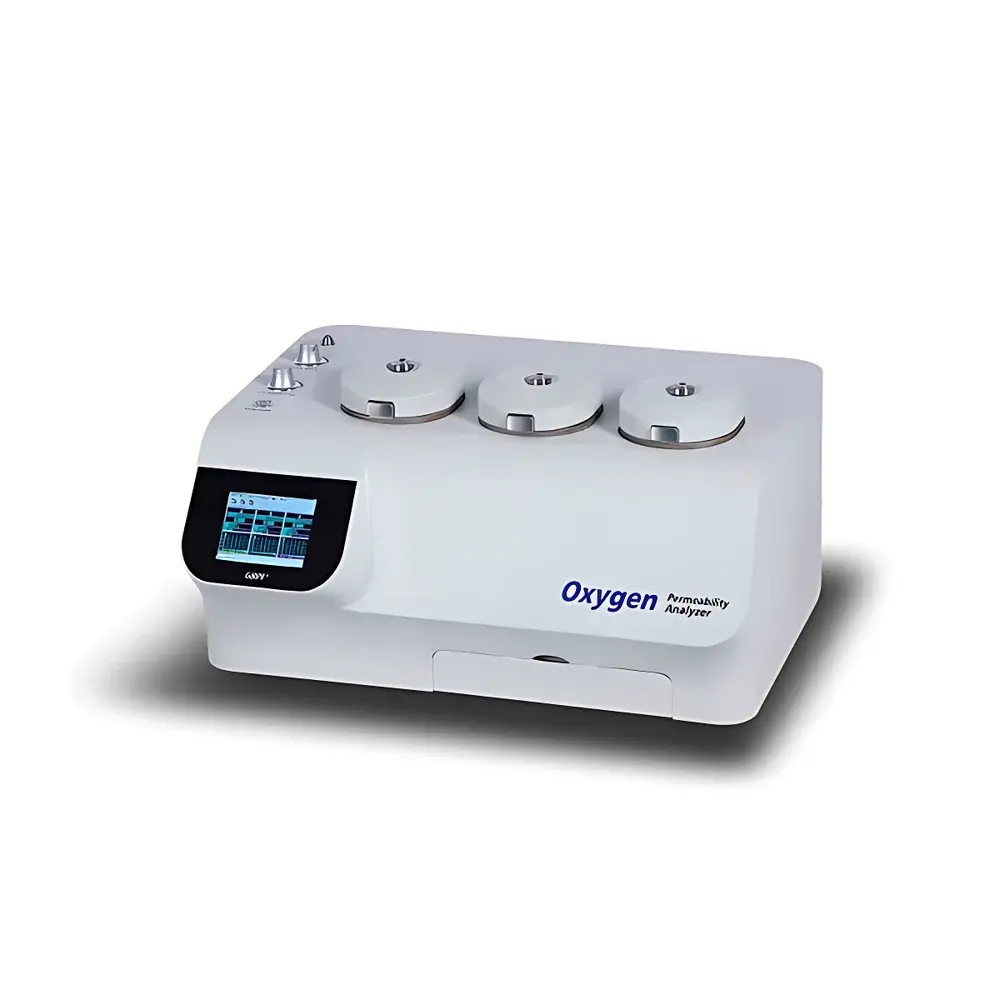
GBPI Y310-7 Isobaric Triple-Chamber Oxygen Transmission Rate (OTR) Analyzer
| Brand | GBPI |
|---|---|
| Origin | Guangdong, China |
| Manufacturer Type | OEM Manufacturer |
| Region | Domestic (China) |
| Model | Y310-7 |
| Price Range | USD 14,000 – 70,000 |
| Test Range | 0.02–16,500 cm³/(m²·24h) (film) |
| O₂ Resolution | 0.001 cm³/(m²·24h) |
| Temp Control | 15–45°C (5–50°C optional) |
| Temp Accuracy | ±0.1°C |
| RH Control | 0% (dry), 30–90% RH |
| RH Accuracy | ±1% RH |
| Test Area | 50.24 cm² |
| Specimen Size | Ø100 mm |
| Max Thickness | ≤3 mm |
| Specimen Qty | 1–3 pcs per test |
| Carrier Gas Pressure | 0.1–0.2 MPa |
| Gas Inlet | 1/8″ stainless steel tubing |
| Dimensions | 700 × 560 × 370 mm |
| Weight | 100 kg |
| Power | 750 W, AC 220 V, 50 Hz |
| Compliance | GB/T 19789–2005, ASTM D3985, ASTM F1927, ASTM F1307, ASTM F2622, ISO 15105-2, YBB00082003–2015, DIN 53380-3, JIS K-7126-B |
Overview
The GBPI Y310-7 Isobaric Triple-Chamber Oxygen Transmission Rate (OTR) Analyzer is a precision instrument engineered for quantitative determination of oxygen permeability through polymeric films, laminates, foils, rigid packaging, and functional barrier materials under controlled temperature and humidity conditions. It operates on the isobaric coulometric sensor principle—where oxygen molecules permeating through a sealed test specimen are carried by a nitrogen stream into an electrochemical oxygen sensor, generating a current proportional to O₂ concentration. This method ensures high reproducibility, low detection limits, and compliance with internationally recognized gravimetric and coulometric OTR measurement standards. Designed for laboratories requiring regulatory-grade data integrity, the Y310-7 supports full traceability, multi-level user access, and audit-ready operation in accordance with FDA 21 CFR Part 11 and EU Annex 11 requirements.
Key Features
- Triple independent test chambers: Each chamber operates autonomously—enabling concurrent testing of three identical or dissimilar specimens with individual start/stop control, independent environmental conditioning, and separate report generation.
- High-resolution coulometric oxygen sensing: Integrated long-life electrochemical sensor with 0.001 cm³/(m²·24h) resolution, validated against NIST-traceable standard reference materials (SRMs) and certified national standard substances (GBW(E)130497/8).
- Precision climate control: Dual-gas (dry/wet nitrogen) humidity regulation achieving ±1% RH stability; electromagnetic step-programmable thermal system maintaining ±0.1°C accuracy across 15–45°C (optional 5–50°C range).
- ARM-based embedded control architecture: Fully functional standalone operation without PC dependency; real-time display of OTR, O₂ concentration, temperature, and RH curves via 7-inch industrial LCD interface with Windows-style navigation and mouse support.
- GMP-compliant software platform: Role-based user management (Administrator, Operator, Viewer), configurable permission sets, and comprehensive audit trails—including system-level, method-level, and run-level event logging with immutable timestamps and operator ID tagging.
- Extended application capability: Optional face mask accessory enables high-flux OTR measurements up to 260,000 cm³/(m²·24h); dedicated fixtures available for bottles, pouches, trays, and blister cavities per ASTM F1307 and ISO 15105-2 container protocols.
Sample Compatibility & Compliance
The Y310-7 accommodates flat specimens up to Ø100 mm and 3 mm thickness—including monolayer plastics (PET, PP, PE), metallized films (AlOx, SiOx), aluminum foil, rubber sheets, ceramic substrates, pharmaceutical blister lidding, solar backsheet laminates, OLED encapsulation films, hydrogel contact lenses, and transdermal patches. All test configurations adhere strictly to pharmacopoeial and industrial standards: USP , YBB00082003–2015 (Chinese Pharmacopoeia), ASTM D3985 (film), ASTM F1927 (high-barrier), ASTM F1307 (containers), ISO 15105-2 (dual-sensor method), and GB/T 19789–2005 (national standard for plastic film OTR). Calibration is supported via certified reference films and primary-standard gas mixtures (99.999% O₂/N₂), with documented uncertainty budgets traceable to CNAS-accredited metrology labs.
Software & Data Management
The embedded GBPI OTR-Studio software provides full lifecycle data governance—from method creation and parameter validation to raw signal visualization, statistical analysis (mean, SD, CV%), and GLP-compliant reporting. All test data are stored in an encrypted local SQLite database with automatic backup and export functions (PDF, Excel, CSV). Reports include instrument ID, calibration history, environmental logs, curve overlays, pass/fail flags against specification limits, and digital signatures. The system enforces electronic signature workflows compliant with 21 CFR Part 11 Subpart B—requiring dual authentication for critical actions such as method modification, result deletion, or calibration override. Audit trail records preserve all user activity, including login/logout events, parameter changes, and report generation timestamps—retained for ≥15 years per internal SOP.
Applications
- Quality control of barrier packaging for sterile medical devices and pharmaceuticals
- R&D evaluation of novel polymer blends, nanocomposite films, and atomic layer deposition (ALD) coatings
- Stability studies of oxygen-sensitive biologics, lyophilized vaccines, and lipid-based nutraceuticals
- Validation of vacuum-sealed food packaging integrity under accelerated aging conditions
- Performance benchmarking of flexible electronics encapsulation layers (e.g., OLED, perovskite PV)
- Regulatory submission support for FDA IND/NDAs and EMA CMC dossiers requiring OTR evidence
FAQ
What gases are required for operation?
High-purity nitrogen (≥99.999%) as carrier gas and oxygen (≥99.999%) for calibration—both supplied via pressure-regulated stainless steel lines with 1/8″ NPT fittings.
Is the instrument suitable for container testing?
Yes—when equipped with optional container fixtures and face mask assembly, it complies with ASTM F1307 and ISO 15105-2 for rigid and semi-rigid packaging.
How is calibration performed?
Using either certified reference films (e.g., 125 µm PET standard) or certified O₂/N₂ gas mixtures; calibration data is entered directly into the software interface and automatically applied to subsequent tests.
Does the system support remote monitoring?
Local Ethernet connectivity enables networked data export and remote desktop supervision; however, cloud-based telemetry is not implemented to maintain air-gap security for regulated environments.
What maintenance intervals are recommended?
Oxygen sensor replacement every 18–24 months under continuous use; annual verification of temperature/humidity sensors against NIST-traceable references; quarterly cleaning of sealing surfaces and gas pathways per SOP-OTR-MNT-01.






