
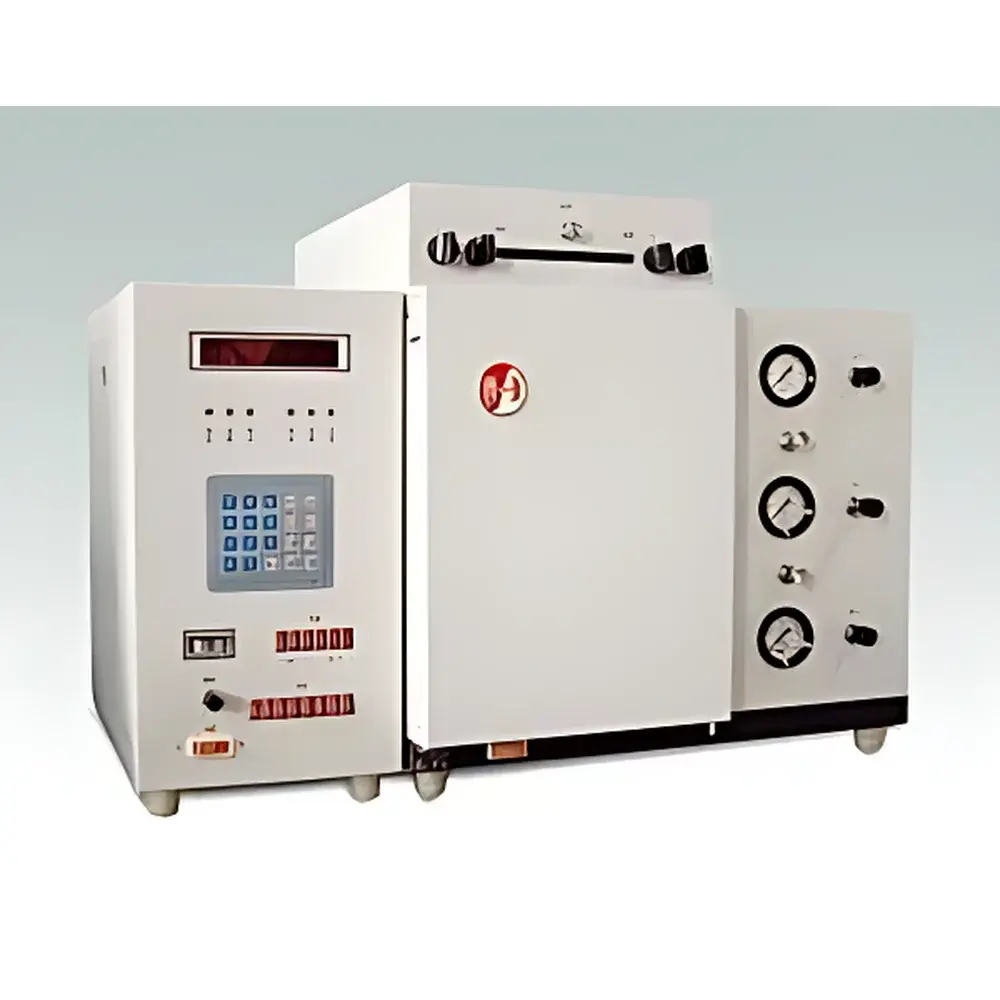
GC-4075 (ZRJ-1) Coal Spontaneous Combustion Tendency Analyzer
| Origin | Beijing, China |
|---|---|
| Manufacturer Type | Authorized Distributor |
| Origin Category | Domestic (China) |
| Model | GC-4075 |
| Pricing | Upon Request |
| Measurement Method | Dual-Channel Flow Chromatographic Oxygen Adsorption Method |
| Oxygen Uptake Range | 0.05–4 mL/g (coal) |
| Measurement Error | ≤5% |
| Baseline Drift | ≤0.6 mV/hr |
| Carrier Gas Purity | N₂ ≥99.99% |
| Adsorption Gas Purity | O₂ ≥99.99% |
| Sensitivity | ≥10 mV/mL (N₂ carrier, O₂ peak height) |
| Temperature Control Accuracy | ±0.5°C |
| Power Supply | 220 V ±20%, 50 Hz ±0.5 Hz, 500 W |
Overview
The GC-4075 (ZRJ-1) Coal Spontaneous Combustion Tendency Analyzer is a dedicated laboratory instrument engineered for quantitative assessment of coal’s propensity toward low-temperature oxidation and spontaneous ignition. It implements the dual-channel flow chromatographic oxygen adsorption method—a standardized physicochemical technique specified in MT/T 707–1997, the Chinese industry standard for coal spontaneous combustion tendency determination by gas chromatography. The instrument measures oxygen uptake kinetics under controlled isothermal conditions (typically 30–70°C), where finely ground coal samples are exposed to a purified oxygen stream while nitrogen serves as the carrier gas. Oxygen depletion is monitored continuously via a high-stability thermal conductivity detector (TCD) with antioxidant tungsten-rhenium filaments, enabling precise quantification of oxygen adsorbed per gram of coal. This metric—expressed in mL O₂/g coal—is directly correlated to the coal’s intrinsic reactivity and forms the basis for classification into three standardized spontaneous combustion tendency grades: “Prone to Spontaneous Combustion,” “Susceptible,” and “Not Prone”—as defined in national safety protocols.
Key Features
- Dedicated dual-channel gas chromatographic architecture optimized exclusively for coal oxygen adsorption analysis, minimizing cross-contamination and enhancing method reproducibility.
- Four independent sample processing channels operating in parallel, significantly increasing throughput for routine quality control or mine-site batch testing.
- Thermal conductivity detector equipped with oxidation-resistant tungsten-rhenium filament elements and constant-average-temperature bridge excitation circuitry, ensuring long-term signal stability and minimal baseline drift (≤0.6 mV/hr).
- Microprocessor-based temperature control system with ±0.5°C accuracy across the operational range (ambient to 80°C), critical for maintaining consistent adsorption thermodynamics.
- Fully automated operation sequence: sample introduction, gas switching, isothermal exposure, peak integration, calculation, classification, and report generation—including direct thermal printing of final classification results per MT/T 708–1997 compliance requirements.
Sample Compatibility & Compliance
The GC-4075 accepts air-dried, sieved coal samples (≤0.2 mm particle size) prepared in accordance with GB/T 212–2008 (Chinese standard for coal proximate analysis). Sample mass is precisely weighed (typically 0.5–1.0 g) and loaded into quartz reaction tubes compatible with inert gas environments. The analyzer complies fully with MT/T 707–1997 and MT/T 708–1997, and its measurement traceability aligns with national metrological verification procedures for coal safety instrumentation. While not certified to ISO/IEC 17025 for accredited testing, the system supports GLP-aligned documentation practices—including timestamped raw chromatograms, operator ID logging, and audit-ready printouts—facilitating internal QA/QC and regulatory review under China’s Coal Mine Safety Regulations.
Software & Data Management
The integrated control unit runs embedded firmware supporting real-time chromatogram display, automatic peak detection, and stoichiometric oxygen uptake calculation using preloaded calibration coefficients. All analytical data—including raw voltage-time profiles, calculated O₂ uptake values, classification logic outputs, and environmental parameters (temperature, flow rate)—are stored locally with date/time stamps. Export functionality permits CSV-formatted data transfer for secondary statistical analysis or LIMS integration. The system maintains full audit trails for all critical operations (e.g., calibration events, temperature setpoint changes, result overrides), satisfying basic requirements for data integrity under GLP frameworks and preparatory alignment with FDA 21 CFR Part 11 principles—though formal electronic signature implementation requires external validation.
Applications
- Routine assessment of raw coal and blended feedstocks in coal preparation plants prior to stockpiling or transportation.
- Supporting mine ventilation planning and fire risk mapping through systematic screening of seam-specific coal samples.
- Verification of inertization effectiveness (e.g., after N₂ or CO₂ injection) by comparative oxygen uptake profiling.
- Research applications in coal geochemistry, low-temperature oxidation kinetics, and inhibitor efficacy studies.
- Regulatory submission support for mine safety documentation required by provincial coal safety bureaus and the National Mine Safety Administration (NMSA).
FAQ
What gas purity specifications are mandatory for reliable operation?
Carrier gas (N₂) must be ≥99.99% pure; adsorption gas (O₂) must be ≥99.99% pure. Lower purity introduces hydrocarbon or moisture interference, compromising TCD response linearity and baseline stability.
Is the instrument suitable for ASTM or ISO-compliant testing?
The GC-4075 implements MT/T 707–1997, a China-specific standard. While conceptually aligned with oxygen uptake principles referenced in ASTM D5373 and ISO 1171, it is not validated against those methods and lacks formal equivalency certification.
Can the system accommodate custom classification thresholds?
Classification logic is hard-coded per MT/T 707–1997 (e.g., 1.0 mL/g = Prone). Threshold modification requires firmware-level reconfiguration and is not supported in standard operation.
What maintenance intervals are recommended for sustained accuracy?
TCD filament inspection and column conditioning are advised every 200 analyses; gas line filters should be replaced quarterly; annual calibration verification using certified O₂/N₂ reference mixtures is strongly recommended.
Does the analyzer include remote diagnostics or network connectivity?
No. The GC-4075 operates as a standalone instrument with local control and thermal printing. Data export is limited to manual USB or serial transfer; Ethernet or cloud connectivity is not implemented.





