
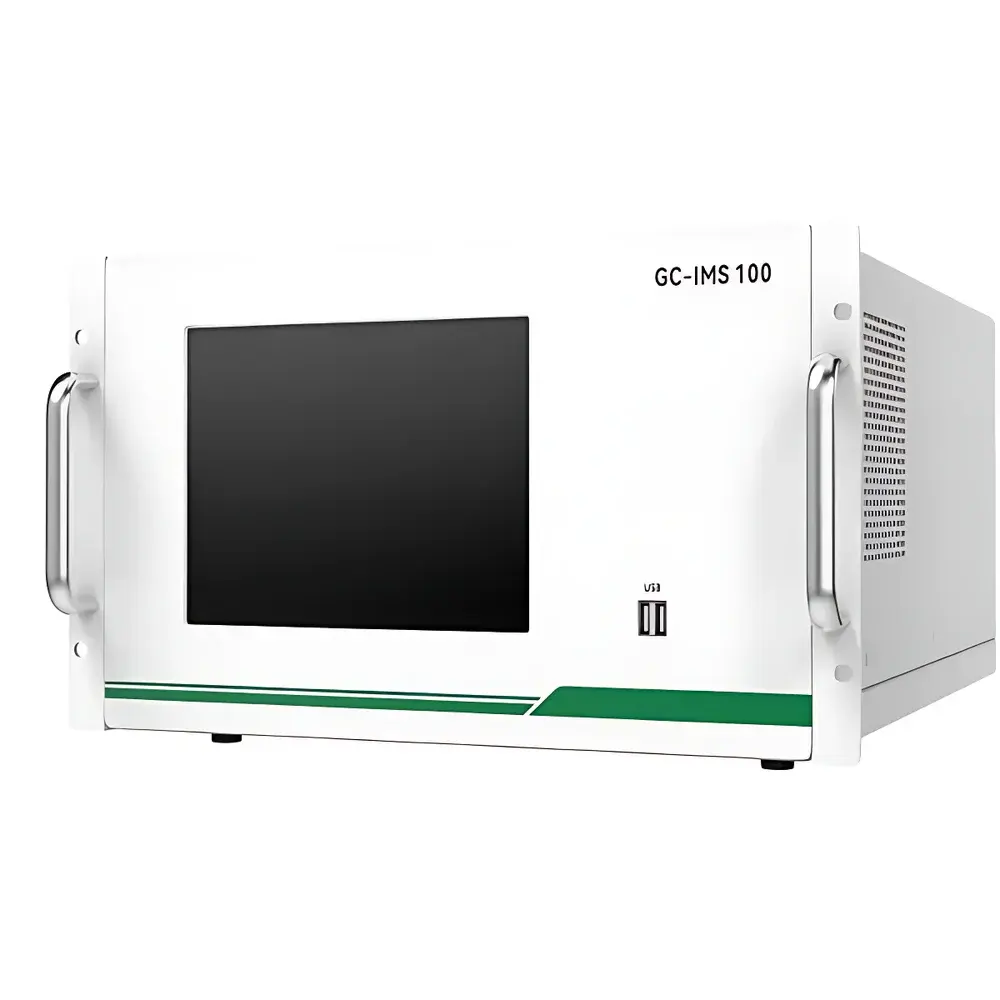
GC-IMS 1000 Rack-Mounted Gas Chromatography–Ion Mobility Spectrometry System
| Brand | Titan Instruments |
|---|---|
| Origin | Beijing, China |
| Manufacturer | Titan Instruments |
| Type | Domestic |
| Model | GC-IMS 1000 |
| Pricing | Upon Request |
Overview
The GC-IMS 1000 is a rack-mounted analytical platform integrating gas chromatography (GC) and high-resolution ion mobility spectrometry (IMS) in a single, compact architecture. Engineered for trace volatile organic compound (VOC) detection in complex gaseous matrices, the system operates on the principle of differential ion mobility—separating ions based on their collision cross-section (CCS) and drift time under a weak electric field in ambient-pressure nitrogen or purified air. Coupled with a fast, low-thermal-mass GC column (typically 1–2 m fused silica), the instrument achieves orthogonal separation: first by volatility and polarity (GC), then by ion shape and size (IMS). This dual-dimensionality delivers enhanced peak capacity, reduced spectral overlap, and improved confidence in compound identification—particularly critical for isomeric VOCs, odorants, and transient metabolites that co-elute in conventional GC-MS systems. Designed for laboratory, mobile lab, and fixed-site monitoring applications, the GC-IMS 1000 meets the operational requirements of environmental surveillance, industrial hygiene, clinical breath analysis, and security screening without requiring vacuum infrastructure or radioactive ionization sources.
Key Features
- Rack-mountable 19″ chassis (4U height) compatible with standard server cabinets or benchtop deployment
- Integrated modular architecture: sampling module with negative-pressure draw-in inlet, chemically inert valve train (electropolished stainless steel & PFA-lined), rapid GC oven (0–150 °C, ramp rate up to 10 °C/s), dual-polarity IMS cell (± polarity switching in <500 ms), and embedded industrial PC with real-time data acquisition
- Non-radioactive, UV-based photoionization source (VUV lamp, 10.6 eV) ensuring operator safety, long-term stability (>12 months maintenance-free operation), and compliance with IEC 61010-1 for electrical safety
- Full inert flow path: electropolished stainless-steel tubing, PTFE/PFA seals, and passivated surfaces minimizing adsorption and memory effects for ppt-level detection sensitivity
- Configurable sampling protocols: single-shot, time-series, triggered acquisition, and programmable duty cycles (sampling interval: 1 s–24 h)
- Built-in touchscreen interface with native Chinese-language software (Titan IMS Suite v3.x), supporting real-time drift-time calibration, peak deconvolution, library matching (NIST-compatible IMS spectral database), and semi-quantitative analysis using internal standards or response factor libraries
Sample Compatibility & Compliance
The GC-IMS 1000 accepts direct gas-phase samples from Tedlar® bags, SUMMA canisters, ambient air (via built-in pump), headspace vials, and online process streams. Its low sample volume requirement (50–500 µL), absence of cryogenic cooling, and ambient-pressure operation eliminate the need for pre-concentration traps or carrier gas optimization typical in GC-MS workflows. The system conforms to ISO 16000-6 (indoor air VOC analysis), ASTM D6196 (selection of sorbents for VOC sampling), and supports GLP-compliant data integrity through audit-trail-enabled software logging (user actions, method parameters, calibration history). Optional integration with rack-mounted zero-air generators (ISO 8573-1 Class 1) and dynamic dilution calibrators enables traceable calibration across 3–6 orders of magnitude—fully aligned with EPA Method TO-15 and EU EN 14662 for ambient VOC monitoring.
Software & Data Management
Titan IMS Suite provides a unified environment for instrument control, spectral visualization (2D heatmaps: retention time vs. drift time), and post-acquisition processing. Raw .ims files are stored in HDF5 format with embedded metadata (timestamp, temperature, pressure, voltage settings). The software supports batch processing, PCA and PLS-DA multivariate modeling, and export to common formats (CSV, mzML-compatible IMS extensions). For regulated environments, optional 21 CFR Part 11-compliant modules provide electronic signatures, role-based access control, and immutable audit trails—validated for use in QC labs operating under GMP or ISO/IEC 17025 frameworks. Remote monitoring via Ethernet or optional Wi-Fi module allows centralized fleet management across distributed monitoring networks.
Applications
- Environmental Monitoring: Real-time odor profiling (e.g., H2S, mercaptans, aldehydes), landfill/WWTP emissions tracking, and fugitive VOC leak detection (LDAR)
- Food & Agriculture: Volatile fingerprinting of agricultural products (e.g., tea, wine, honey), geographical origin authentication, fermentation process monitoring, and plant BVOC emission studies
- Industrial Hygiene: Semiconductor cleanroom airborne molecular contaminant (AMC) surveillance, automotive interior off-gassing assessment (aldehydes, siloxanes), and natural gas sulfur speciation (H2S, COS, mercaptans)
- Clinical & Translational Research: Exhaled breath VOC profiling for non-invasive disease biomarker discovery (e.g., lung cancer, diabetes, COPD), anesthetic agent monitoring, and metabolic phenotyping
- Security & Defense: Rapid screening for explosives (TNT, RDX), chemical warfare agents (sarin, VX), toxic industrial chemicals (TICs), and quarantine-relevant volatiles (e.g., methyl bromide, phosphine)
FAQ
Does the GC-IMS 1000 require radioactive sources or high-vacuum pumps?
No. It employs a solid-state VUV photoionization lamp and operates at ambient pressure, eliminating regulatory burdens associated with radioactive materials and mechanical vacuum systems.
Can the system be integrated into automated monitoring networks?
Yes. With Modbus TCP, OPC UA, and RESTful API support, it interfaces seamlessly with SCADA platforms and central data lakes.
Is method validation documentation available for regulatory submissions?
Titan Instruments provides IQ/OQ documentation templates, performance qualification protocols, and reference spectra libraries compliant with ISO/IEC 17025 requirements.
What maintenance intervals are recommended for routine operation?
The ionization source and IMS cell require no scheduled maintenance; GC column replacement is advised every 6–12 months depending on sample load, and annual calibration verification is recommended.
How does GC-IMS compare to PTR-MS or SIFT-MS for breath analysis?
GC-IMS offers superior isomer resolution and lower cost-of-ownership, though with slightly reduced mass accuracy; it excels in targeted panels where retention/drift time fingerprints provide orthogonal identification confidence.




