
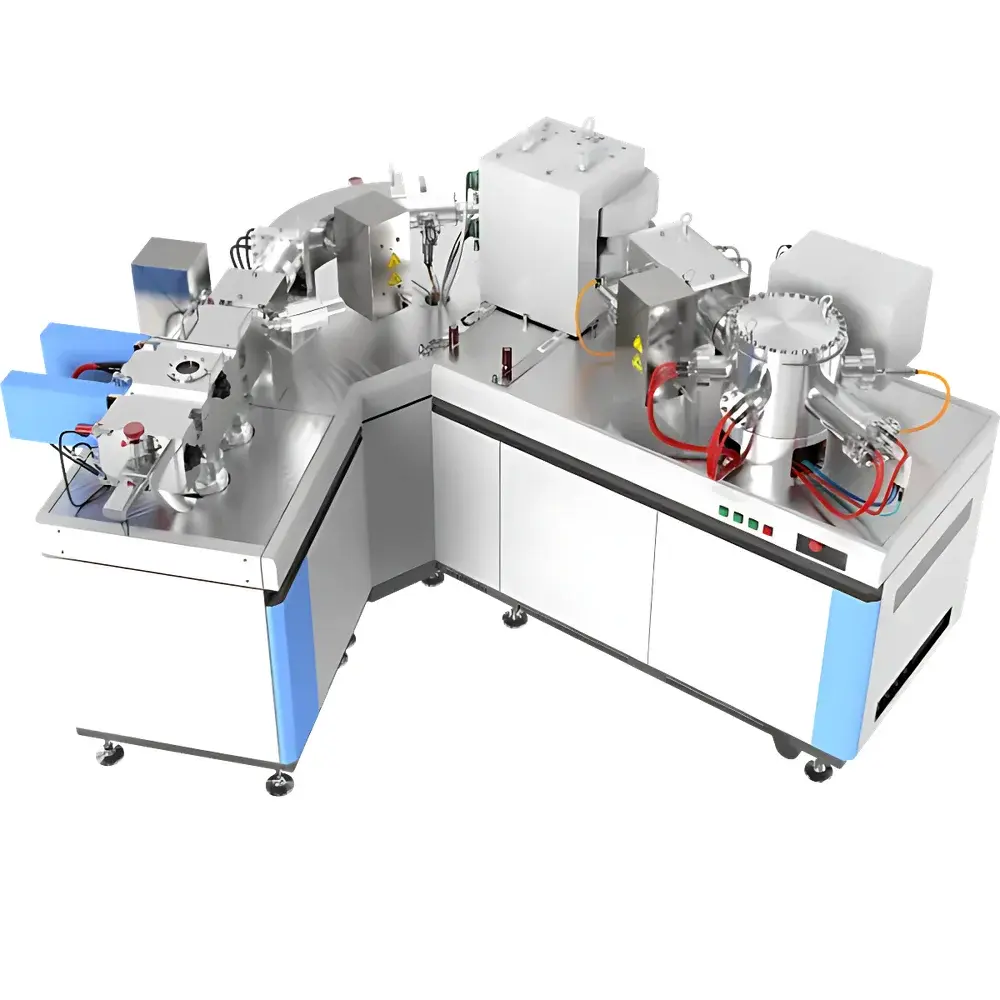
GD-MS Sparkle High-Resolution Glow Discharge Mass Spectrometer
| Brand | Kunyuan Instruments |
|---|---|
| Origin | Tianjin, China |
| Model | Sparkle |
| Cooling | Liquid Nitrogen (Ambient Pressure) |
| Resolution Modes | 400 / 4000 / 10,000 (switchable in <1 s) |
| Detection Limit | Sub-ppb (typical), down to low-ppt (element-dependent) |
| Dynamic Range | 12 decades (Faraday cup + electron multiplier) |
| Sample Throughput | Full-element scan (78 elements) <5 min |
| Depth Resolution | Sub-micrometer |
| Gas Consumption | Ar, ≥99.9995% purity |
| Dimensions | 2160 × 2040 × 1480 mm (L×W×H) |
| Power | AC 220 V / 50 Hz, grounding resistance <2 Ω |
| Cooling | External chiller (500 W) for turbo pumps & magnet |
| Ambient | 18–24 °C, 40–60% RH |
Overview
The GD-MS Sparkle High-Resolution Glow Discharge Mass Spectrometer is a dedicated solid-sample elemental and isotopic analysis platform engineered for ultra-trace quantification, depth profiling, and high-precision isotopic ratio measurement. Based on pulsed or continuous glow discharge ionization coupled with double-focusing magnetic sector mass spectrometry, the system enables direct solid sampling without dissolution or digestion—preserving spatial integrity and eliminating solution-based contamination or memory effects. Its core architecture integrates a cryogenically cooled ion source (≤−180 °C), a high-transmission dual-mode mass analyzer, and a hybrid detection system optimized for both major matrix components and trace impurities across the full periodic table (Li to U). Designed for laboratories requiring regulatory-compliant, high-reproducibility data in semiconductor metrology, advanced materials R&D, and nuclear-grade material certification, the Sparkle GD-MS delivers robust performance under GLP and GMP-aligned operational frameworks.
Key Features
- Cryogenic Ion Source: Ambient-pressure liquid nitrogen cooling maintains ion source temperature below −180 °C, suppressing residual gas background and enabling stable analysis of low-melting-point solids (e.g., Ga, In, Sn, Sb) without thermal degradation or preferential sputtering.
- Triple-Resolution Magnetic Sector Analyzer: Switchable resolution settings (R = 400, 4000, 10,000) achieved in under 1 second; flat-top peak shape at medium resolution ensures high mass accuracy and improved precision for quantitative isotope ratio determination.
- High-Transmission Optics: Optimized ion optics preserve signal intensity even at R = 10,000—unlike conventional sector instruments where transmission drops sharply with resolution increase—enabling simultaneous high sensitivity and high mass separation.
- Hybrid Detector System: Integrated Faraday cup and discrete-dynode electron multiplier provide seamless coverage over 12 orders of magnitude, supporting quantification from bulk wt% levels down to sub-ppb impurity concentrations in a single acquisition.
- Rapid Solid Sampling: Tool-free sample exchange in ≤60 seconds; compatible with bulk metals, semiconductors (Si, SiC, GaN), insulators (Al2O3, YSZ), powders, wires, and shavings—no conductive coating or matrix-matched standards required for semi-quantitative screening.
- Low-Consumption Gas Operation: Argon consumption as low as 0.3 mL/min in reaction mode; optional integration with inert-atmosphere gloveboxes for air-sensitive or radioactive samples.
Sample Compatibility & Compliance
The Sparkle GD-MS accepts conductive and non-conductive solids—including high-purity silicon wafers, sputtering targets (Ti, Ta, Cu, Co), rare-earth oxides, nuclear graphite, Li-ion cathode precursors (NMC, LFP), and aerospace superalloys (Inconel, Hastelloy). Sample forms include disks (6–25 mm), rods, foils, and pressed pellets. The system meets essential requirements for ISO/IEC 17025-accredited testing laboratories and supports audit-ready documentation per FDA 21 CFR Part 11 (electronic records/signatures) and EU Annex 11 (computerized systems). Depth profiling adheres to ASTM E1598 (sputter rate calibration) and ISO 18115-2 (surface chemical analysis—depth profiling methodology). All hardware and software modules are validated for traceability, calibration stability, and inter-laboratory reproducibility.
Software & Data Management
The proprietary SparkleControl Suite provides end-to-end workflow automation—from vacuum sequence initiation and discharge parameter optimization to real-time spectral visualization, multi-isotope deconvolution, and ISO-compliant report generation. Key capabilities include: automated mass calibration using internal reference gases; depth-scale conversion with sputter-rate modeling; interference correction via mass-resolved peak stripping; batch processing for multi-sample comparative analysis; and export to LIMS-compatible formats (CSV, XML, ASTM E1392). Audit trails log all user actions, method changes, and instrument status events with time stamps and operator IDs—fully compliant with GLP/GMP data integrity principles.
Applications
- Semiconductor Industry: Impurity mapping in 300-mm Si wafers, dopant profiling in GaN HEMT substrates, oxygen/carbon contamination in sapphire substrates.
- Advanced Packaging: Trace metal analysis in Al2O3 and AlN substrates; interface chemistry characterization of Cu/Ta diffusion barriers.
- Energy Materials: Transition metal leaching assessment in NMC811 cathodes; boron/hydrogen content in solar-grade polycrystalline silicon.
- Aerospace & Nuclear: Zr/Hf ratio verification in zirconium cladding alloys; chlorine/fluorine ingress detection in nuclear graphite moderators.
- Metallurgy & Catalysis: Rare earth element distribution in NdFeB magnets; sulfur segregation at grain boundaries in high-strength steels.
FAQ
What sample preparation is required prior to GD-MS analysis?
Minimal preparation: flat, clean surfaces are sufficient. Conductive samples require no coating; non-conductive materials (e.g., ceramics) may be analyzed directly using pulsed GD mode with minimal surface charging.
Can the Sparkle GD-MS perform isotopic ratio measurements?
Yes—its high mass resolution (up to R = 10,000) and stable ion beam enable precise isotope ratio determination (e.g., 206Pb/207Pb, 143Nd/144Nd) with internal precision better than 0.1% RSD for ratios >0.01.
Is external calibration necessary for quantitative results?
Matrix-matched certified reference materials (CRMs) are recommended for highest accuracy; however, relative sensitivity factors (RSFs) allow semi-quantitative screening with <30% deviation in absence of CRMs.
How is depth resolution validated?
Depth resolution is verified using certified layered standards (e.g., Si/SiO2/Si multilayers) and cross-referenced against SIMS and XPS data per ISO 18115-2 protocols.
What maintenance intervals are recommended for routine operation?
Ion source cleaning every 200–300 hours of operation; turbo pump oil replacement every 12 months; annual magnetic field calibration and mass scale verification using argon isotopes.






