
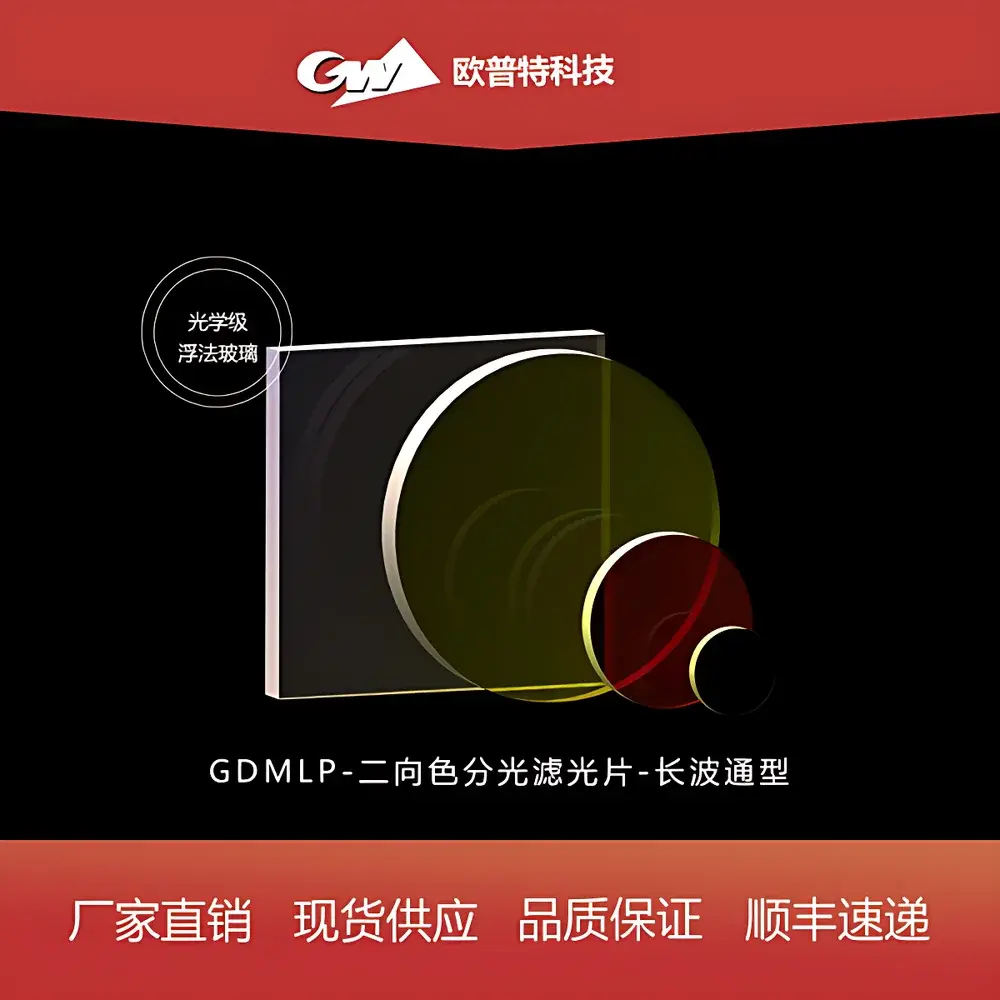
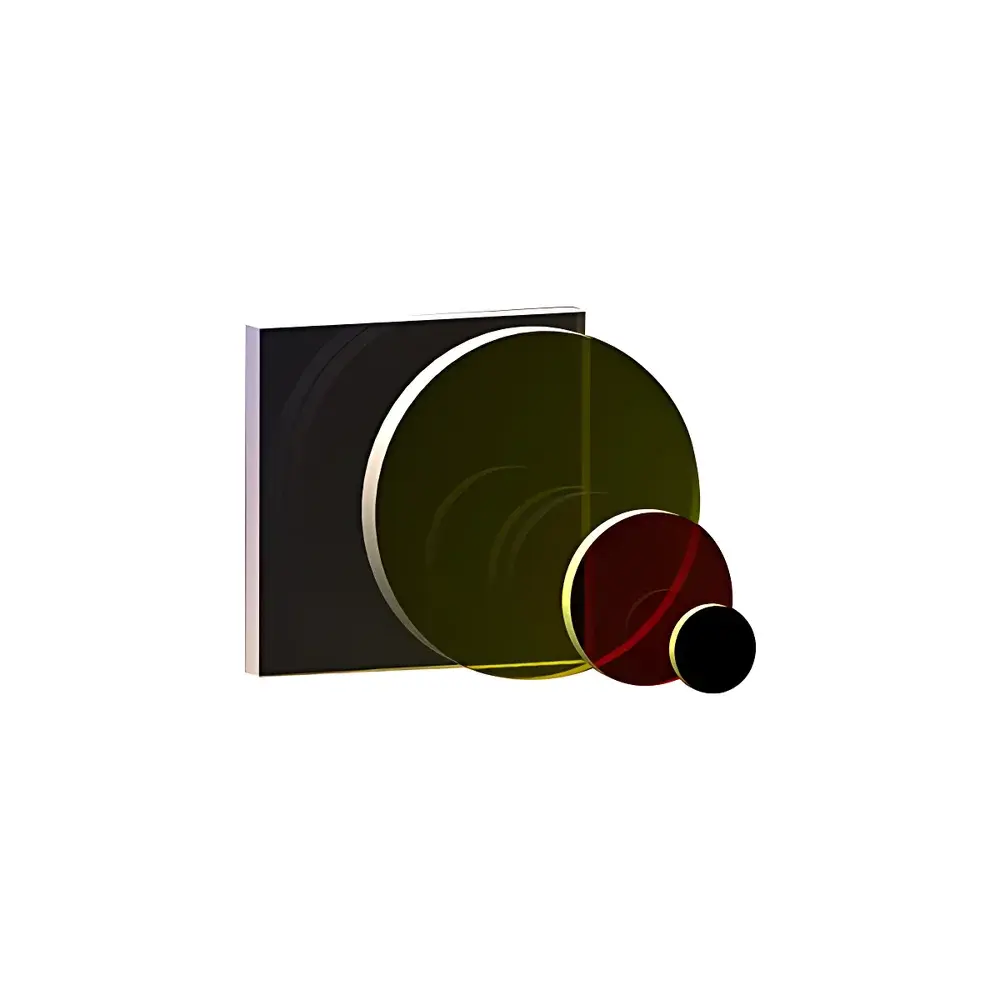
GDMLP Dichroic Long-Wave Pass Filter
| Origin | Beijing |
|---|---|
| Manufacturer Type | Distributor |
| Origin Category | Domestic |
| Model | GDMLP |
| Price Range | USD 0.15–75.00 (per unit) |
| Component Category | Optical Element |
| Substrate Material | Optical-Grade Float Glass |
| Surface Flatness | λ/4 @ 633 nm |
| Parallelism | < 30 arcsec |
| Surface Quality | 3–4 scratch-dig |
| Diameter Tolerance | +0.0 / −0.1 mm |
| Thickness | 2.0 ± 0.2 mm |
| Center Wavelength (λC) | ±10 nm |
| Average Transmission (Tavg) | >90% in transmission band |
| Average Reflection (Ravg) | >98% in reflection band |
| Clear Aperture | >90% of nominal diameter |
| Angle of Incidence | 45° |
| λC Definition | Wavelength at which transmission = 50% |
| Available Sizes | Φ12.5 mm (part no. 12.5×17.5 mm), Φ25 mm (part no. 25×39 mm) |
Overview
The GDMLP Dichroic Long-Wave Pass Filter is a precision thin-film interference filter engineered for high-fidelity spectral separation in demanding optical systems. Operating on the principle of multilayer dielectric interference, it transmits wavelengths longer than a defined cutoff (λC) while reflecting shorter wavelengths—enabling efficient spectral routing with minimal polarization-dependent loss. Designed for 45° angle of incidence, the filter maintains consistent spectral performance across its clear aperture (>90% of nominal diameter), making it suitable for beam combiners, fluorescence microscopy illumination paths, and laser line cleanup in confocal or widefield systems. Its optical-grade float glass substrate ensures low wavefront distortion (λ/4 @ 633 nm) and mechanical stability under standard laboratory environmental conditions.
Key Features
- High spectral fidelity: Average transmission >90% in the long-wave passband and average reflection >98% in the short-wave rejection band
- Strict optical tolerances: Surface flatness λ/4 @ 633 nm, parallelism <30 arcsec, and surface quality rated 3–4 scratch-dig per MIL-PRF-13830B
- Precision dimensional control: Diameter tolerance +0.0 / −0.1 mm; thickness 2.0 ± 0.2 mm; center wavelength accuracy ±10 nm
- Optimized for 45° incidence: Spectral edge position and bandwidth are calibrated and validated at 45° AOI to ensure compatibility with standard dichroic mirror mounts and cube assemblies
- Robust thin-film architecture: Hard-coated dielectric stack deposited via ion-assisted e-beam evaporation, resistant to humidity, mild solvents, and repeated cleaning with optical-grade acetone and methanol
Sample Compatibility & Compliance
The GDMLP filter is compatible with standard optomechanical mounting solutions—including SM1-threaded lens tubes, kinematic mirror mounts, and OEM filter wheels. It meets baseline requirements for ISO 10110-7 (surface imperfections), ISO 10110-3 (surface form), and ANSI/OEOSC OP1.002 (optical coating durability). While not certified to specific regulatory frameworks (e.g., FDA 21 CFR Part 11), its material traceability, batch-controlled deposition process, and documented spectral validation reports support integration into GLP-compliant analytical workflows such as fluorescence-based QC assays or Raman spectrometer calibration protocols.
Software & Data Management
No embedded firmware or proprietary software is associated with this passive optical component. Spectral performance data—including measured transmission/reflection curves, angle-tuned edge shift profiles, and environmental aging test results—are provided in standardized ASCII format (.csv) and PDF documentation per batch. Users may import these datasets directly into optical design tools (e.g., Zemax OpticStudio, CODE V, FRED) for system-level stray light analysis or throughput modeling. All calibration reports include NIST-traceable reference measurements performed using a calibrated UV-VIS-NIR spectrophotometer (PerkinElmer Lambda 1050+ with integrating sphere).
Applications
- Fluorescence microscopy: Separating excitation light (reflected) from emission signal (transmitted) in epifluorescence and TIRF configurations
- Raman spectroscopy: Blocking Rayleigh scatter while transmitting Stokes-shifted Raman signals in free-space or fiber-coupled probe heads
- Astronomical instrumentation: Suppressing skyglow and atmospheric OH emission lines in narrowband imaging filters and adaptive optics wavefront sensors
- Machine vision: Enhancing contrast in multispectral inspection systems by isolating target spectral bands (e.g., NIR defect detection in semiconductor wafers)
- Spectroscopic beam combining: Integrating multiple laser sources (e.g., 405 nm + 532 nm + 640 nm) into a single collimated path for holography or optical trapping
FAQ
What is the definition of center wavelength (λC) for this filter?
λC is defined as the wavelength at which the measured transmission reaches 50% of its maximum value in the long-wave passband, determined under collimated 45° incidence with p- and s-polarized light averaged.
Can the GDMLP filter be used at angles other than 45°?
Yes, but spectral edges will shift toward shorter wavelengths as incidence angle increases; angular tuning curves are supplied upon request for system integration planning.
Is the filter suitable for high-power laser applications?
It is rated for continuous-wave (CW) operation up to 500 mW/cm² at 532 nm and 1064 nm; pulsed laser use requires LIDT verification per pulse duration and repetition rate.
How is clear aperture verified during quality control?
Clear aperture is measured interferometrically using a Zygo Verifire™ HD system, confirming >90% unobstructed area within the nominal diameter boundary.
Are custom center wavelengths or dimensions available?
Yes—standard λC options range from 450 nm to 1050 nm in 25 nm increments; custom diameters and rectangular formats (e.g., 12.5 × 17.5 mm, 25 × 39 mm) are offered with lead times of 4–6 weeks.






