
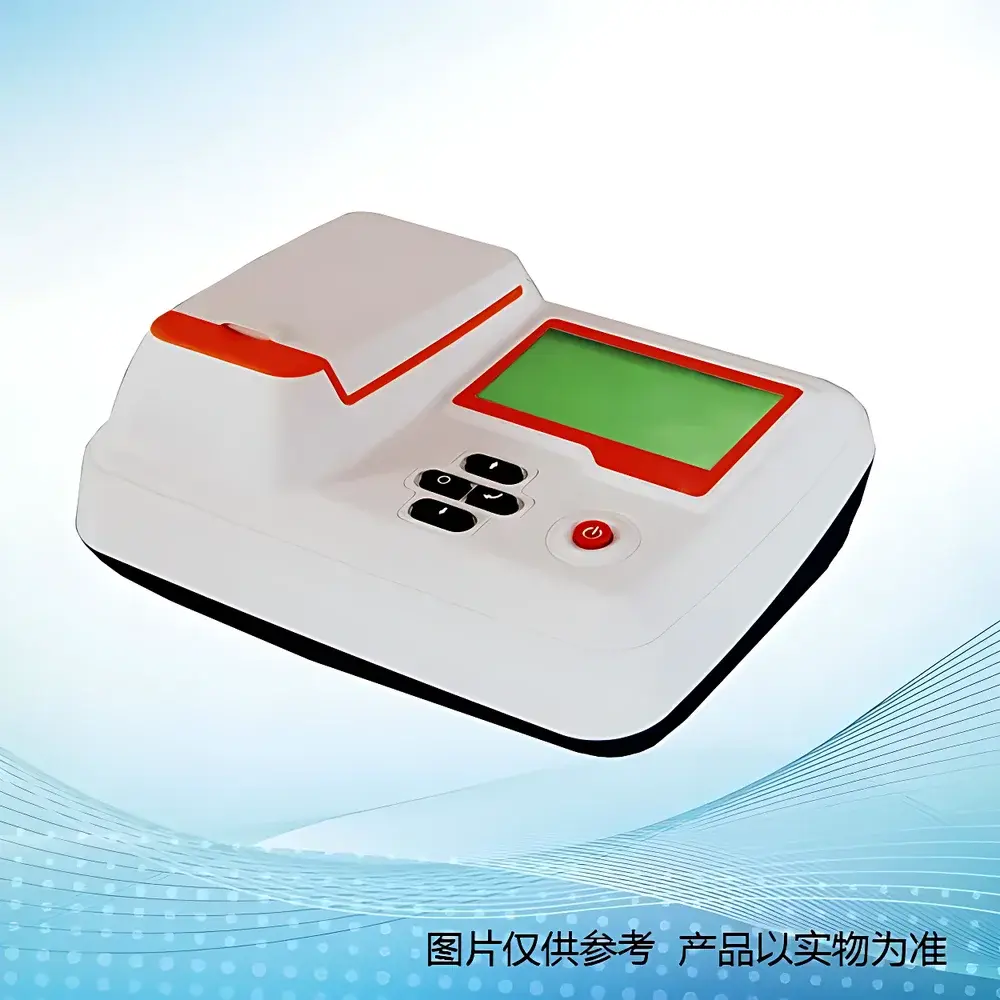
GDYQ-201SQ2 Food Formaldehyde Rapid Analyzer by Jida Xiaotianshe
| Brand | Jida Xiaotianshe |
|---|---|
| Origin | Jilin, China |
| Manufacturer Type | Direct Manufacturer |
| Country of Origin | China |
| Model | GDYQ-201SQ2 |
| Pricing | Available Upon Request |
| Detection Principle | Acetylacetone Colorimetric Method |
| Detection Limit | 1.0 mg/kg |
| Measurement Range | 0.0–100.0 mg/kg |
| Accuracy | ±2% |
| Analysis Time | ≤10 min per sample |
| Display | Backlit LCD with Chinese UI |
| Control System | Embedded Microcontroller |
| Data Functions | Measurement logging, statistical processing, parameter setting, help system, USB/RS232 communication |
| Sample Prep | Dedicated pretreatment kit + single-use reagent cartridges |
| Compliance Basis | Modified GB/T 5009.49 & GB 5009.276 methods |
Overview
The GDYQ-201SQ2 Food Formaldehyde Rapid Analyzer is a dedicated benchtop photometric instrument engineered for the quantitative determination of formaldehyde residues in food matrices. It operates on the internationally recognized acetylacetone colorimetric principle (also known as the Nash reaction), wherein formaldehyde reacts with acetylacetone under acidic conditions and heat to form a stable yellow chromophore (3,5-diacetyl-1,4-dihydrolutidine) measurable at 412 nm. This method is referenced in modified versions of China’s national food safety standards—specifically GB/T 5009.49 (for starch-based foods) and GB 5009.276 (for broader food categories)—and aligns with AOAC Official Method 2005.03 for formaldehyde in seafood and processed products. The GDYQ-201SQ2 is not a screening-only device; it delivers trace-level quantification with metrological traceability to certified reference materials, making it suitable for routine quality control laboratories operating under GLP-aligned workflows.
Key Features
- Two-mode analytical protocol: supports both rapid semi-quantitative screening (≤5 min) and full quantitative analysis (≤10 min) using standardized calibration curves generated from formaldehyde standard solutions (0–100 mg/kg).
- Integrated optical detection system featuring a precision LED light source, fixed-wavelength filter (412 ± 2 nm), and silicon photodiode detector—optimized for minimal interferences from common food matrix components (e.g., reducing sugars, amino acids, and organic acids).
- Embedded microcontroller architecture with real-time clock, non-volatile memory (≥1000 test records), and firmware-upgradable operation—ensuring long-term stability and audit-ready data integrity.
- Backlit monochrome LCD display with native Chinese menu navigation, intuitive icon-driven interface, and context-sensitive on-screen prompts for calibration, measurement, and error diagnostics.
- Dedicated sample preparation module—including centrifuge-compatible extraction tubes, pH-adjustment reagents, and heating blocks calibrated to 60 °C ± 1 °C—designed to minimize operator variability and maximize analyte recovery.
- Single-use reagent cartridges pre-loaded with stabilized acetylacetone reagent, ammonium acetate buffer, and acid catalyst—eliminating manual reagent preparation and reducing cross-contamination risk.
Sample Compatibility & Compliance
The GDYQ-201SQ2 has been validated for use across diverse food categories including but not limited to: aquatic products (e.g., squid, shrimp, fish fillets), tofu and soy-based analogues, rice noodles, vermicelli, dried mushrooms, and pickled vegetables. Matrix-matched calibration and spike-recovery studies demonstrate average recoveries between 92–105% at fortification levels of 2.0, 10.0, and 50.0 mg/kg. While not FDA 21 CFR Part 11–compliant out-of-the-box, the device supports exportable CSV-formatted logs compatible with LIMS integration. Its methodology satisfies the technical requirements of GB 2760–2024 (food additive usage standard), GB 5009.276–2023 (national food safety standard for formaldehyde determination), and ISO 15238:2015 (guidance on formaldehyde testing in food contact materials).
Software & Data Management
Data acquisition and reporting are managed via embedded firmware without external PC dependency. Each measurement record includes timestamp, operator ID (manually entered), sample ID, calibration curve ID, absorbance value, calculated concentration (mg/kg), and pass/fail flag relative to regulatory thresholds (e.g., 10 mg/kg for aquatic products per GB 2760). Records can be exported via USB mass storage mode or RS232 serial interface to laboratory information management systems (LIMS) or Excel-based QA databases. Statistical functions include mean, SD, CV%, linear regression diagnostics (R² ≥ 0.999 for 5-point calibration), and outlier detection using Grubbs’ test (α = 0.05). Audit trail functionality logs all parameter changes and calibration events.
Applications
- Routine QC testing in food manufacturing facilities producing wet-noodle, tofu, or marine-derived products where illegal formaldehyde adulteration is historically observed.
- Regulatory inspection labs conducting market surveillance under SAMR (State Administration for Market Regulation) mandates.
- Third-party certification bodies performing GMP or HACCP-compliant verification of raw material acceptance criteria.
- Research institutions studying formaldehyde migration from packaging or thermal degradation pathways in carbohydrate-rich foods.
- University teaching labs demonstrating colorimetric assay fundamentals, method validation parameters (LOD, LOQ, linearity), and food fraud detection protocols.
FAQ
What formaldehyde standards are supported for calibration?
Certified formaldehyde standard solutions traceable to NIM (National Institute of Metrology, China) or equivalent ISO/IEC 17025-accredited providers, diluted to 0.0, 2.5, 10.0, 25.0, 50.0, and 100.0 mg/kg in deionized water.
Can the instrument measure formaldehyde in liquid versus solid samples without modification?
Yes—the included pretreatment kit provides validated protocols for both: homogenized solids (e.g., tofu) require aqueous extraction and centrifugation; liquids (e.g., brine, broth) undergo direct derivatization after pH adjustment.
Is third-party verification documentation available?
Factory calibration certificates and method validation reports (including precision, accuracy, specificity, and ruggedness per ICH Q2(R2)) are supplied with each unit upon request.
How often must the optical path be cleaned or recalibrated?
Optical components require cleaning only if visible residue accumulates; baseline drift is monitored automatically during warm-up—recalibration is recommended after every 50 measurements or daily in high-throughput environments.
Does the system support multi-user access control or electronic signatures?
No—user authentication is limited to alphanumeric operator ID entry; for 21 CFR Part 11 compliance, data must be transferred to validated LIMS software with role-based permissions and digital signature capability.





