
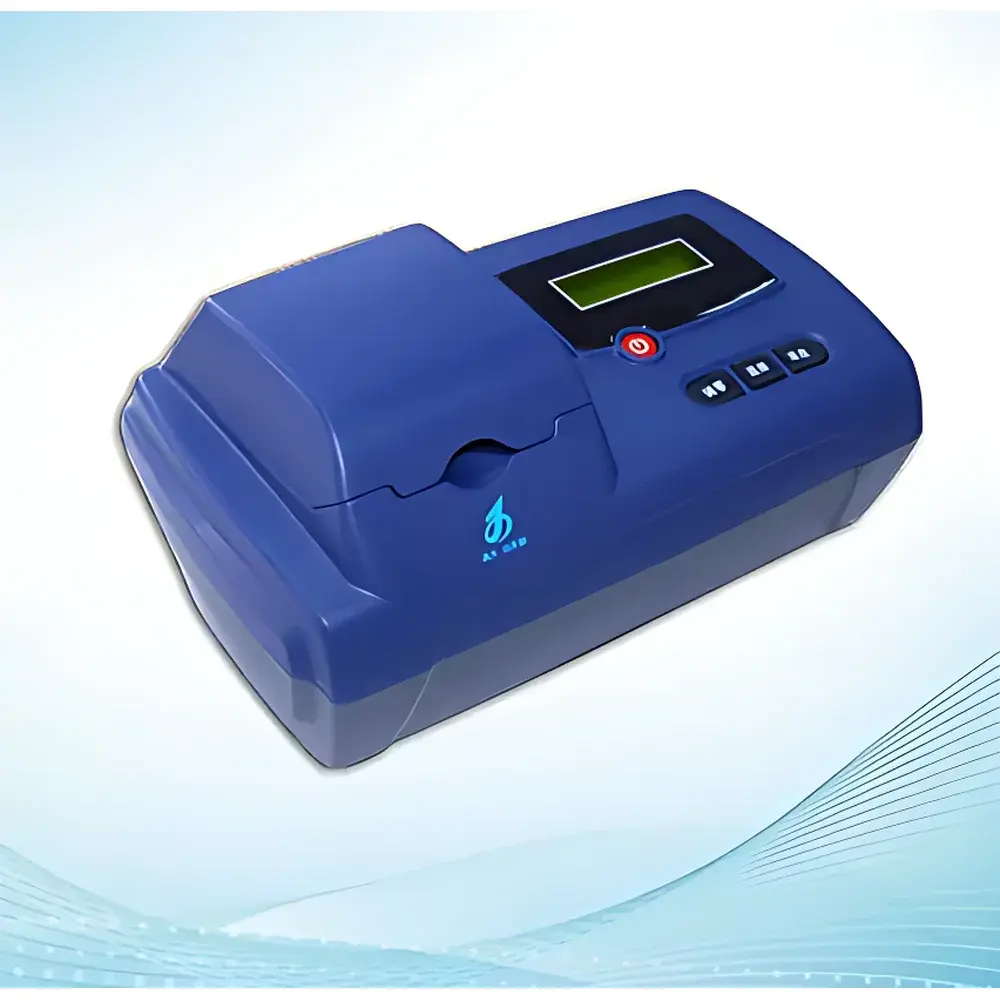
GDYS-101SP Portable pH Analyzer by Jilin University Xiaotianshe
| Brand | Jilin University Xiaotianshe |
|---|---|
| Origin | Jilin, China |
| Manufacturer Type | Direct Manufacturer |
| Origin Category | Domestic (China) |
| Model | GDYS-101SP |
| Pricing | Available Upon Request |
| Detection Limit | pH 5.50 |
| Measurement Range | pH 5.50–9.00 |
| Accuracy | ±5% of full scale |
| Analysis Time | ≤3 minutes per sample |
| Reagent Format | Single-use, pre-calibrated test kits |
Overview
The GDYS-101SP Portable pH Analyzer is a field-deployable, colorimetric water quality analyzer engineered for rapid, on-site quantitative determination of hydrogen ion activity in aqueous samples. Unlike electrochemical pH meters relying on glass electrodes and calibration buffers, this instrument implements standardized spectrophotometric detection based on pH-sensitive indicator chemistry—specifically, a buffered bromocresol green–methyl red dual-indicator system optimized for the alkaline-to-moderately acidic range. The device operates on the principle of absorbance ratio measurement at two discrete wavelengths (typically ~430 nm and ~620 nm), enabling compensation for turbidity, color interference, and minor reagent batch variation. Designed for routine monitoring in resource-constrained or mobile settings, it delivers traceable, reproducible results without requiring stable power supply, temperature-controlled environments, or skilled electrochemical maintenance.
Key Features
- Field-optimized optical architecture: Integrated LED light source, precision interference filters, and silicon photodiode detector ensure stable photometric performance across ambient temperatures from 5 °C to 40 °C.
- Single-use, factory-preloaded reagent cartridges: Each GDYS-101SP test kit contains lyophilized indicator mixture, buffer matrix, and stabilizers in sealed, moisture-resistant vials—eliminating manual reagent preparation and minimizing operator error.
- Three-minute analysis cycle: Sample introduction, reagent dissolution, reaction incubation, and digital readout are completed within ≤180 seconds, supporting high-throughput screening during emergency response or routine surveillance.
- Calibration traceability: Instrument firmware includes embedded reference absorbance curves validated against NIST-traceable pH standard solutions (pH 5.50, 7.00, and 9.00), with optional user verification using certified secondary standards.
- Ruggedized housing: IP65-rated polycarbonate enclosure with rubberized grip and shock-absorbing corners meets IEC 60529 requirements for portable environmental instrumentation used in outdoor, industrial, or wastewater infrastructure sites.
Sample Compatibility & Compliance
The GDYS-101SP is validated for use with clarified or low-turbidity aqueous matrices, including distilled water, potable water, municipal tap water, surface water (rivers, lakes, reservoirs), and pre-treated wastewater effluents. Samples with suspended solids >50 mg/L or dissolved organic carbon >15 mg/L require centrifugation or membrane filtration (0.45 µm) prior to analysis. The method complies with the analytical principles outlined in ISO 10523:2008 (Water quality — Determination of pH) for colorimetric alternatives, and supports documentation requirements under ISO/IEC 17025:2017 for testing laboratories. While not an electrochemical primary standard, its performance characteristics meet the data quality objectives specified in US EPA Method 150.1 for field-based pH screening in non-regulated monitoring programs.
Software & Data Management
Data acquisition and reporting are handled via the embedded microcontroller firmware (v3.2+), which stores up to 500 test records—including date/time stamp, sample ID, measured pH value, confidence flag (based on signal-to-noise ratio), and operator code. Export is supported via USB-C interface to CSV-formatted files compatible with LIMS platforms (e.g., LabWare, Thermo Fisher SampleManager). Audit trail functionality logs all calibration events, firmware updates, and user-initiated resets in accordance with GLP principles. No cloud connectivity or proprietary software installation is required; raw absorbance values and internal diagnostic codes remain accessible for technical review upon request.
Applications
- Emergency response teams assessing acid mine drainage or post-spill water conditions where electrode-based systems risk fouling or drift.
- Municipal drinking water utilities conducting daily distribution system checks at remote sampling points lacking AC power.
- Environmental consultants performing baseline surveys of wetlands, springs, or agricultural runoff where rapid pH stratification mapping is needed.
- Educational institutions utilizing the GDYS-101SP in undergraduate environmental chemistry labs to demonstrate fundamental acid–base equilibria and method validation concepts.
- Industrial pretreatment facilities verifying neutralization efficiency prior to discharge into municipal sewer networks—aligned with local wastewater ordinance pH limits (typically pH 6.0–9.0).
FAQ
Does the GDYS-101SP replace laboratory-grade pH meters for regulatory compliance reporting?
No. It is intended for screening, trend analysis, and preliminary assessment—not for definitive compliance certification under EPA NPDES permits or ISO 17025-accredited testing.
Can the instrument measure samples below pH 5.50 or above pH 9.00?
No. Its optical detection window and indicator pKa profile are strictly limited to pH 5.50–9.00. Outside this range, color transition is incomplete or non-linear, violating Beer–Lambert assumptions.
Are reagent kits certified for shelf life and stability?
Yes. Each batch undergoes accelerated aging (40 °C/75% RH for 90 days) and is assigned a 24-month shelf life from manufacture date when stored at 2–8 °C in original packaging.
Is third-party verification data available for method accuracy?
Yes. Interlaboratory validation studies conducted per ISO 5725-2:2019 are available upon formal request and include repeatability (r = 0.12 pH units) and reproducibility (R = 0.28 pH units) statistics.
What maintenance is required beyond reagent replacement?
Annual optical path cleaning with isopropyl alcohol and lint-free swabs, plus biannual verification using supplied pH 7.00 reference standard—documented in the included Maintenance Logbook.







