
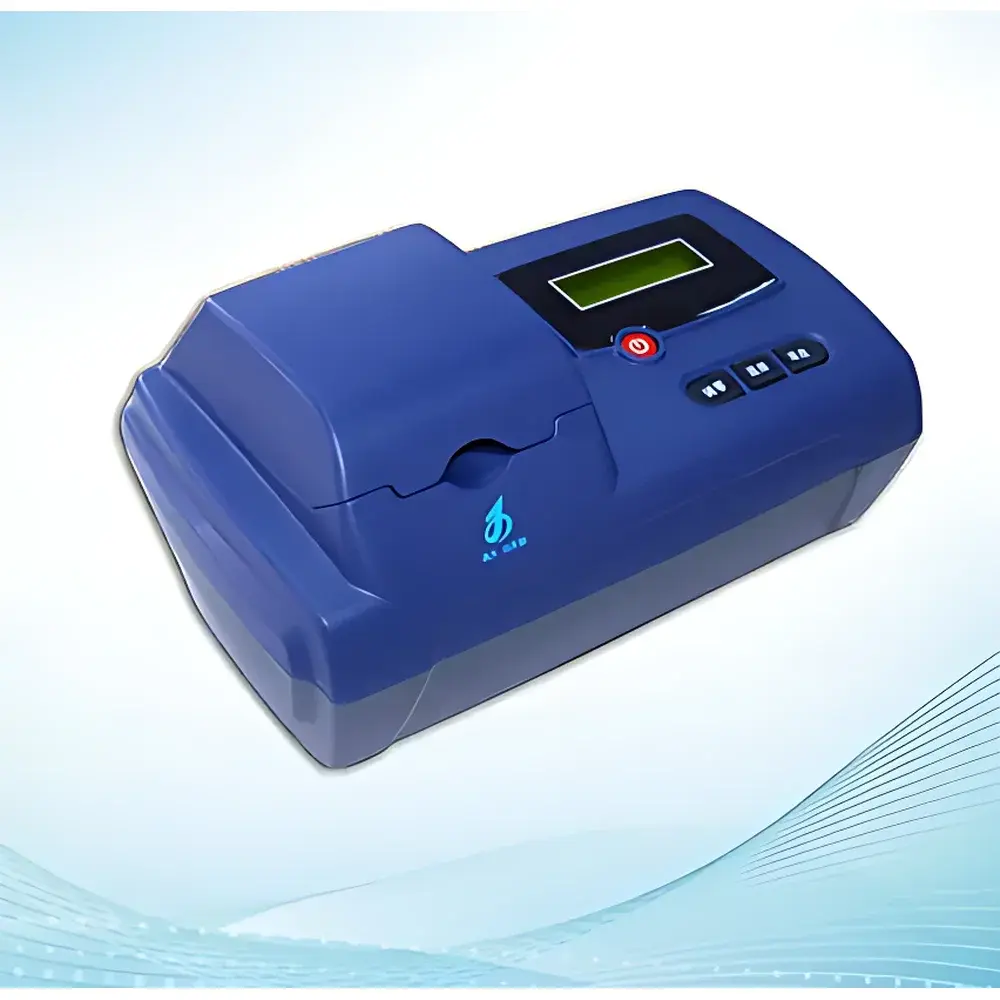
GDYS-101ST Iron Analyzer by Jilin University Xiaotian’e
| Brand | Jilin University Xiaotian’e |
|---|---|
| Origin | Jilin, China |
| Manufacturer Type | Direct Manufacturer |
| Origin Category | Domestic (China) |
| Model | GDYS-101ST |
| Pricing | Upon Request |
| Detection Limit | 0.1 mg/L |
| Measurement Range | 0.0–3.0 mg/L |
| Accuracy | ±5% |
| Method Standard | GB/T 5750.6–2006 |
Overview
The GDYS-101ST Iron Analyzer is a portable, field-deployable photometric analyzer engineered for rapid, quantitative determination of total dissolved iron (Fe²⁺ and Fe³⁺) in drinking water, surface water, groundwater, and treated wastewater. It operates on the principle of colorimetric analysis using the 1,10-phenanthroline method—a spectrophotometric technique standardized under GB/T 5750.6–2006, which is fully aligned with international equivalents such as ISO 6332:1981 (Water quality — Determination of iron — 1,10-phenanthroline spectrophotometric method) and APHA Standard Method 3500-Fe B. In this process, ferrous ions form an orange-red complex with 1,10-phenanthroline under controlled pH conditions; the absorbance of the resulting solution is measured at 510 nm using a built-in LED-based optical system. The instrument’s microprocessor correlates absorbance to concentration via a pre-calibrated curve, delivering results in mg/L within 30 minutes—without requiring laboratory infrastructure or skilled spectroscopists.
Key Features
- Field-ready design with integrated reagent kit storage, ruggedized housing (IP65-rated), and battery-powered operation (≥8 hours continuous use)
- Pre-programmed calibration curve compliant with GB/T 5750.6–2006, traceable to NIST-certified iron standard solutions
- Dual-wavelength photometric detection (510 nm measurement + reference channel) to minimize turbidity and matrix interference
- On-device data logging for up to 500 test records, each timestamped and associated with sample ID and operator code
- Self-diagnostic routines including LED intensity verification, blank stability check, and cuvette alignment validation
- No external PC or software required for routine operation—results displayed directly on high-contrast LCD with backlight
Sample Compatibility & Compliance
The GDYS-101ST accepts raw or filtered aqueous samples with turbidity ≤5 NTU and chloride concentration <200 mg/L. For high-turbidity or high-chloride matrices (e.g., seawater-influenced estuaries or industrial effluents), optional pretreatment protocols—including centrifugation, membrane filtration (0.45 µm), or ascorbic acid reduction—are supported per GB/T 5750.6–2006 Annex A. The analyzer meets the performance criteria for field instrumentation outlined in ISO/IEC 17025:2017 (Clause 7.2.2) when operated under documented SOPs. Its methodology satisfies regulatory reporting requirements for iron under China’s GB 5749–2022 (Hygienic Standard for Drinking Water) and is routinely accepted in municipal water utility QA/QC programs. While not FDA 21 CFR Part 11–compliant out-of-the-box, audit trails and electronic records can be exported in CSV format for integration into validated LIMS environments supporting GLP/GMP workflows.
Software & Data Management
Data export is performed via USB-C interface to standard mass-storage devices or Windows/macOS computers. Exported files include sample ID, date/time stamp, measured absorbance, calculated concentration, operator code, and QC flag status (e.g., “blank drift exceeded threshold”). Firmware updates are delivered through signed binary packages verified via SHA-256 checksum. No cloud connectivity or remote telemetry is embedded—ensuring full data sovereignty and compatibility with air-gapped laboratory networks. Calibration verification reports and daily system suitability checks can be printed via optional thermal printer module (GDYS-PRN1), generating hard-copy documentation suitable for internal audits and regulatory inspections.
Applications
- Routine monitoring of iron levels in municipal drinking water distribution systems to prevent red-water complaints and pipe corrosion assessment
- Field screening of groundwater sources during wellfield characterization and remediation site assessments
- Compliance verification for iron discharge limits in industrial wastewater permits (e.g., electroplating, mining, and metal finishing facilities)
- Educational use in environmental science laboratories for teaching standardized wet-chemistry analytical methods
- Emergency response deployment following pipeline breaks or natural disasters where rapid iron leaching from corroded infrastructure must be assessed
FAQ
What sample volume is required for analysis?
A minimum of 10 mL of homogenized, unacidified water sample is required. Pre-filtration through a 0.45 µm membrane syringe filter is recommended for turbid or particulate-laden samples.
Can the GDYS-101ST distinguish between ferrous (Fe²⁺) and ferric (Fe³⁺) iron?
No—it measures total soluble iron after reduction of Fe³⁺ to Fe²⁺ using hydroxylamine hydrochloride, as specified in GB/T 5750.6–2006 Section 5.2. Speciation requires complementary techniques such as HPLC-ICP-MS or sequential extraction protocols.
Is reagent lot traceability supported?
Yes. Each reagent kit includes a QR-coded label linking to a digital certificate of analysis (CoA), listing batch number, expiration date, certified iron standard value, and uncertainty budget (k=2).
How often must the instrument be recalibrated?
Calibration verification using a mid-range standard (1.5 mg/L Fe) is required before each testing session. Full multi-point calibration is recommended every 30 days or after reagent lot change, whichever occurs first.







