
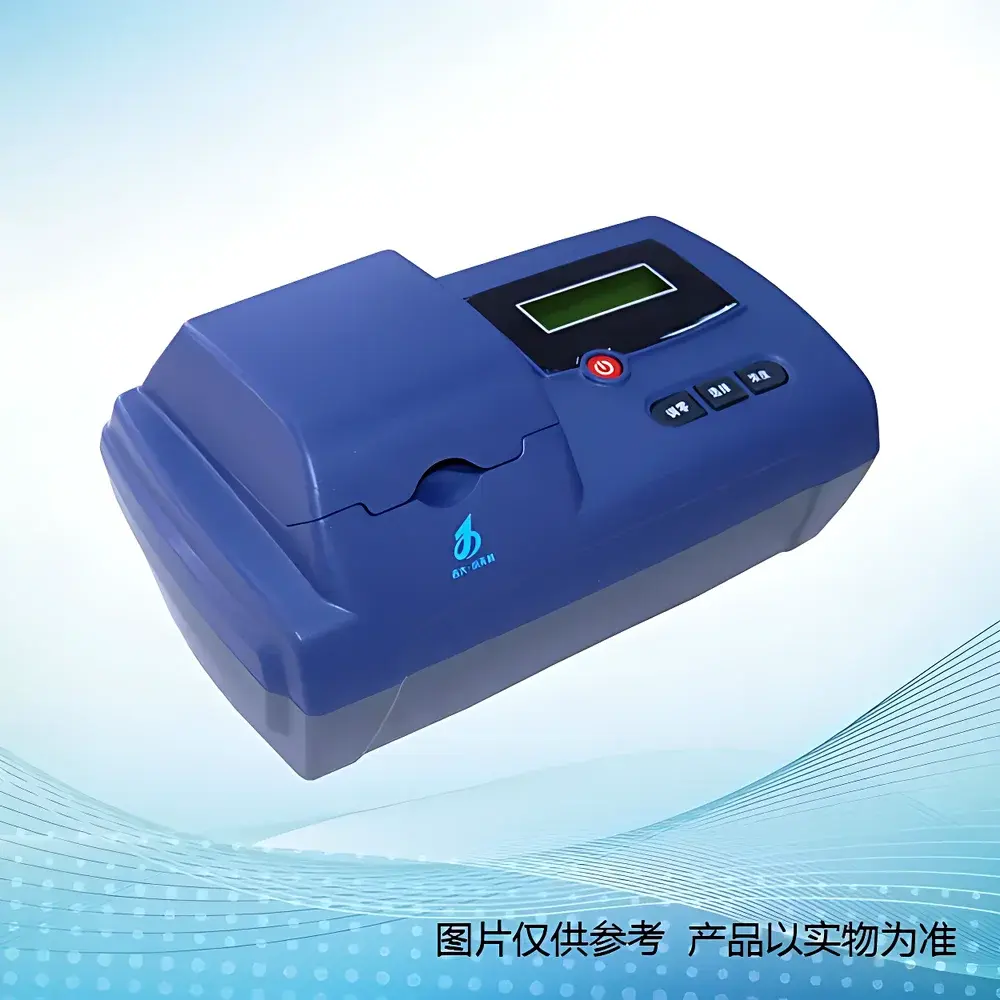
GDYS-102SH2 Portable Sulfate Analyzer by Jilin University Xiaotian’e
| Brand | Jilin University Xiaotian’e |
|---|---|
| Origin | Jilin, China |
| Manufacturer Type | Direct Manufacturer |
| Regional Classification | Domestic (China) |
| Model | GDYS-102SH2 |
| Instrument Type | Portable / Handheld Water Quality Analyzer |
| Measured Parameter | Sulfate |
| Detection Limit | 2.0 mg/L |
| Measurement Range | 0.0–20.0 mg/L |
| Accuracy | ±5% |
| Analysis Time | ≤5 minutes |
| Reagent Format | Single-use, pre-packaged test kit |
Overview
The GDYS-102SH2 Portable Sulfate Analyzer is an engineered field-deployable instrument designed for rapid, on-site quantification of sulfate (SO₄²⁻) in aqueous samples using a standardized colorimetric method based on barium chloride turbidimetry. This principle relies on the stoichiometric precipitation of sulfate ions with barium chloride under controlled acidic conditions, forming insoluble barium sulfate (BaSO₄), whose turbidity is directly proportional to sulfate concentration and measured photometrically at 420 nm. The system integrates optical detection, temperature-compensated signal processing, and embedded calibration logic—enabling reliable quantification without laboratory infrastructure. It is intended for routine monitoring in municipal drinking water distribution systems, surface water assessment, groundwater screening, and wastewater effluent verification where regulatory or operational thresholds for sulfate (e.g., WHO guideline value of 250 mg/L, EPA secondary standard of 250 mg/L, or local limits for taste/corrosion control) require frequent verification.
Key Features
- Field-ready handheld design with integrated optical path, LED light source, and silicon photodiode detector optimized for 420 nm absorbance/turbidity measurement
- Pre-calibrated firmware supporting linear interpolation across the 0.0–20.0 mg/L range, traceable to NIST-traceable sulfate reference standards
- Single-use, lyophilized reagent kits housed in sealed aluminum foil pouches—each containing precisely dosed barium chloride, hydrochloric acid, and stabilizers to ensure batch-to-batch consistency and shelf stability (>18 months at 4–30 °C)
- Automated timing sequence: sample aspiration, reagent addition, mixing, reaction incubation (exactly 5 min), and photometric readout—all initiated via single-button operation
- Backlit LCD display with real-time numerical output in mg/L SO₄²⁻, unit auto-conversion capability (ppm), and pass/fail indicator relative to user-defined threshold
- Rugged ABS housing rated IP65 for dust and water jet resistance; operating ambient range: 5–40 °C, <85% RH non-condensing
Sample Compatibility & Compliance
The GDYS-102SH2 accepts clarified, non-turbid water samples with total suspended solids (TSS) <5 mg/L and free chlorine 5 mg/L), silicate (>10 mg/L), or heavy metals (e.g., Fe³⁺ > 2 mg/L) may suppress turbidity formation and necessitate matrix-matched calibration or pretreatment. The analyzer conforms to ISO 9297:2000 (Water quality — Determination of sulfate — Turbidimetric method) and supports GLP-compliant documentation when paired with optional external thermal printer (model XP-200). All reagents are classified as non-hazardous under UN GHS criteria and comply with REACH Annex XIV exemption status.
Software & Data Management
Data logging is supported via built-in memory storing up to 500 test records—including date/time stamp, measured value, operator ID (user-input), and environmental temperature. Export is enabled through micro-USB interface to PC using proprietary Windows-compatible software (Xiaotian’e DataLink v3.2), which generates CSV reports compliant with LIMS import protocols. Audit trail functionality includes tamper-evident timestamps, user login history, and firmware revision tracking—meeting foundational requirements for FDA 21 CFR Part 11 alignment in non-GMP environmental monitoring contexts. Calibration verification checks are prompted every 30 measurements or upon power-on reset.
Applications
- Verification of sulfate removal efficiency in ion exchange or reverse osmosis desalination units
- Compliance screening against national drinking water standards (e.g., GB 5749–2022, US EPA 813-B-95-002)
- Corrosion potential assessment in district heating networks and cooling tower circuits
- Baseline sulfate profiling during watershed health surveys and agricultural runoff studies
- Emergency response testing following industrial spill incidents involving sulfuric acid or gypsum leaching
- Educational use in environmental science laboratories for method validation exercises
FAQ
What is the recommended sample volume?
A precise 10.0 mL aliquot is required—delivered via supplied volumetric pipette to ensure metrological consistency.
Can the instrument measure sulfate in seawater?
No—high ionic strength and chloride interference exceed method validity; use IC or ICP-MS for saline matrices.
Is periodic recalibration required?
Factory calibration remains stable for 12 months; annual verification with certified sulfate standard (10.0 mg/L) is advised.
How is reagent lot variability managed?
Each kit includes a QR-coded lot-specific calibration curve embedded in the instrument’s firmware upon scanning.
Does the analyzer support multi-parameter testing?
No—it is dedicated exclusively to sulfate; Xiaotian’e offers separate analyzers for nitrate, fluoride, hardness, and residual chlorine.







