
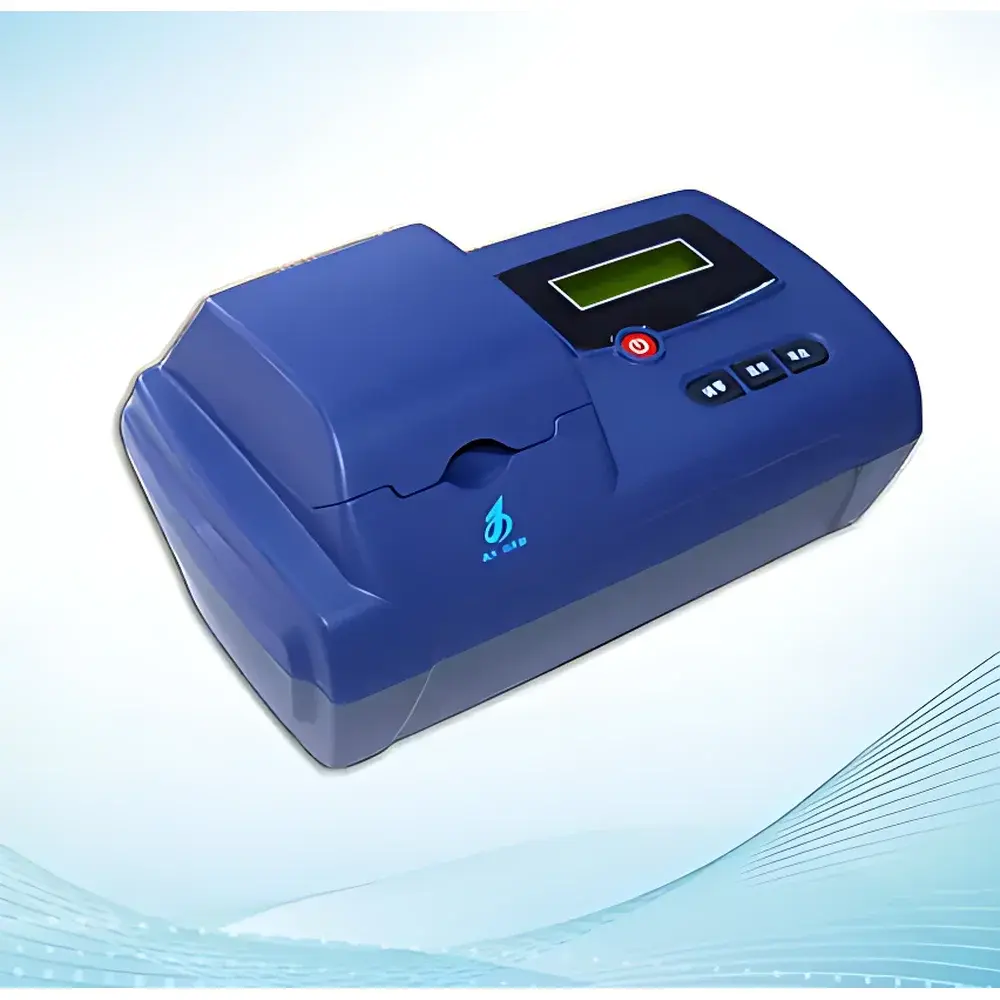
GDYS-102SN Copper Analyzer by Jilin University Xiaotian’e
| Brand | Jilin University Xiaotian’e |
|---|---|
| Origin | Jilin, China |
| Manufacturer Type | Direct Manufacturer |
| Origin Category | Domestic (China) |
| Model | GDYS-102SN |
| Pricing | Available Upon Request |
| Detection Limit | 0.05 mg/L |
| Measurement Range | 0.00–1.00 mg/L |
| Accuracy | ±5% |
| Analysis Time | ≤3 minutes |
| Reagent Format | Single-use, pre-packaged test kit |
Overview
The GDYS-102SN Copper Analyzer is a portable, field-deployable photometric analyzer engineered for rapid, quantitative determination of dissolved copper (Cu²⁺) in water samples. It operates on the principle of colorimetric analysis using a highly selective chromogenic reagent—bathocuproine disulfonate or a structurally analogous copper-specific ligand—that forms a stable, orange-red complex with Cu²⁺ ions under controlled pH conditions. The intensity of the resulting color, measured at a defined wavelength (typically 450–490 nm), is directly proportional to copper concentration and quantified via calibrated absorbance interpolation. Designed specifically for compliance-driven environmental monitoring, this instrument meets the functional requirements of routine surveillance in drinking water distribution systems, wastewater effluent streams, surface water bodies, and industrial process water loops where copper contamination poses ecological or regulatory concern.
Key Features
- Field-ready operation: No external power supply required—operates on standard AA batteries with >200 tests per charge cycle.
- Three-minute analysis time: From sample introduction to digital concentration readout, enabling high-throughput screening during emergency response or routine patrol.
- Integrated optical path: Fixed-wavelength LED light source and silicon photodiode detector ensure long-term photometric stability without recalibration between batches.
- Pre-calibrated single-use reagent kits: Each sealed foil pouch contains lyophilized reagents, buffer tablets, and reaction vials—eliminating pipetting errors, cross-contamination, and lot-to-lot variability.
- Digital display with auto-zeroing: Backlit LCD shows concentration in mg/L with automatic blank subtraction and unit conversion capability (e.g., µg/L, ppm).
- Ruggedized housing: IP65-rated enclosure resists dust, moisture, and incidental impact—suitable for outdoor deployment in municipal pumping stations, riverbanks, or treatment plant perimeters.
Sample Compatibility & Compliance
The GDYS-102SN accepts raw, filtered, or clarified aqueous samples—including tap water, groundwater, treated wastewater, and freshwater matrices—with minimal pretreatment. Turbidity up to 5 NTU and chloride concentrations below 200 mg/L do not interfere with measurement integrity. For high-ionic-strength or chelated-copper samples (e.g., those containing EDTA or NTA), acid digestion (HNO₃, 1:1 v/v, 95 °C, 15 min) followed by neutralization is recommended prior to analysis. While not certified to ISO/IEC 17025, the method aligns with the foundational principles of EPA Method 200.7 (ICP-OES) and ASTM D1688-22 (Copper in Water by Colorimetry), and supports data traceability required under GLP and basic GMP frameworks for non-pharmaceutical environmental QA/QC programs.
Software & Data Management
The GDYS-102SN is a standalone hardware platform with no embedded Bluetooth, USB, or cloud connectivity. All measurements are stored locally in non-volatile memory (up to 500 records), each timestamped and tagged with operator ID (manually entered). Data export requires manual transcription or optional IR-printer interface (sold separately). Though lacking FDA 21 CFR Part 11-compliant audit trails, the device supports paper-based record retention compliant with ISO 17025 Clause 7.11 and China’s HJ/T 91-2019 technical specifications for environmental monitoring data management.
Applications
- Drinking water safety verification at point-of-entry and point-of-use locations per WHO guideline value (2 mg/L) and GB 5749-2022 (1.0 mg/L).
- Monitoring copper leaching from brass fittings, copper pipes, or heat exchangers in building plumbing systems.
- Effluent compliance checks against local discharge limits (e.g., China’s Integrated Wastewater Discharge Standard GB 8978-1996 Class I limit: 0.5 mg/L).
- Field assessment of mining-impacted streams and sediment pore water where bioavailable Cu poses toxicity risk to aquatic biota.
- Educational use in university environmental science labs for method validation exercises and inter-laboratory comparison studies.
FAQ
What sample volume is required for one test?
Exactly 10.0 mL of well-mixed water sample is drawn using the supplied volumetric syringe.
Can the instrument measure copper in seawater?
No—high chloride and sodium concentrations cause significant interference; use ICP-MS or graphite furnace AAS for marine matrices.
How often must the instrument be calibrated?
Factory calibration remains valid for 12 months; users perform a daily blank check and verify linearity annually using NIST-traceable Cu standard solutions (0.1 and 0.5 mg/L).
Are reagent kits compatible with other models?
No—GDYS-102SN reagent kits are chemically and geometrically optimized for this specific optical path and timing protocol; cross-model use invalidates accuracy claims.
Does the analyzer detect total copper or only free Cu²⁺?
It measures acid-soluble copper species present after the standardized reagent reaction—effectively reporting “labile” or “readily available” copper, not total recoverable copper per EPA 200.2 unless preceded by hot acid digestion.
Related Products







