
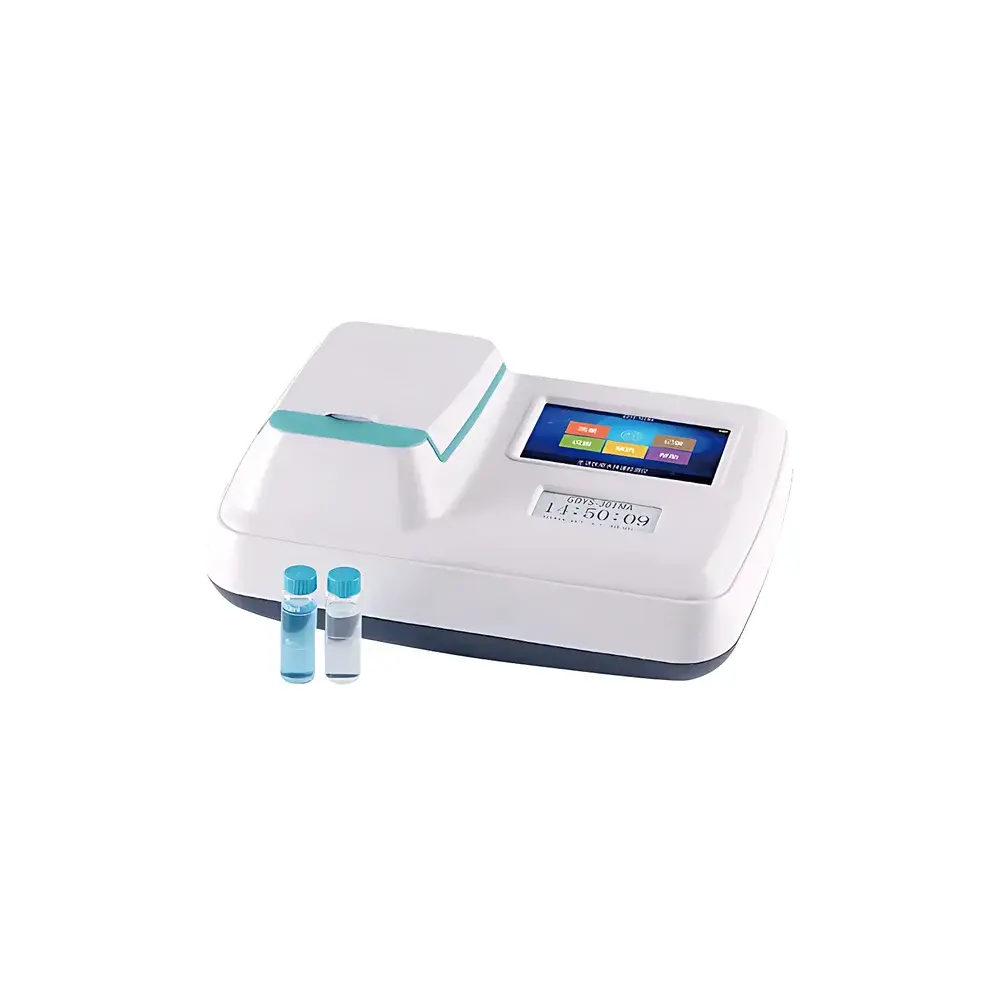
GDYS-301MA Portable Water Quality Analyzer by Jida Xiaotian’e
| Brand | Jida Xiaotian'e |
|---|---|
| Origin | Jilin, China |
| Model | GDYS-301MA |
| Instrument Type | Portable/HANDHELD Water Quality Analyzer |
| Measurable Parameters | Free Chlorine, Total Chlorine, Ozone, Fluoride, Ammonia Nitrogen |
| Display | 5-inch Color Touchscreen + 2.9-inch E-Ink Screen |
| Calibration | Pre-loaded Calibration Curves (No Standard Solution Preparation Required) |
| Data Storage | Up to 10,000 Test Records with Conditional Search |
| Connectivity | Bluetooth for Wireless Printing |
| Compliance Context | Designed for field-deployable compliance screening per GB/T 5750 (China’s Standard Methods for Examination of Drinking Water), supports GLP-aligned data traceability |
Overview
The GDYS-301MA Portable Water Quality Analyzer is an integrated, field-deployable photometric instrument engineered for rapid, on-site quantification of critical disinfectant and nutrient parameters in drinking water and raw water sources. It operates on the principle of spectrophotometric analysis—specifically, colorimetric reaction kinetics coupled with fixed-wavelength absorbance measurement (typically at 510 nm for DPD-based chlorine assays, 630 nm for Nesslerized ammonia nitrogen, and 550 nm for SPADNS-based fluoride detection). Unlike benchtop analyzers requiring reagent standardization and multi-point calibration, the GDYS-301MA embeds factory-validated calibration curves directly into firmware, enabling direct concentration readout without manual curve fitting or external reference standards. This architecture meets operational requirements for time-sensitive deployments in municipal water distribution networks, emergency response scenarios, and routine surveillance by health inspection agencies.
Key Features
- Hybrid display interface: A 5-inch capacitive color touchscreen provides intuitive menu navigation and real-time spectral feedback, while the secondary 2.9-inch e-ink screen delivers low-power, sunlight-readable status summaries—including battery level, last test timestamp, and parameter-specific pass/fail indicators.
- Zero-standard calibration workflow: Internal calibration curves are pre-programmed for each supported analyte (free chlorine, total chlorine, ozone, fluoride, and ammonia nitrogen), eliminating the need for daily standard solution preparation and reducing operator-dependent variability.
- Robust data governance architecture: Stores up to 10,000 test records locally with metadata including date/time stamp, operator ID (user-defined), sample ID, measured value, unit, and method identifier. Records support conditional search by date range, parameter type, or numeric threshold.
- Bluetooth 4.2 LE module enables secure pairing with certified thermal printers (e.g., Zebra ZQ510, Bixolon SRP-350III) for audit-ready hardcopy output compliant with internal QA documentation protocols.
- IP67-rated enclosure with reinforced polycarbonate housing ensures operational reliability in humid, dusty, or splash-prone environments typical of wellhead sampling, reservoir monitoring, and mobile lab vehicles.
Sample Compatibility & Compliance
The GDYS-301MA accepts standard 10–25 mL water samples collected in clean polyethylene or borosilicate glass containers. Sample turbidity must remain below 5 NTU for accurate colorimetric determination; optional built-in turbidity compensation is not provided, necessitating pre-filtration via 0.45 µm membrane filters when analyzing surface water or groundwater with suspended solids. Methodologically, the analyzer aligns with Chinese national standard GB/T 5750.11–2006 (for residual chlorine), GB/T 5750.5–2006 (for ammonia nitrogen), and GB/T 5750.10–2006 (for fluoride), serving as a field-screening tool rather than a definitive regulatory reference method. While not certified to ISO/IEC 17025 or EPA Method 334.0, its performance characteristics support Tier-2 verification under WHO Guidelines for Drinking-water Quality (4th ed.) and provincial-level public health surveillance frameworks.
Software & Data Management
Firmware v3.2.1 supports over-the-air (OTA) updates via USB-C connection and includes encrypted local storage with SHA-256 hash integrity checks per record. Export functionality is limited to CSV format via USB mass storage mode—no cloud synchronization or remote database upload is implemented, preserving data sovereignty for government and institutional users. Audit trail capabilities include immutable timestamps, firmware version logging, and automatic detection of abnormal sensor drift (triggered by >15% deviation from historical baseline absorbance at zero-concentration blank). The system does not implement FDA 21 CFR Part 11 electronic signature controls but maintains GLP-aligned metadata sufficient for internal quality audits.
Applications
- Routine verification of chlorine residual at water treatment plant effluent points and distribution system dead-ends.
- Field assessment of ammonia nitrogen in source water during algal bloom events or agricultural runoff incidents.
- Emergency response testing following natural disasters (e.g., floods, earthquakes) where rapid disinfectant validation is required prior to boil-water advisories.
- Contract laboratory support for municipal utilities conducting quarterly compliance spot-checks per local health code.
- Educational use in environmental science curricula for hands-on instruction in colorimetric assay principles and field analytical methodology.
FAQ
Does the GDYS-301MA require annual recalibration by an accredited service provider?
No—calibration curves are embedded in firmware and validated against NIM-traceable reference materials at time of manufacture. Users perform only daily blank verification using deionized water.
Can test results be exported to LIMS systems?
Direct LIMS integration is not supported. Data must be manually imported from exported CSV files using standardized column headers (e.g., “Sample_ID”, “Parameter”, “Result_mg_L”, “Date_YYYYMMDD”).
Is the instrument suitable for seawater or high-salinity groundwater analysis?
Not recommended. High chloride concentrations (>1000 mg/L) interfere with DPD-based chlorine assays and may saturate the photodiode detector; use is restricted to freshwater matrices per GB/T 5750 scope.
What is the operating temperature range?
10 °C to 40 °C ambient, with relative humidity ≤85% non-condensing. Battery life drops by ~35% at temperatures below 15 °C.
Are reagent kits supplied with the instrument traceable to certified reference materials?
Yes—each batch of GDYS-branded reagent tablets includes a CoA referencing CRM numbers from China National Institute of Metrology (NIM) or equivalent ISO 17034-accredited suppliers.
Related Products







