
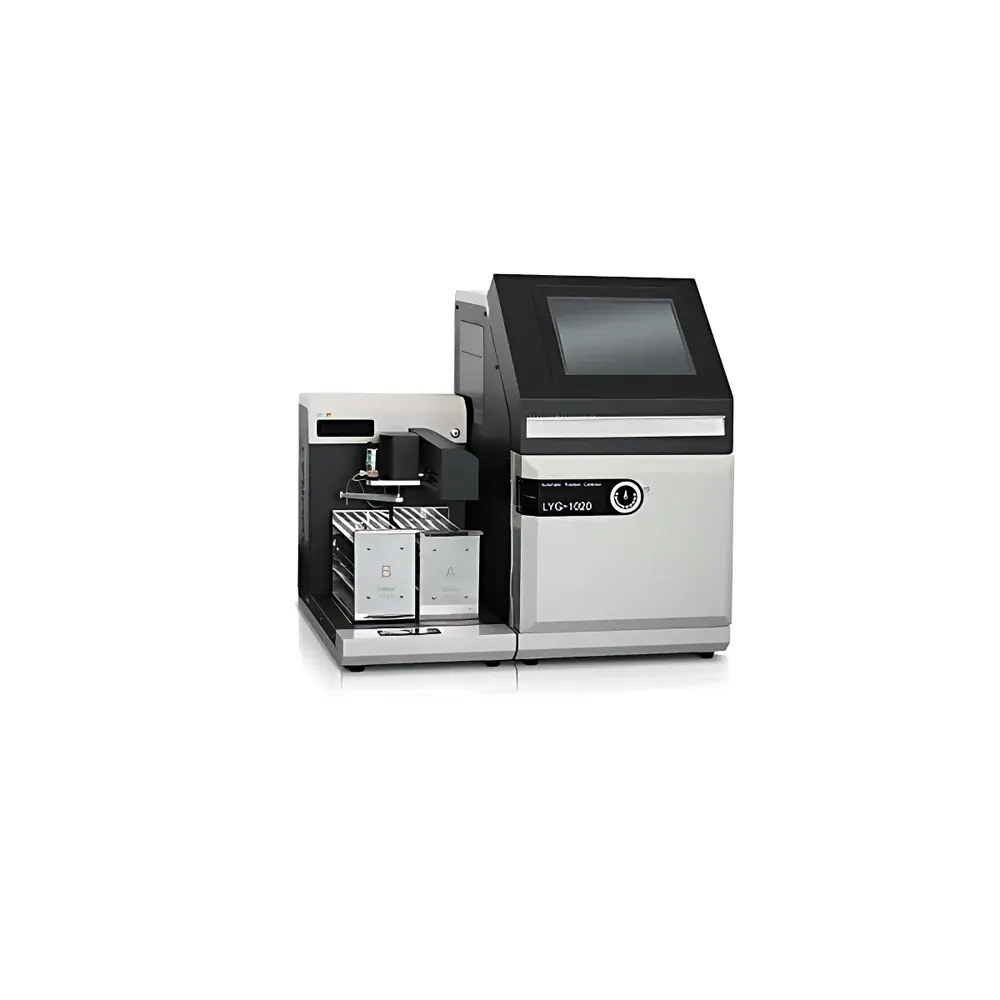
Gel Permeation Chromatography System LABORAT LYG-1020
| Brand | LABORAT |
|---|---|
| Model | LYG-1020 |
| Origin | Hebei, China |
| Instrument Type | High-Temperature GPC System |
| UV Detector Wavelength Range | 190–700 nm |
| Flow Rate (Standard) | 0.01–50.00 mL/min |
| Flow Rate (Optional High-Precision) | 0.001–10.000 mL/min |
| Auto-Sampler Volume (Standard) | 10 mL loop |
| Column Dimensions (Standard) | 25 × 400 mm |
| Fraction Collector | 5-position valve-based system (customizable) |
| Detection Light Source | Deuterium/Tungsten dual-lamp assembly |
| Software | Integrated industrial PC with audit-trail-enabled chromatography control software |
Overview
The LABORAT LYG-1020 Gel Permeation Chromatography (GPC) System is a high-temperature-capable, fully integrated analytical platform engineered for precise molecular weight distribution (MWD) characterization of synthetic polymers, natural macromolecules, and complex organic matrices. Operating on the principle of size-exclusion chromatography (SEC), the system separates analytes based on hydrodynamic volume in solution—larger molecules elute earlier while smaller species penetrate deeper into the porous stationary phase and elute later. Designed for routine QC/QA laboratories and research environments requiring regulatory-compliant data integrity, the LYG-1020 integrates all core components—including dual-piston high-flow pump, dual-wavelength UV detector, automated fraction collector, and inert column hardware—within a single, rigid chassis. Its architecture supports both ambient and elevated temperature operation (up to 80 °C), enabling enhanced resolution for thermally stable polymers such as polyolefins, polycarbonates, and styrenic copolymers.
Key Features
- Monolithic instrument design with internalized fluidic pathways, power management, and thermal control—reducing footprint, minimizing external tubing, and enhancing mechanical stability.
- High-reliability dual-plunger reciprocating pump delivering flow rates from 0.01 to 50.00 mL/min (standard); optional ultra-low-flow configuration (0.001–10.000 mL/min) enables micro-scale GPC applications and improved retention time reproducibility.
- Inert 316L stainless steel or passivated borosilicate glass purification columns with axial compression mechanism—ensuring consistent bed density, minimal channeling, and long-term column-to-column repeatability.
- Dual-wavelength UV-Vis detector equipped with deuterium and tungsten lamps, covering a continuous spectral range from 190 nm to 700 nm; supports simultaneous dual-channel detection at user-selectable wavelengths for co-elution analysis or baseline correction.
- Fraction collection via programmable 5-port switching valve with three trigger modes: time-based, threshold-based (absorbance threshold), and slope-based (derivative-triggered); manual override capability allows real-time intervention during run execution.
- Embedded industrial-grade controller running proprietary chromatography software with full Chinese-language UI—no external PC required for operation, method development, or data review.
Sample Compatibility & Compliance
The LYG-1020 accommodates a broad range of sample types including polyethylene (PE), polypropylene (PP), ethylene-propylene-diene monomer (EPDM), poly(methyl methacrylate) (PMMA), polystyrene standards, and natural rubber extracts. Compatible solvents include tetrahydrofuran (THF), chloroform, o-dichlorobenzene (ODCB), and trichlorobenzene (TCB)—all supported by chemically resistant wetted materials (316L SS, PEEK, fused silica). The system conforms to key international method frameworks including ASTM D5296 (standard test method for molecular weight averages of polystyrene by SEC), ISO 16014 (plastics—determination of average molecular weights of polymers by SEC), and USP <621> (chromatography). Audit-trail functionality meets GLP and GMP documentation requirements per FDA 21 CFR Part 11 for electronic records and signatures.
Software & Data Management
The embedded chromatography software provides complete instrument control, method setup, real-time chromatogram visualization, peak integration, calibration curve generation, and MWD calculation (Mn, Mw, Đ). All user actions—including method edits, parameter changes, and data exports—are timestamped and logged with operator ID, ensuring full traceability. Data files are stored in vendor-neutral formats (e.g., .cdf-compatible binary) and support export to CSV, PDF, and XML for LIMS integration. Software includes built-in validation tools for system suitability testing (SST), including backpressure monitoring, retention time stability assessment, and detector noise/DR evaluation.
Applications
- Quality control of polymer feedstocks and finished resins in petrochemical and plastics manufacturing.
- Characterization of degradation products in aged rubber compounds and elastomeric sealants.
- Purification and fractionation of environmental extracts (e.g., PAHs, PCBs, pesticides) prior to GC-MS or LC-MS analysis.
- Molecular weight profiling of biodegradable polyesters (e.g., PLA, PHA) under accelerated aging conditions.
- Method development and validation for pharmacopeial compliance in excipient testing (e.g., polyvinylpyrrolidone, hydroxypropyl methylcellulose).
FAQ
Is the LYG-1020 compatible with high-temperature GPC applications?
Yes—the system supports column oven temperatures up to 80 °C, enabling analysis of high-melting-point polymers in high-boiling-point solvents such as o-dichlorobenzene.
Can the UV detector be configured for single-wavelength operation?
Yes—while the standard configuration includes dual-wavelength capability, fixed-wavelength detectors (e.g., 254 nm or 280 nm) are available as factory options.
Does the software support 21 CFR Part 11 compliance?
Yes—the audit-trail module logs all critical events with immutable timestamps and user authentication, satisfying electronic record and signature requirements for regulated environments.
What column dimensions are supported out-of-the-box?
The system ships with 25 × 400 mm gel permeation columns compliant with national standard specifications; alternative lengths and internal diameters can be accommodated via custom column kits.
Is remote monitoring or network connectivity available?
The embedded controller supports Ethernet-based local network access for remote status viewing and file transfer; however, full remote control requires on-site authentication and is not enabled by default for security reasons.




