
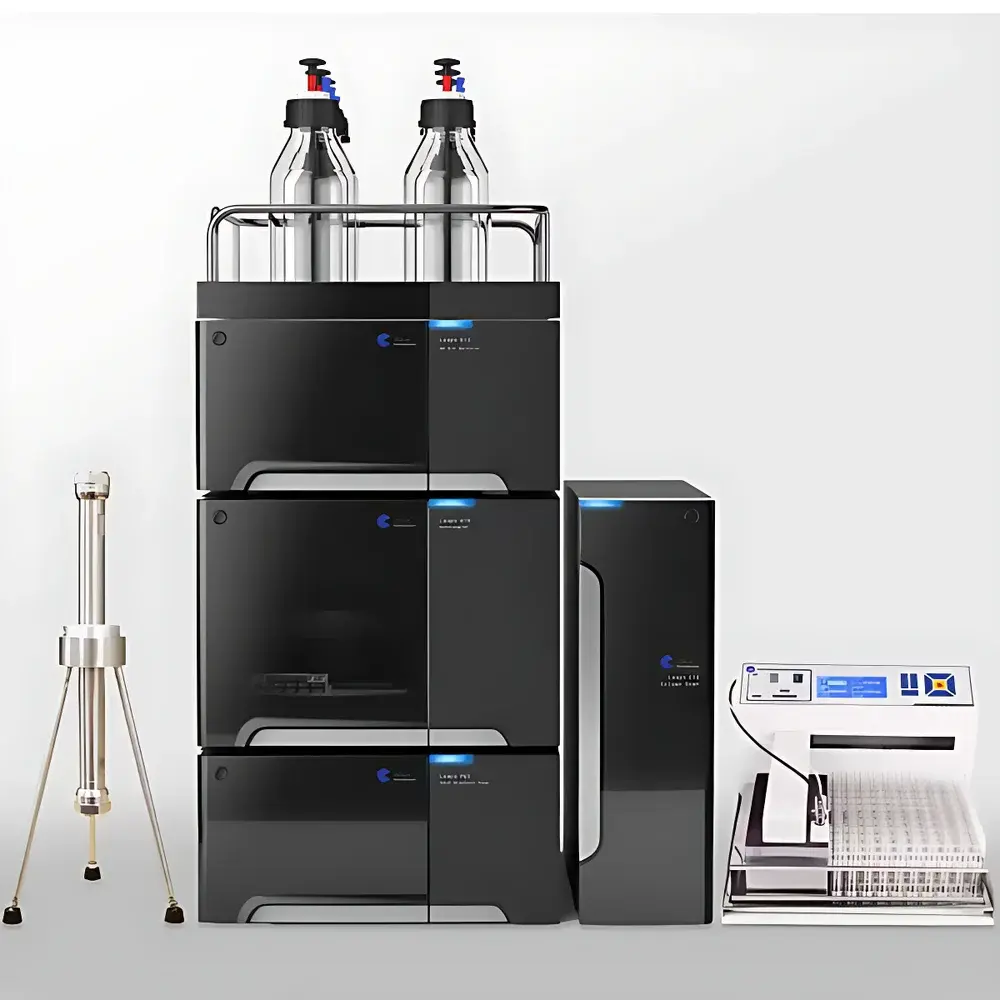
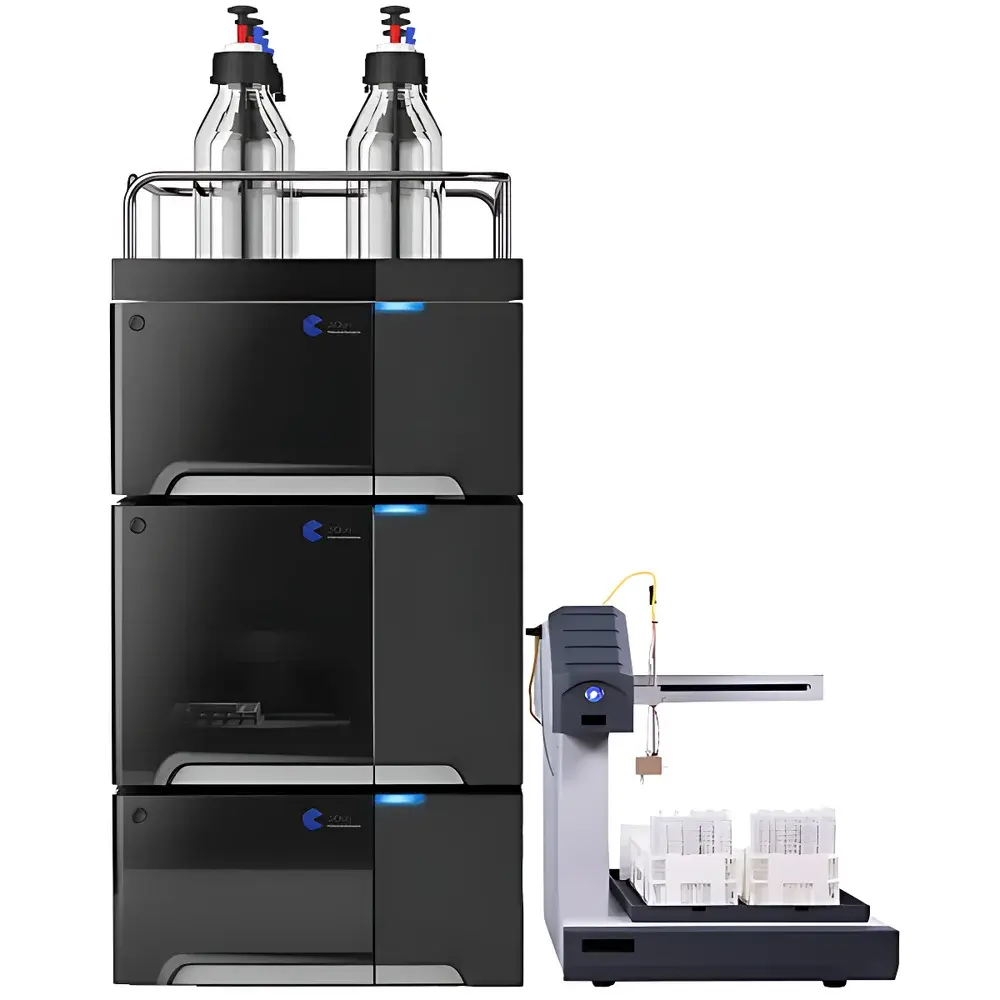
Gel Purification System JQ-HGBQ-1005
| Brand | JIQUN |
|---|---|
| Origin | Jiangsu, China |
| Model | JQ-HGBQ-1005 |
| Pump Pressure | Up to 72 MPa |
| Flow Rate Range | Up to 10 mL/min |
| UV-Vis Detector Data Acquisition Rate | 100 Hz |
| Linear Range | >2.5 AU |
| Fraction Collector Modes | Time-based, Peak-triggered, Drop-counting |
| Autosampler Precision | 0.3% RSD |
| Carryover | <0.0025% |
| Compliance | Designed for GLP-compliant laboratories |
| Software | PC-controlled with graphical sample map interface |
| Column Compatibility | Standard GPC/SEC columns (e.g., Styragel, PLgel, OHpak) |
Overview
The JQ-HGBQ-1005 Gel Purification System is a laboratory-scale gel permeation chromatography (GPC) — also known as size-exclusion chromatography (SEC) — platform engineered for automated, high-fidelity sample cleanup prior to quantitative analysis. It separates analytes from complex biological, environmental, and food matrices based on hydrodynamic volume in solution, enabling selective removal of macromolecular interferences (e.g., lipids, proteins, polymers) and low-molecular-weight contaminants (e.g., pigments, salts, residual solvents). Unlike conventional solid-phase extraction, GPC provides orthogonal selectivity rooted in molecular size rather than polarity or charge, making it indispensable for multi-residue analysis where matrix suppression and instrument fouling are critical concerns. The system operates under isocratic or gradient elution conditions using organic mobile phases (e.g., tetrahydrofuran, chloroform, or dichloromethane), and is routinely deployed in accredited testing labs conducting residue analysis per ISO 17025, EPA Method 3640A, and EU SANTE/11312/2021 guidelines.
Key Features
- High-pressure binary or quaternary solvent delivery system with programmable flow control (0.001–10.000 mL/min) and pressure capability up to 72 MPa — compatible with sub-2 µm particle-size SEC columns for enhanced resolution and throughput.
- UV-Vis detector with 100 Hz data acquisition rate, optical path length optimized for trace-level detection, and linear dynamic range exceeding 2.5 AU — suitable for monitoring both major matrix components and trace analytes in a single run.
- Intelligent fraction collector with multiple triggering modes: time-programmed, peak-threshold activated, and drop-counted collection — supporting precise cut-point definition and minimizing cross-contamination between fractions.
- Robust autosampler with dual 54-well or 96-well plate capacity, 0.3% RSD injection precision, and dual-needle wash architecture achieving <0.0025% carryover — validated for sequential analysis of hundreds of samples without manual intervention.
- Modular hardware design allows seamless integration of online solid-phase extraction (Online-SPE), column-switching valves, and optional fluorescence or mass spectrometric interfaces for method scalability.
Sample Compatibility & Compliance
The JQ-HGBQ-1005 accommodates a broad spectrum of sample types requiring clean-up prior to GC-MS, LC-MS/MS, or HPLC-UV analysis. Validated applications include pesticide residue analysis in fruits, vegetables, cereals, meat, dairy, honey, and tea; mycotoxin determination (e.g., aflatoxins in oils and milk); polycyclic aromatic hydrocarbons (PAHs) in soil and wastewater; polychlorinated biphenyls (PCBs) in effluents; and dioxin-like compounds in animal feed. All hardware components comply with CE electromagnetic compatibility (EMC) directives and are constructed from chemically resistant materials (e.g., stainless steel 316L, PEEK, sapphire windows) suitable for aggressive organic solvents. System operation supports audit trails, electronic signatures, and user-access controls aligned with FDA 21 CFR Part 11 requirements when paired with compliant LIMS or chromatography data systems (CDS).
Software & Data Management
Control and data acquisition are managed via a Windows-based software suite featuring a graphical sample map interface, real-time chromatogram visualization, and customizable fraction collection logic. Sequence methods store complete instrument parameters — pump gradients, detector wavelengths, collector trigger thresholds, and autosampler positions — ensuring full method reproducibility across operators and shifts. Raw data files adhere to AIA/ANDI standards for interoperability with third-party processing tools (e.g., Chromeleon, OpenLab CDS, MassHunter). Audit trail functionality logs all method edits, run executions, and user logins with timestamps, satisfying GLP and ISO/IEC 17025 documentation requirements. Optional report templates support automatic generation of QC summaries, calibration curves, and fraction inventory logs.
Applications
This system is routinely applied in regulatory and contract laboratories performing residue testing in accordance with AOAC Official Methods, EN 15662, and Chinese GB standards. In environmental labs, it enables reliable PAH and PCB cleanup from sediment extracts prior to GC×GC-TOFMS analysis. In food safety settings, it removes triglycerides and sterols from fatty matrices — significantly reducing ion suppression in LC-MS/MS quantitation of neonicotinoids or triazoles. In life sciences research, it serves as a preparative tool for isolating native protein complexes or synthetic polymer fractions prior to MALDI-TOF characterization. Its robustness and modularity also support method development for emerging contaminants such as microplastics leachates and PFAS precursors.
FAQ
What types of columns are compatible with the JQ-HGBQ-1005?
Standard analytical and preparative GPC/SEC columns packed with cross-linked polystyrene-divinylbenzene (PS-DVB), silica-based diol, or hydrophilic interaction media — including commercially available columns from Waters, Agilent, and Tosoh — are fully supported.
Can the system be used for both analytical and semi-preparative purification?
Yes — by adjusting flow rate, column dimensions, and fraction volume settings, the platform supports both high-resolution analytical screening and milligram-scale fraction collection for downstream identification or bioassay.
Is the software validated for regulated environments?
The base software includes configurable audit trail, electronic signature, and role-based access controls. Full 21 CFR Part 11 compliance requires deployment within a validated IT infrastructure and documented IQ/OQ/PQ protocols.
What maintenance intervals are recommended for routine operation?
Pump seals and check valves should be inspected every 500 hours of operation; UV lamp replacement is recommended every 2,000 hours; column frits and injector rotors require cleaning or replacement after 100 injections of dirty matrices.
Does the system support remote monitoring or integration with LIMS?
Yes — the software provides OPC UA and REST API endpoints for bidirectional communication with laboratory information management systems and centralized monitoring dashboards.



