
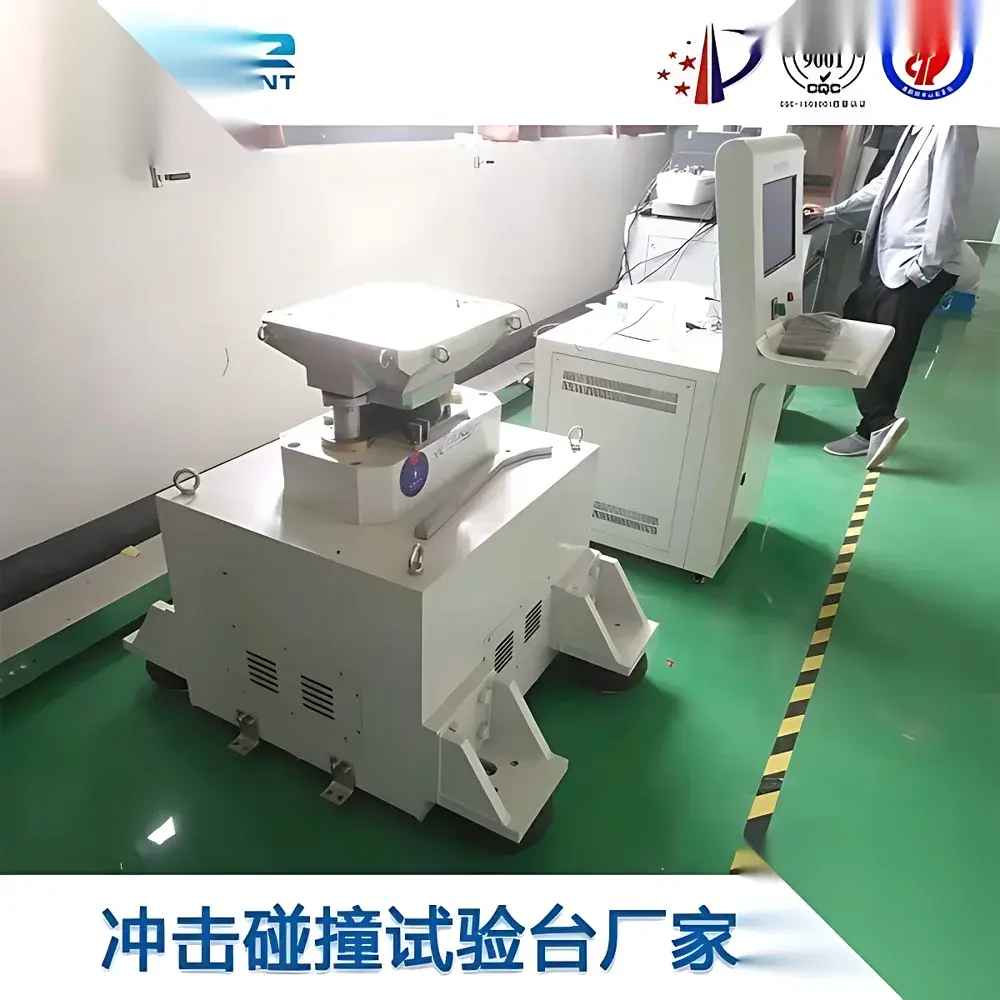
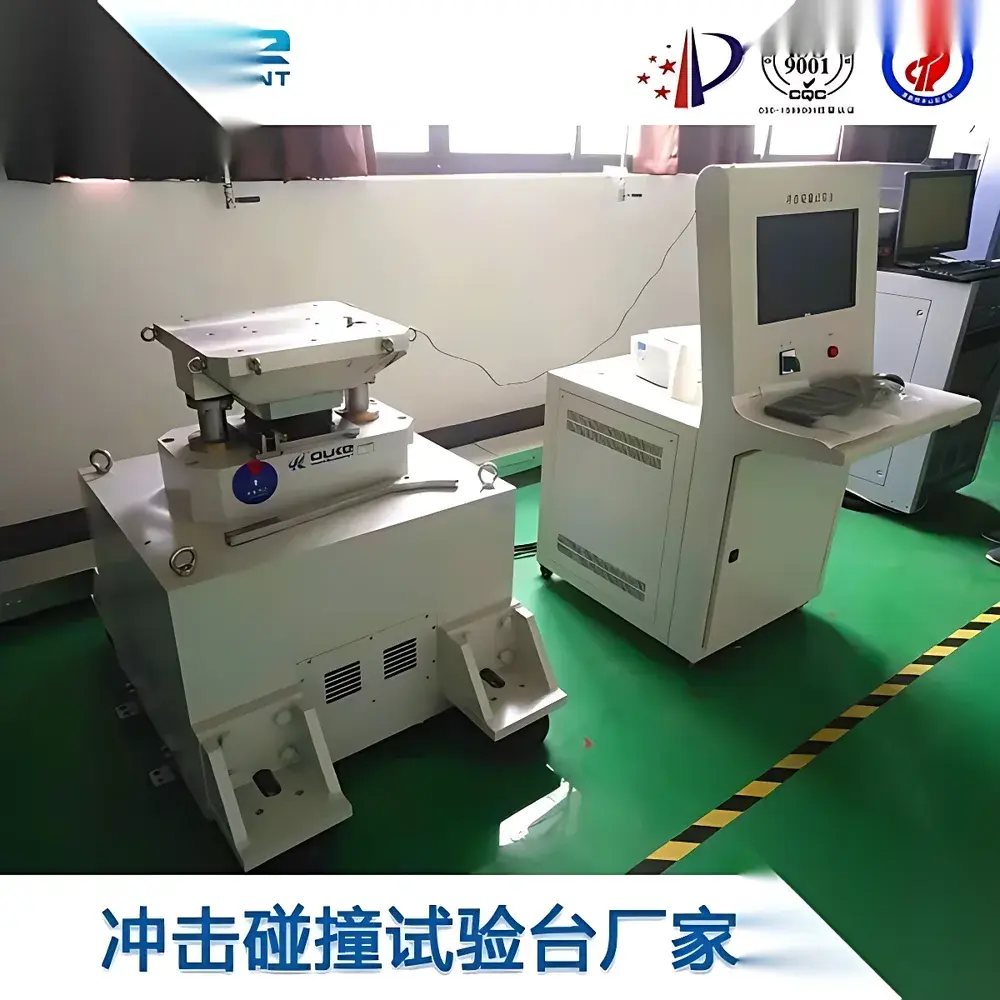
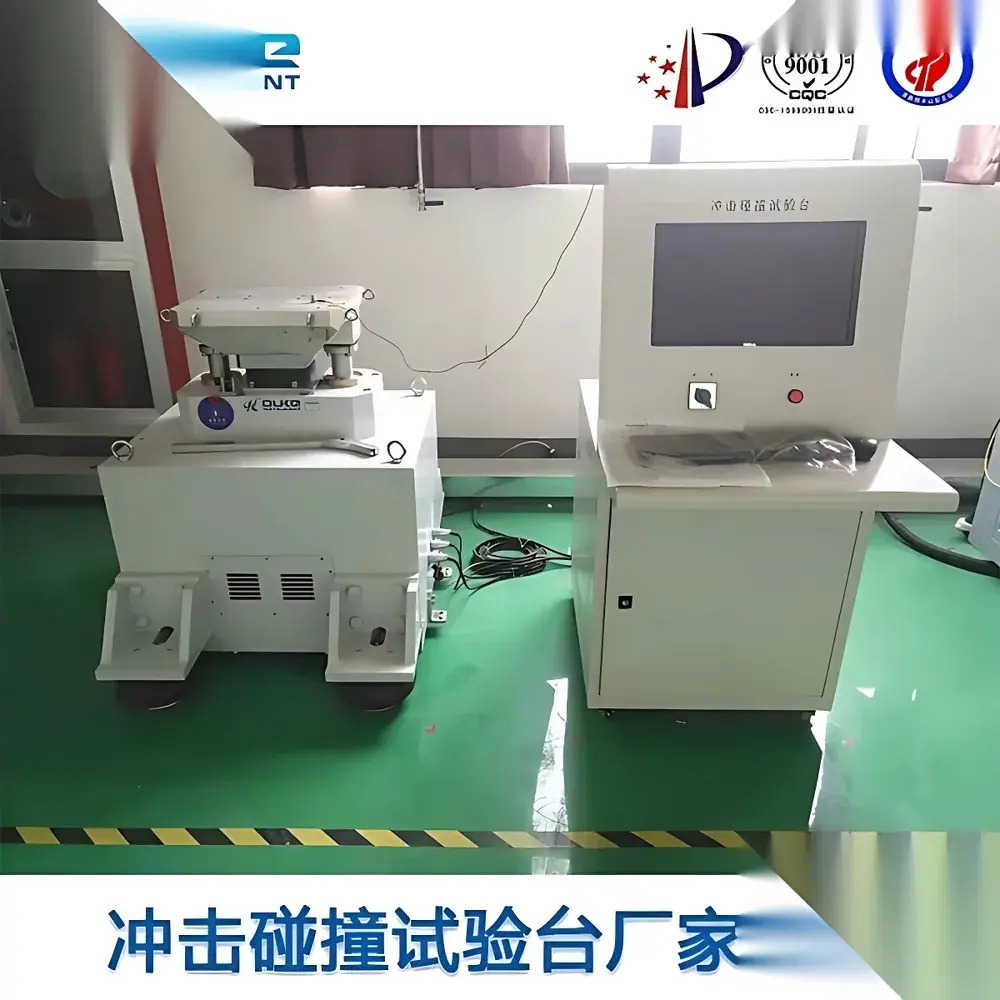
Generic Brand SHK-200 Vertical Electro-Hydraulic Shock Test Table
| Impact Table Surface | 200 × 200 mm |
|---|---|
| Maximum Load Capacity | 10 kg |
| Pulse Duration Range | 0.2–100 ms (programmable, auto-controlled) |
| Peak Acceleration Range | 50–9999 m/s² |
| Waveform Type | Half-sine |
| Shock Direction | Vertical |
| Deceleration Mechanism | Hydraulic-friction dual-stage arrestor |
| Height Adjustment | Digital preset + hydraulic lifting |
| Control & Measurement System | Integrated real-time acquisition unit |
| Frame Weight | 2800 kg |
| Dimensions (W×L×H) | 750 × 2600 × 1000 mm |
| Power Supply | AC 380 V ±10%, 50 Hz, 3 kVA |
| Repetition Rate | 0–100 shocks/min |
| Sampling Rate | 200 kHz |
| Filtering | Analog anti-aliasing + 160 dB/octave digital anti-aliasing filter |
| Compliance Standards | IEC 60068-2-27, GB/T 2423.5, GJB 150.18A, GJB 360B, JJG 497 |
| Software Platform | Windows XP-based with DAO engine, automated Word report generation, real-time display of height, acceleration amplitude, pulse width, and Δv |
Overview
The SHK-200 Vertical Electro-Hydraulic Shock Test Table is a precision-engineered mechanical shock simulation system designed for laboratory-grade qualification testing of electronic components, avionics modules, automotive ECUs, and military-grade enclosures under controlled half-sine impact conditions. Based on the classical drop-weight principle enhanced by closed-loop hydraulic actuation and digital height control, the system delivers repeatable, metrologically traceable shock pulses in strict accordance with international environmental stress screening (ESS) and reliability verification protocols. Its core architecture integrates a rigid cast-iron base frame, vertically aligned guided drop mass, and a high-damping hydraulic arrestor to eliminate secondary rebound—ensuring single-event fidelity required for compliance with MIL-STD-810H Method 516.6 and ISO 16750-3. The table operates exclusively in the vertical axis, minimizing cross-axis coupling and enabling unambiguous correlation between input pulse parameters and device-under-test (DUT) response.
Key Features
- Digitally programmable impact height with hydraulic lifting mechanism—enabling precise, reproducible energy delivery across the full acceleration range (50–9999 m/s²)
- Real-time closed-loop pulse monitoring via integrated piezoelectric accelerometer and 200 kHz sampling acquisition system
- Dual-stage hydraulic–friction deceleration system eliminating post-impact oscillation and ensuring ≤0.1% residual vibration after pulse termination
- Configurable half-sine waveform generation with user-adjustable rise/fall asymmetry (0.4D–0.1D / 0.4D–1.1D per IEC 60068-2-27 Annex B)
- Automated pulse parameter tracking: peak acceleration, pulse width (0.2–100 ms), velocity change (Δv), and zero-crossing alignment
- Robust structural design: 2800 kg reinforced steel frame with vibration-isolated foundation mounting interface
- Comprehensive signal conditioning: analog anti-aliasing filters + 160 dB/octave digital anti-aliasing processing to preserve spectral integrity up to Nyquist frequency
Sample Compatibility & Compliance
The SHK-200 accommodates test specimens up to 10 kg mounted on its 200 × 200 mm impact surface, with standardized fixture interfaces compatible with MIL-STD-1377 and IPC-J-STD-001 mounting plates. It meets or exceeds the waveform tolerance envelopes defined in IEC 60068-2-27 (Test Ea), GB/T 2423.5 (Shock), GJB 150.18A (Shock), GJB 360B (Method 213), and JJG 497 (Calibration Specification for Shock Test Systems). All pulse parameters—including acceleration amplitude, duration, and symmetry—are validated against reference calibration shocks traceable to NIM (National Institute of Metrology, China) and certified per ISO/IEC 17025. The system supports GLP-compliant audit trails when operated with calibrated transducers and timestamped data logs.
Software & Data Management
The embedded Windows XP-based control software utilizes Microsoft DAO database architecture to manage test configurations, calibration records, and raw time-series datasets. It provides real-time visualization of lift height, measured acceleration waveform, pulse width, and Δv; performs automatic waveform fitting to idealized half-sine models; and computes statistical metrics including standard deviation across multi-cycle sequences. All results are exported directly to editable Microsoft Word reports containing test header metadata, annotated waveform plots, pass/fail evaluation against selected standards, and operator signature fields. Data files adhere to IEEE 1584-compliant binary format with embedded calibration coefficients and sensor ID tagging—ensuring long-term archival integrity and regulatory readiness for FDA 21 CFR Part 11 or ISO 9001 audits.
Applications
- Qualification testing of PCB assemblies, MEMS sensors, and solder joint integrity per IPC-A-610 and JEDEC JESD22-B110
- Environmental stress screening (ESS) of aerospace flight hardware prior to thermal vacuum cycling
- Validation of packaging robustness for medical devices subject to transport shock (ASTM D4169)
- Failure mode analysis of battery management systems under mechanical abuse scenarios
- Calibration verification of accelerometers and shock recorders used in field instrumentation
- Research into dynamic material response under transient loading—e.g., polymer damping behavior, composite delamination thresholds
FAQ
What standards does the SHK-200 support out-of-the-box?
The system includes preloaded test profiles compliant with IEC 60068-2-27, GB/T 2423.5, GJB 150.18A, and JJG 497, with waveform tolerances automatically enforced during execution.
Can the system be integrated into an existing test automation framework?
Yes—the controller exposes TCP/IP and RS-232 APIs for remote command execution, status polling, and data streaming; compatible with LabVIEW, Python (PySerial), and MATLAB Instrument Control Toolbox.
Is third-party calibration documentation provided?
Each unit ships with a factory calibration certificate traceable to national metrology institutes, including sensitivity values for the onboard accelerometer and linearity verification across the full pulse duration range.
What maintenance intervals are recommended?
Hydraulic fluid replacement every 24 months; guide rail lubrication and arrestor friction pad inspection every 6 months; annual full-system metrological verification recommended.
Does the software support multi-user role-based access control?
No—the current version uses single-user Windows authentication; however, audit logs capture operator ID, timestamp, and parameter changes for internal QA review.



