
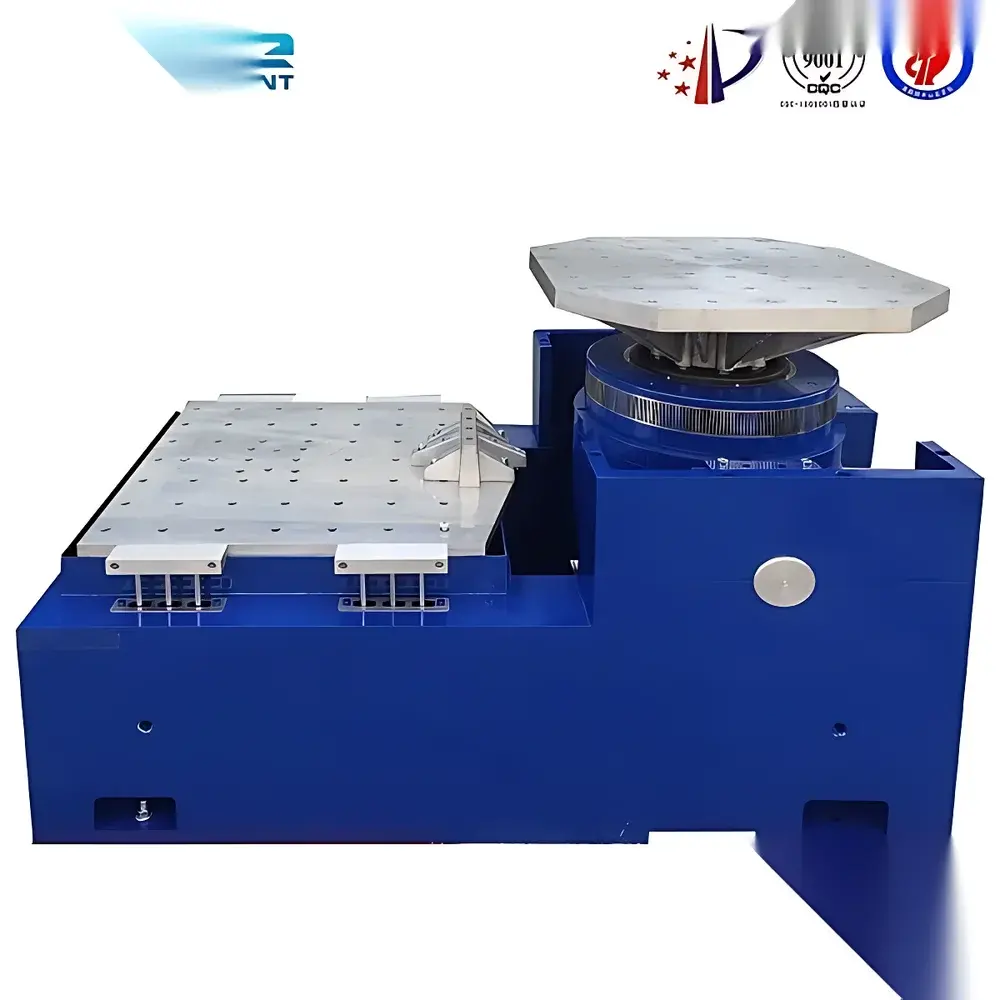
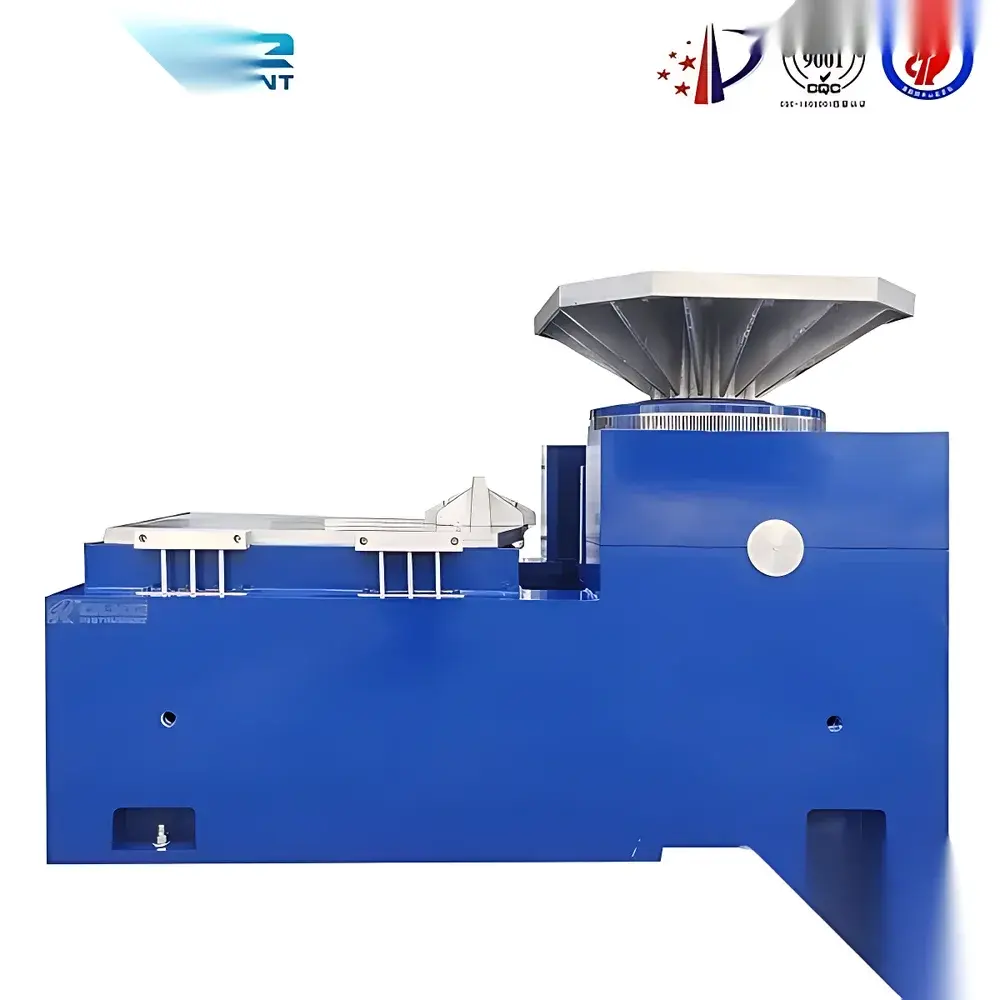
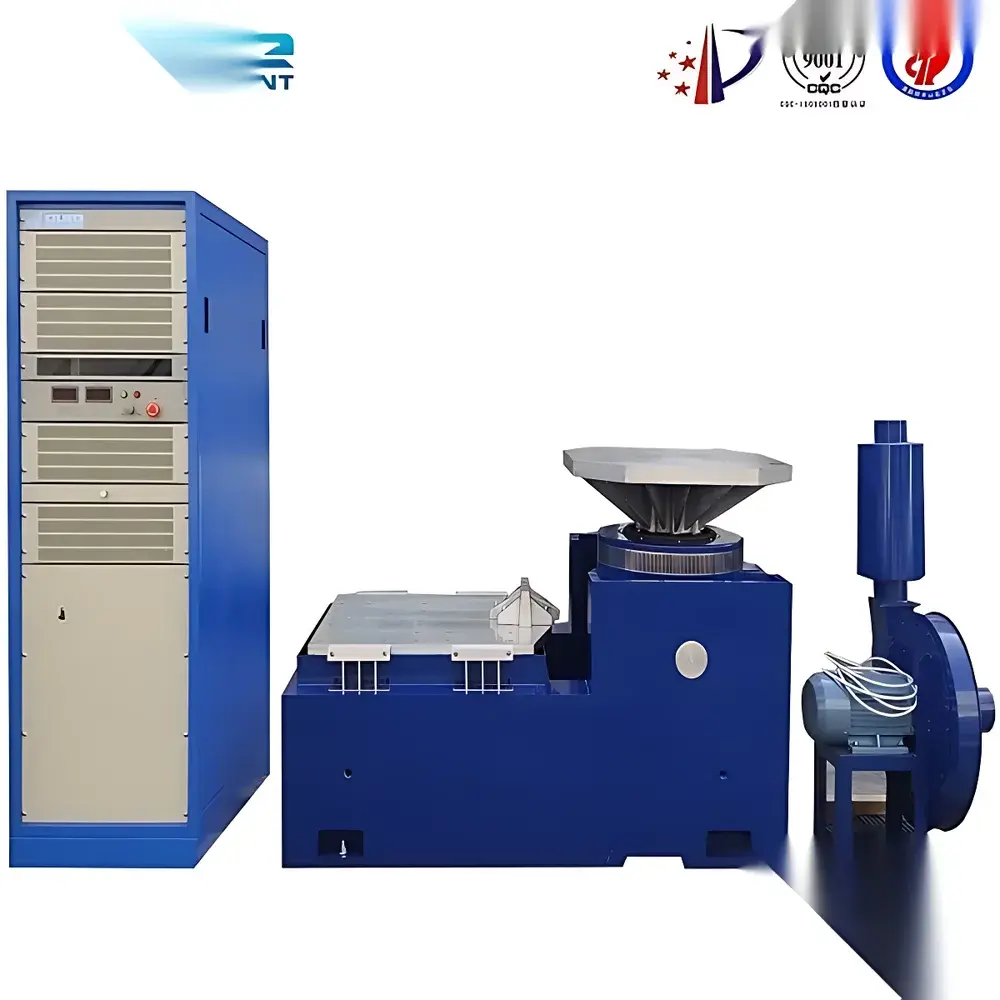
Generic Model VTS-5000 Electromagnetic Vibration Shaker System
| Brand | Other Brands |
|---|---|
| Origin | Imported |
| Manufacturer Type | Authorized Distributor |
| Table Surface Dimensions | 50 × 50 cm |
| Shaker Body Dimensions (L×H×W) | Horizontal Mode: 50 × 26.5 × 50 cm |
| Vertical Mode | 50 × 20 × 50 cm |
| Payload Capacity | 100 kg |
| Vibration Axis | Vertical or Horizontal (90° rotatable) |
| Waveform | Sine |
| Frequency Range | 2–600 Hz |
| Programmable Sweep Range | 2–600 Hz |
| Adjustable Peak-to-Peak Amplitude | 0–5 mm |
| Maximum Acceleration | 20 g |
| Rated Power | 2.2 kW |
| Supply Voltage | 220 V AC |
| Max Current Draw | 5 A |
| Control Interface | RS-232 / USB for PC-based operation |
| Frequency Resolution | 0.01 Hz |
| Frequency Accuracy | ±0.1 Hz |
| Operating Temperature Range | 0–40 °C |
| Relative Humidity | ≤80% RH (non-condensing) |
Overview
The Generic Model VTS-5000 Electromagnetic Vibration Shaker System is a high-fidelity, dual-orientation electrodynamic vibration test platform engineered for precision mechanical stress evaluation in laboratory and industrial quality assurance environments. Based on Lorentz-force actuation principles, the system generates controlled sinusoidal motion via a voice-coil-driven moving assembly—comprising a lightweight armature, suspension frame, and rigid aluminum test table—within a high-flux permanent magnet circuit. Its core architecture integrates a patented rocker-arm guidance mechanism coupled with axial air-spring suspension, enabling exceptional transverse stiffness and waveform fidelity (>95% sine purity at rated load). The shaker’s gimbal-mounted magnetic cylinder allows rapid reconfiguration between vertical and horizontal excitation axes without realignment, supporting standardized test orientations per ISO 10816, ASTM D999, IEC 60068-2-6, and MIL-STD-810H. Designed for repeatable, traceable testing, it delivers stable displacement output up to 25 mmp-p at full 100 kg payload—a performance benchmark uncommon in mid-range electrodynamic shakers.
Key Features
- Electrodynamic actuation with high-efficiency neodymium magnet circuit and low-mass moving coil assembly
- Dual-axis capability: 90° rotational gimbal mount enables seamless switching between vertical and horizontal vibration modes
- Rocker-arm guidance system with axial air-spring suspension ensures minimal off-axis motion (<0.5% lateral acceleration at 20 g)
- Programmable control architecture supporting fixed-frequency, swept-sine, logarithmic sweep, and step-sweep profiles
- Real-time frequency resolution of 0.01 Hz and accuracy within ±0.1 Hz across full 2–600 Hz operational bandwidth
- Integrated thermal protection, over-acceleration cutoff, and impedance monitoring for safe extended-duration testing
- Low-noise design compliant with ISO 7029 acoustic emission limits during continuous operation
Sample Compatibility & Compliance
The VTS-5000 accommodates rigid and semi-rigid specimens up to 100 kg mass and 50 × 50 cm footprint, including packaged electronics, automotive ECUs, aerospace avionics enclosures, and industrial control cabinets. Mounting interfaces conform to ISO 5344 standard bolt patterns. All control firmware and calibration protocols adhere to ISO/IEC 17025 requirements for testing laboratories. The system supports audit-ready test execution under GLP and GMP frameworks, with optional timestamped digital logs compatible with FDA 21 CFR Part 11-compliant data archiving systems. Test reports generated via host software include traceable calibration certificates (NIST-traceable accelerometer and laser vibrometer verification), spectral coherence metrics, and pass/fail flags aligned with user-defined acceptance thresholds per IEC 60721-3-2 (environmental classes) and JEDEC JESD22-B103 (mechanical shock and vibration).
Software & Data Management
Control and analysis are executed through Windows-compatible PC software supporting TCP/IP, RS-232, and USB 2.0 communication. The application provides real-time FFT spectrum visualization, time-domain waveform capture (up to 100 kS/s), and automated compliance checking against preloaded test standards (e.g., ISTA 3A, GB/T 4857.7, EN 60068-2-64). All test parameters—including sweep rate, dwell time, amplitude ramping, and hold segments—are stored as XML-based project files with SHA-256 checksums for integrity verification. Export options include CSV, PDF, and MATLAB .mat formats. Optional add-ons enable integration with LabVIEW™, Python-based automation scripts (via PyVISA), and enterprise LIMS platforms via RESTful API endpoints.
Applications
- Environmental stress screening (ESS) of printed circuit board assemblies and solder joint reliability assessment
- Vibration fatigue life prediction for consumer electronics housings and battery modules
- Modal survey support for finite element model validation using stepped-sine excitation
- Transport simulation testing per ASTM D4169 and ISTA Series protocols
- Qualification of medical device packaging under USP and ISO 11607-1
- Resonance detection and damping characterization of composite structural components
FAQ
What is the maximum allowable payload for full-stroke 25 mmp-p displacement operation?
At 25 mmp-p, the system maintains rated displacement up to 100 kg when operated below 10 Hz; above 10 Hz, displacement is limited by acceleration constraints per the constant-velocity-constant-acceleration envelope.
Does the system support random vibration testing?
No—the VTS-5000 is optimized exclusively for deterministic sinusoidal excitation (fixed, swept, and programmable sine). Random vibration capability requires a dedicated controller and power amplifier not included in this base configuration.
Is third-party calibration certification available?
Yes—factory calibration includes NIST-traceable accelerometer sensitivity verification and shaker response linearity mapping (2–600 Hz), documented in a formal certificate valid for 12 months.
Can the system be integrated into an automated test cell?
Yes—digital I/O ports (TTL-level start/stop, fault status, and cycle completion signals) and Modbus TCP support enable synchronization with PLCs and robotic handlers.
What maintenance intervals are recommended?
Annual inspection of air-spring preload, rocker-arm bearing lubrication, and magnet gap debris clearance is advised; no routine coil or suspension replacement is required within first 10,000 operating hours under nominal load conditions.



