
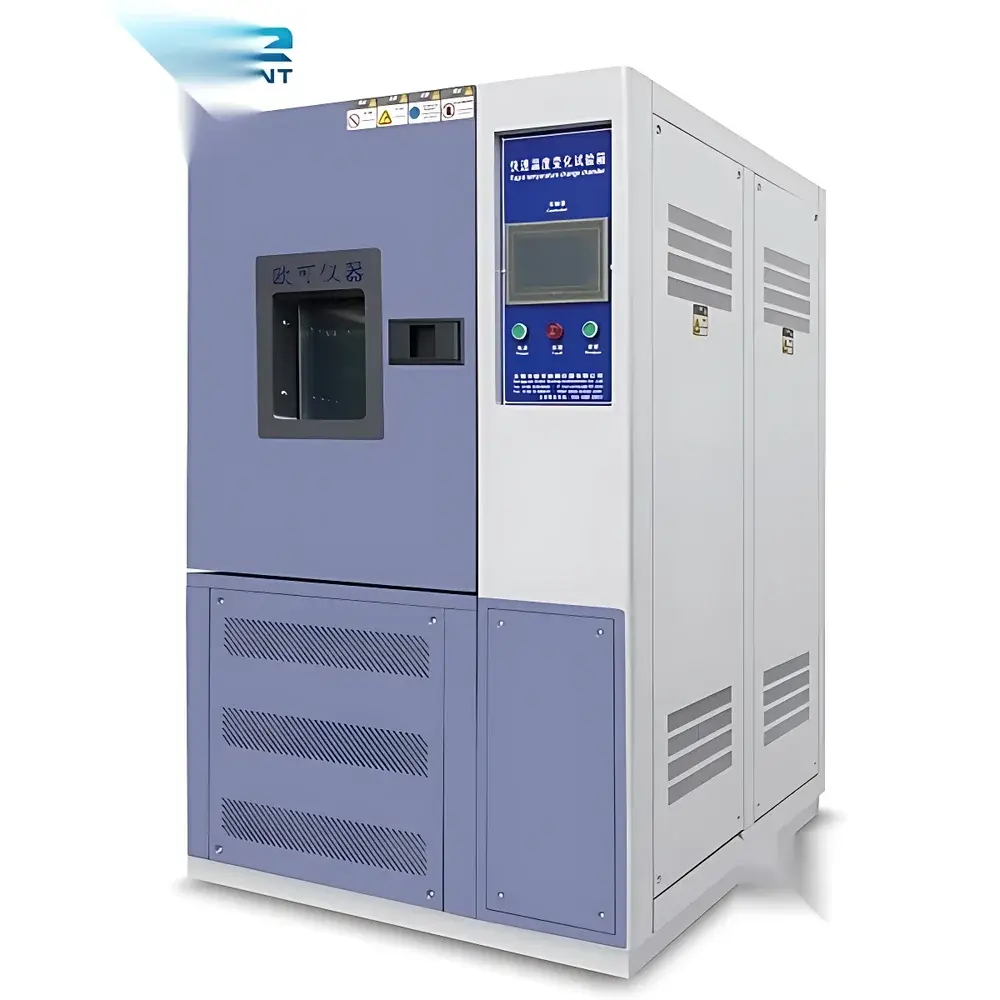
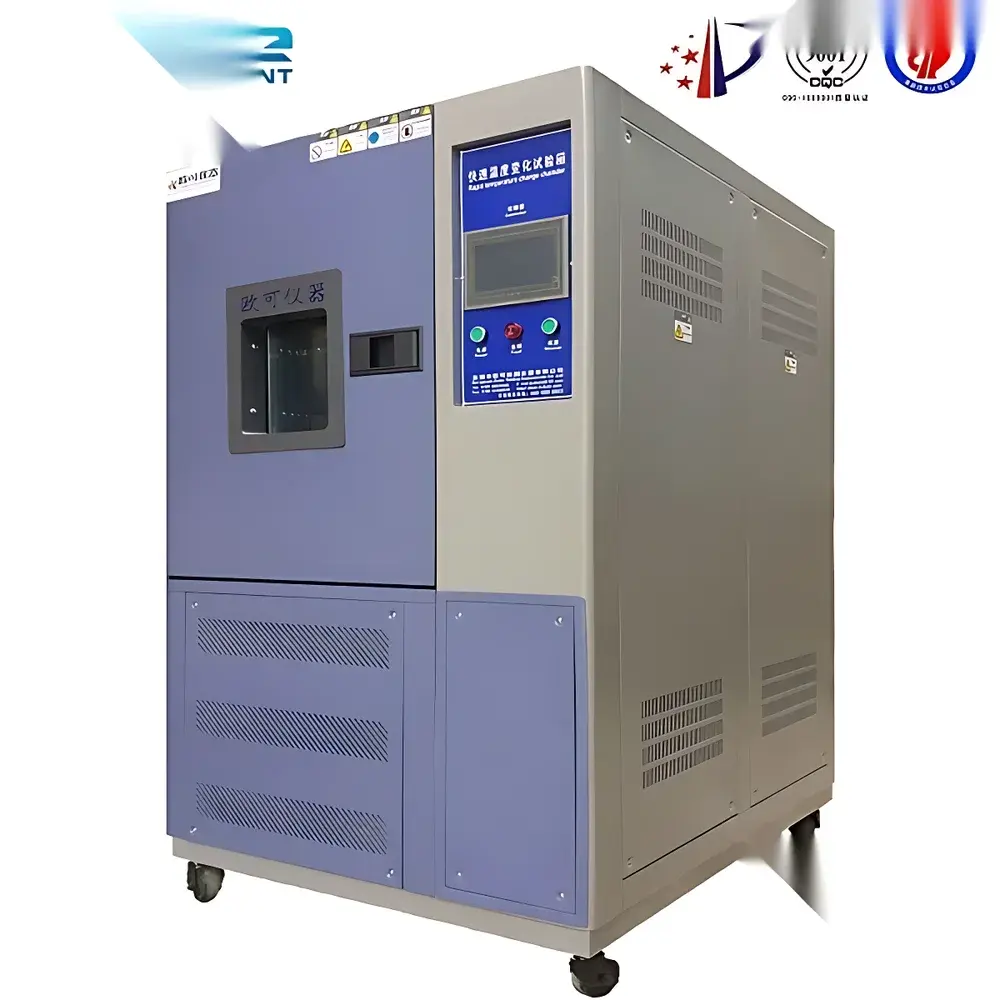
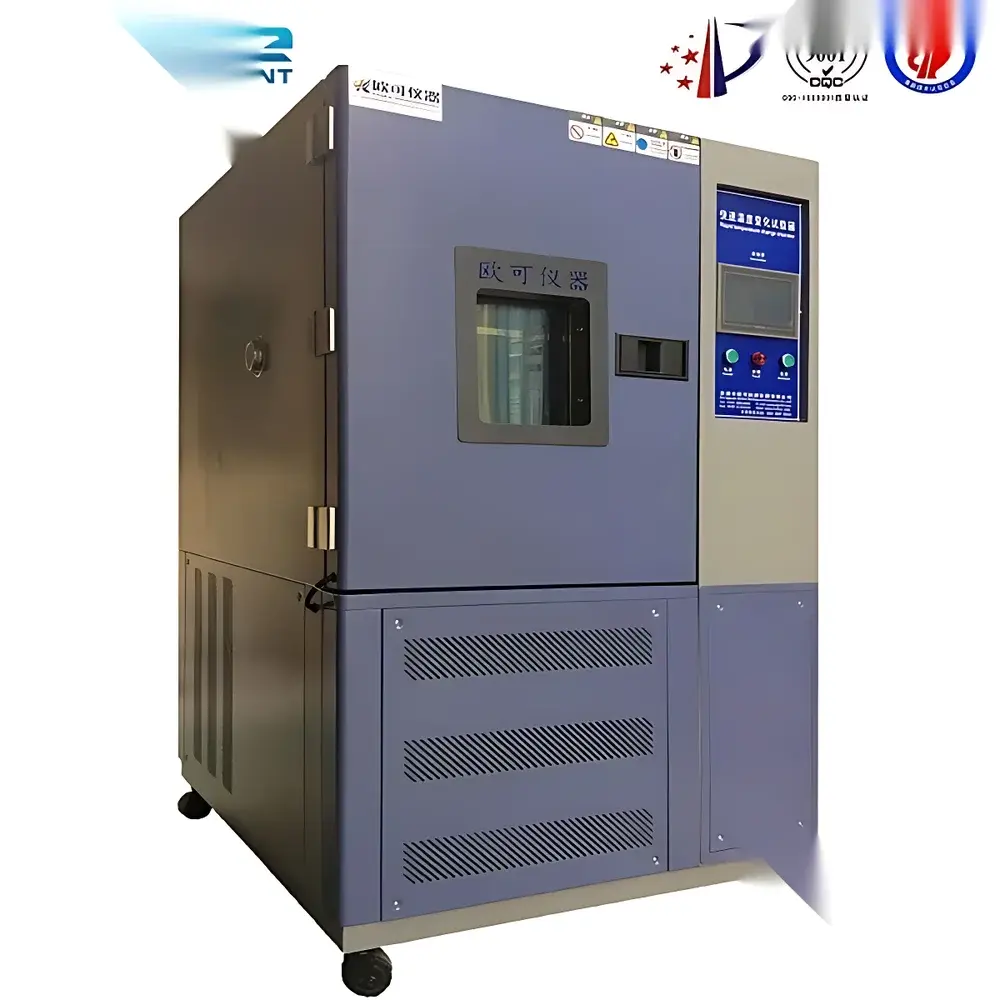
Generic Rapid Temperature Change Chamber
| Brand | Other brands |
|---|---|
| Origin | Imported |
| Manufacturer Type | General distributor |
| Price | USD 2,600 (approx.) |
| Temperature Range | -20°C to 150°C / -40°C to 150°C / -60°C to 150°C / -70°C to 150°C |
| Temperature Fluctuation | ±0.5°C (ambient pressure, empty chamber) |
| Temperature Uniformity | ±2°C (ambient pressure, empty chamber) |
| Temperature Deviation | ±3°C (ambient pressure, empty chamber) |
| Heating Rate | 1.0–3.0°C/min |
| Cooling Rate | 0.7–1.0°C/min |
| Pressure Range | Ambient to 0.5 kPa |
| Pressure Tolerance | ±1.8 kPa (ambient–40 kPa), ±4.5% (40–4 kPa), ±0.1 kPa (4–0.5 kPa) |
| Depressurization Time | ≤45 min (ambient → 0.5 kPa) |
Overview
The Generic Rapid Temperature Change Chamber is a programmable environmental test system engineered for accelerated thermal stress evaluation of electronic components, aerospace materials, automotive parts, and packaging systems. It operates on a forced-air convection principle with dual-stage refrigeration and electric heating, enabling controlled transitions between extreme temperature setpoints under ambient or reduced-pressure conditions. Unlike standard thermal chambers, this unit supports rapid ramp rates—up to 3.0°C/min heating and 1.0°C/min cooling—while maintaining traceable stability and uniformity per IEC 60068-2-1 (cold), IEC 60068-2-2 (dry heat), and MIL-STD-810H Method 502.7. The integrated vacuum capability (down to 0.5 kPa) extends its utility to altitude simulation and outgassing testing, making it suitable for qualification protocols in aerospace, defense, and high-reliability electronics manufacturing.
Key Features
- Four standard temperature range configurations: -20°C to 150°C, -40°C to 150°C, -60°C to 150°C, and -70°C to 150°C—each validated under empty-chamber, ambient-temperature (≤25°C) conditions.
- Precision temperature control with fluctuation ≤±0.5°C and uniformity ≤±2°C across the working volume, compliant with GB/T 5170.2–1996 and ISO 16750-4 for thermal test equipment calibration.
- Programmable ramp rates: heating from 1.0 to 3.0°C/min; cooling from 0.7 to 1.0°C/min—optimized for thermal shock profile execution without overshoot or dwell instability.
- Vacuum-compatible design with pressure regulation from ambient down to 0.5 kPa, featuring multi-zone pressure tolerance specifications aligned with ISO 20685 for low-pressure environmental testing.
- Safety-integrated architecture: over-temperature cutoff, door interlock, grounding mandatory circuitry, non-explosion-proof classification (not rated for hazardous atmospheres), and mandatory pre-operational grounding verification per IEC 61000-6-2.
- Robust mechanical construction with insulated double-wall chamber, stainless-steel interior, and sealed air circulation ducts to minimize particulate ingress and ensure long-term repeatability.
Sample Compatibility & Compliance
This chamber accommodates samples up to standard internal dimensions (customizable upon request), supporting rigid and semi-rigid specimens including PCB assemblies, molded enclosures, battery modules, and sealed sensor housings. It complies with multiple national and international standards, including GB 11158–2006 (High-Temperature Test Chambers), GB/T 2423.1–2001 (Cold Test), GB/T 2423.2–2001 (Dry Heat), GB/T 2423.3–1993 (Steady-State Damp Heat), and GB/T 5170.5–1996 (Humidity Equipment Verification). While not certified to UL 61010-1 or ATEX, its electrical safety design meets IEC 61010-1 requirements for laboratory equipment. Users deploying this system for regulated quality assurance must validate operational parameters per their internal SOPs and maintain calibration records traceable to NIST or equivalent national metrology institutes.
Software & Data Management
The chamber interfaces via RS485 or optional Ethernet port with vendor-neutral SCPI command sets, enabling integration into LabVIEW, MATLAB, or custom Python-based test orchestration platforms. Onboard controller logs timestamped temperature, pressure, and cycle status data at user-defined intervals (1–60 s resolution), storing ≥10,000 data points internally. Export formats include CSV and Excel-compatible .xls. Audit trail functionality supports GLP-compliant environments when paired with external data acquisition systems configured for 21 CFR Part 11 compliance (electronic signatures, change control, and user access logging). Firmware updates are performed via USB flash drive with version-locking and checksum validation to prevent unauthorized modification.
Applications
Typical use cases include thermal cycling reliability assessment per JEDEC JESD22-A104, solder joint fatigue analysis in automotive ECUs, moisture barrier integrity verification for medical device packaging, and thermal vacuum preconditioning prior to HALT/HASS. Its ability to combine rapid thermal transients with sub-atmospheric pressure enables combined environment testing relevant to UAV component certification (RTCA DO-160 Section 4.12), satellite subsystem screening (ECSS-E-ST-10-03C), and battery thermal runaway propagation studies under depressurized conditions.
FAQ
Is this chamber suitable for explosive or flammable atmospheres?
No. This unit is explicitly classified as non-explosion-proof and must never be operated in environments containing combustible gases, vapors, or dusts.
What is the required power supply specification?
A stable single-phase AC supply within ±10% of rated voltage (typically 220 V ±10%, 50/60 Hz) is mandatory. Undervoltage or overvoltage conditions may impair compressor performance or trigger protective shutdown.
Can the chamber door be opened during operation?
Opening the door mid-cycle is strongly discouraged. High-temperature exposure risks thermal burns; low-temperature exposure risks frostbite and evaporator icing. If unavoidable, operators must wear ANSI-rated cryogenic or heat-resistant gloves and face shields.
Does the system support custom test profiles?
Yes. Up to 99 programmable segments—including ramp, soak, and step functions—can be stored and recalled. Profiles may incorporate simultaneous temperature and pressure setpoint sequencing.
Is third-party calibration documentation provided?
Factory calibration certificates (traceable to national standards) are included. Full ISO/IEC 17025-accredited calibration requires engagement with an accredited external lab and is not supplied by default.



