GenesisGEO fs-LA-ICP-MS Trace Element Analysis Service for High-Purity Quartz
| Brand | Chemlab Pro |
|---|---|
| Origin | Shanghai, China |
| Manufacturer Type | Authorized Distributor |
| Product Category | Domestic |
| Model | High-Purity Quartz Trace Element Detection Service |
| Quotation | Available Upon Request |
| Service Experience | 3–5 Years |
Overview
This service provides high-sensitivity, spatially resolved trace element analysis of optically transparent, refractory minerals—including high-purity quartz, fluorite, apatite, and rock crystal—using a state-of-the-art femtosecond laser ablation inductively coupled plasma triple quadrupole mass spectrometry (fs-LA-ICP-QQQ-MS) platform. The analytical system integrates the GenesisGEO femtosecond laser ablation system with the Agilent 8900 ICP-QQQ-MS, enabling robust quantification of elements at sub-ppb detection limits while minimizing elemental fractionation and thermal effects typical of nanosecond lasers. The method is specifically engineered for low-matrix-interference, high-reproducibility analysis of SiO₂-rich materials where conventional digestion-based approaches fail due to contamination risk or incomplete dissolution. Helium (99.999% purity) serves as the carrier gas to maximize aerosol transport efficiency and signal stability. Data acquisition follows time-resolved pulse counting protocols synchronized with laser firing, ensuring precise integration of transient signals across all isotopes.
Key Features
- Femtosecond laser ablation (1030 nm, <500 fs pulse width) for minimal thermal alteration and near-stoichiometric sampling of quartz lattices
- Adjustable ablation spot size: 1–500 µm (circular or rectangular), with calibrated depth profiling capability
- Detection limits <3 ppb for most lithophile elements (e.g., Al, Ti, Li, B, P, K, Ca, Fe, Mn, Rb, Sr, Y, REEs, U, Th)
- Standardized warm-up (15 s) and wash-out (45 s) intervals before/after each ablation event to ensure baseline stability and cross-contamination control
- Multi-matrix external calibration using NIST SRMs (610, 612, 614, 616) and ARM series (ARM-1, ARM-2, ARM-3), with bracketing every 10 unknown spots
- Quantitative imaging mode with 50 µm spatial resolution, 137,000-pixel coverage over a 15.7 × 12.6 mm area
Sample Compatibility & Compliance
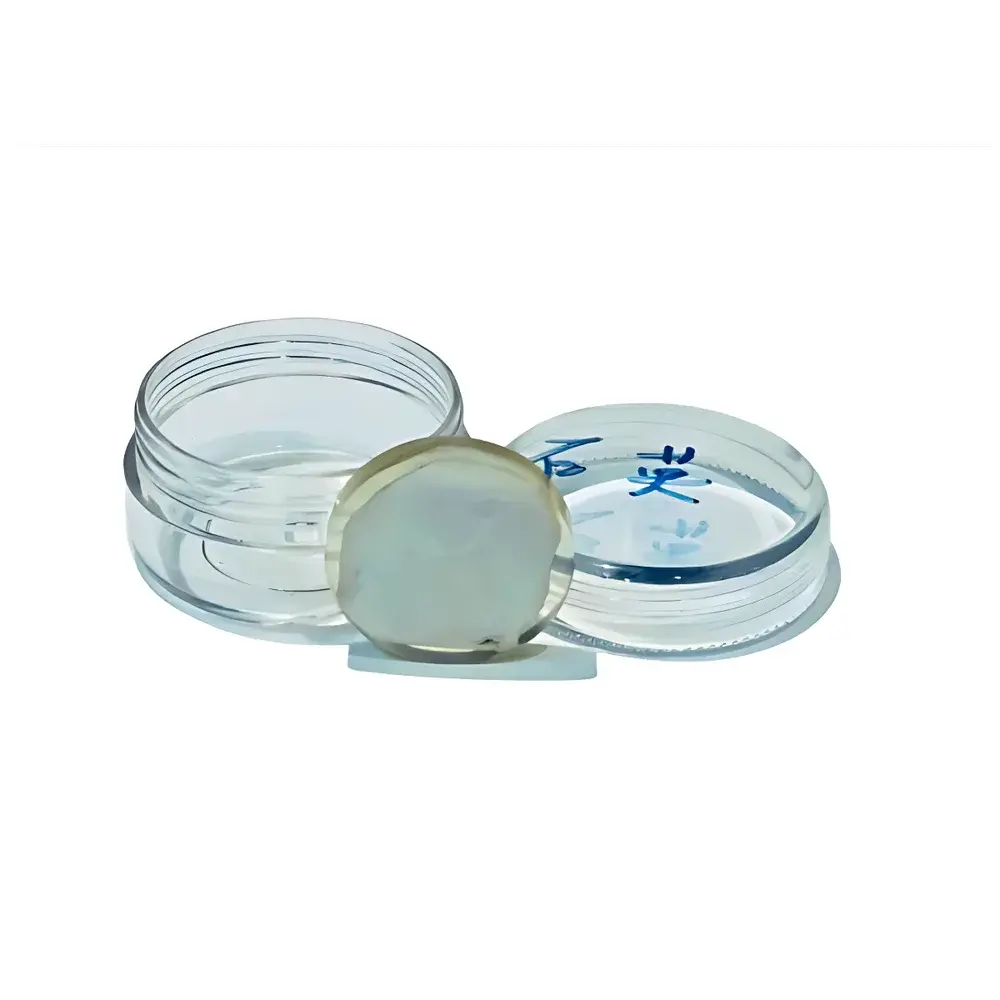
The service accepts polished thin sections, epoxy-mounted probe mounts, optically flat glass slides, and resin-embedded targets. Sample surfaces must be mechanically polished to ≤1 nm RMS roughness; height variations exceeding ±0.5 µm will compromise ablation consistency and image fidelity. Maximum dimensions: 10 cm × 10 cm × 2.5 cm (L × W × H); custom chamber adaptation is available for oversized specimens upon technical review. All analyses comply with ISO/IEC 17025:2017 requirements for testing laboratories. Calibration traceability is maintained to NIST-certified reference materials. Data reporting includes full uncertainty budgets per ISO/IEC Guide 98-3 (GUM), and raw transient signal files (.csv/.txt) are archived for ≥7 years per GLP archival standards.
Software & Data Management
Data reduction and quantification are performed using Iolite v4.6 with the TimeRes and LAtools modules. The multi-standard normalization algorithm corrects for instrumental drift, matrix effects, and sensitivity fluctuations using internal (²⁹Si) and external (NIST/ARM) standards. Output includes calibrated concentration maps (µg/g), single-spot concentration tables (with 2σ SE), detection limit reports per element, and ablation pit depth profiles derived from interferometric profilometry. All processed datasets are delivered in standardized .xlsx and .tif formats compatible with ArcGIS, MATLAB, and Python-based geochemical visualization pipelines (e.g., PyMCA, GeochemR). Audit trails—including instrument parameters, standardization logs, and processing version history—are embedded in metadata and retained for regulatory review.
Applications
- Geochemical fingerprinting of hydrothermal quartz for ore genesis modeling and fluid source tracing
- Assessment of semiconductor-grade quartz purity (e.g., Al, Na, K, Fe content) against SEMI F57 specifications
- Trace element zoning studies in magmatic quartz phenocrysts to constrain crystallization histories
- Contamination screening of synthetic quartz used in optical resonators and UV-transmitting optics
- Correlation of lattice-bound impurities with mechanical strength and radiation-induced darkening in nuclear-grade quartz
FAQ
What sample preparation is required prior to submission?
Polished, contamination-free surfaces are mandatory. Samples must be cleaned ultrasonically in high-purity HNO₃ (1:1 v/v) and DI water, then dried under Class 100 laminar flow. Resin mounts require full polymerization and surface polishing with 0.25 µm diamond suspension.
Can you analyze non-quartz transparent minerals like beryl or topaz?
Yes—fluorite, apatite, zircon, and corundum-based materials are routinely analyzed; method validation data for each matrix are available upon request.
Is CRM certification provided with the final report?
Each report includes certified reference material performance metrics (bias ≤10% relative to certified values), full uncertainty propagation, and ISO/IEC 17025-compliant sign-off by a qualified analyst.
How are detection limits determined for each element?
Method detection limits (MDLs) are calculated per EPA Method 40 CFR Part 136 as 3.14 × standard deviation of 10 replicate blank measurements, acquired under identical ablation conditions.
Related Products