
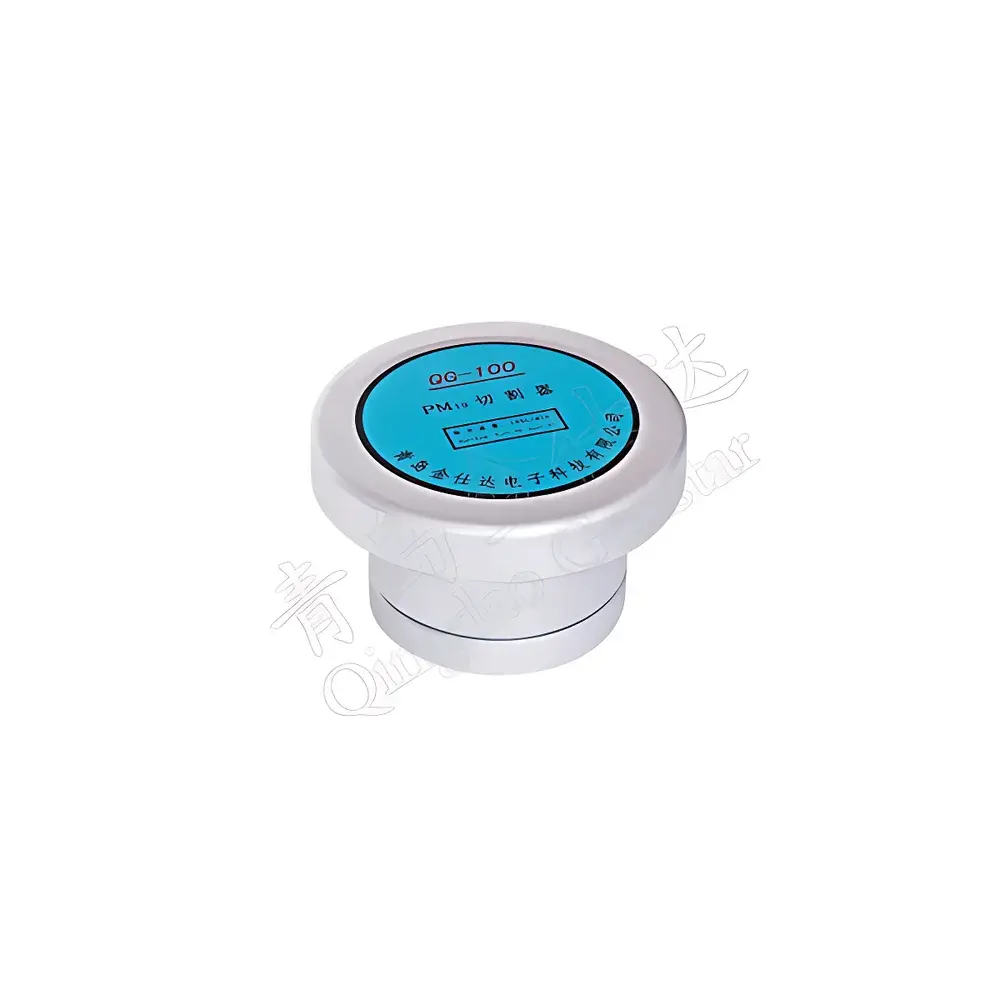
Genetc QG-100 Impactor PM10 Sampler
| Brand | Genetc |
|---|---|
| Origin | Shandong, China |
| Manufacturer Type | Manufacturer |
| Country of Origin | China |
| Model | QG-100 |
| Price | Upon Request |
| Flow Rate | 100 L/min |
| Cut-Point Diameter (Da50) | (10 ± 0.5) µm |
| Geometric Standard Deviation (σg) | (1.5 ± 0.1) |
| Filter Membrane Effective Diameter | Ø80 mm |
| Construction Material | Anodized Aluminum Alloy |
| Compliance | HJ/T 93–2003, HJ 618–2011 |
Overview
The Genetc QG-100 Impactor PM10 Sampler is a precision-engineered inertial separation device designed for regulatory-grade ambient air monitoring of particulate matter with an aerodynamic diameter ≤10 µm (PM10). It operates on the principle of inertial impaction—where airflow is abruptly accelerated through a precisely dimensioned nozzle, causing particles above a defined aerodynamic cutoff to impact onto a collection surface due to their momentum, while smaller particles remain entrained in the airstream. This two-stage cascade impactor configuration separates total suspended particulates (TSP) from the PM10 fraction, enabling gravimetric analysis per standardized methodologies. The sampler is intended for use exclusively with medium-flow rate sampling pumps (100 L/min nominal), and integrates seamlessly into fixed-site ambient monitoring networks or mobile field deployments where traceable, repeatable PM10 mass concentration data are required for compliance reporting, epidemiological studies, or source apportionment modeling.
Key Features
- Regulatory-compliant cut-point performance: Da50 = (10 ± 0.5) µm and σg = (1.5 ± 0.1), validated against HJ/T 93–2003 requirements for sharpness and reproducibility of particle size separation.
- Anodized aluminum alloy construction eliminates electrostatic charge accumulation—critical for minimizing particle bounce, re-entrainment, and adhesion artifacts that compromise gravimetric accuracy, particularly for low-mass loading scenarios.
- Ø80 mm effective filter membrane area ensures sufficient collection surface for extended sampling durations (e.g., 24 h at 100 L/min) while maintaining laminar flow integrity across the filter substrate.
- Modular two-stage design (TSP + PM10) supports parallel or sequential sampling configurations; compatible with standard 47 mm or 80 mm quartz fiber, Teflon, or cellulose ester filters certified for EPA/ISO gravimetric protocols.
- Optimized internal geometry minimizes wall losses and diffusion-related underestimation for submicron fractions, supporting robust performance across temperature and humidity gradients typical of uncontrolled field environments.
Sample Compatibility & Compliance
The QG-100 is validated for use with gravimetric filter media meeting ISO 10473:2001 and EPA Method IO-3.1 specifications. Its mechanical classification performance has been independently verified by the Chinese Center for Disease Control and Prevention (China CDC), Environmental and Health-Related Product Safety Institute, confirming full conformance with HJ 618–2011 “Determination of PM10 and PM2.5 in Ambient Air—Gravimetric Method”. All dimensional tolerances, flow calibration procedures, and pressure drop characteristics adhere to the metrological framework outlined in HJ/T 93–2003, including mandatory testing for loading-dependent shift, wind tunnel response, and multi-lot filter consistency. The unit carries no CE, UKCA, or FDA designation, and is not intended for occupational exposure assessment under OSHA or NIOSH criteria without supplementary validation per EN 12341 or ISO 7708.
Software & Data Management
The QG-100 is a passive, analog sampling component requiring external flow control and calibration. It does not incorporate embedded electronics, firmware, or digital interfaces. Flow rate verification must be performed using a NIST-traceable primary standard (e.g., bubble meter, critical orifice calibrator, or electronic mass flowmeter) before and after each sampling event. When integrated into automated monitoring stations, it interfaces with programmable logic controllers (PLCs) or data loggers capable of recording real-time flow, temperature, barometric pressure, and pump runtime. Raw gravimetric data—including pre- and post-sampling filter masses, desiccation conditions, and balance calibration certificates—must be managed in accordance with GLP documentation practices and retained for audit per national environmental data archiving policies.
Applications
- Ambient air quality monitoring networks operated by provincial and municipal ecological environment bureaus (e.g., China’s National Urban Air Quality Monitoring Network).
- Long-term trend analysis of urban and rural PM10 concentrations aligned with WHO Air Quality Guidelines and China’s Ambient Air Quality Standards (GB 3095–2012).
- Source characterization studies near industrial zones, construction sites, or traffic corridors where coarse-mode particle emissions dominate.
- Method validation and interlaboratory comparison exercises conducted under CNAS (China National Accreditation Service) accredited environmental testing laboratories.
- Research applications involving aerosol physical property characterization, including hygroscopic growth factor estimation when coupled with conditioned inlet systems.
FAQ
Is the QG-100 suitable for PM2.5 sampling?
No—the QG-100 is specifically engineered for PM10 fractionation. For PM2.5, a dedicated three-stage impactor (e.g., WINS or BGI SCC 2.0.2) or a virtual impactor-based system compliant with HJ 656–2013 is required.
Does the sampler include a flow controller or vacuum pump?
No—it is a passive head-only device. A stable, calibrated medium-flow pump delivering 100 L/min ±2% at operating backpressure must be supplied separately.
Can it be used with TEOM or beta attenuation monitors (BAM)?
Not directly—the QG-100 outputs a physical filter for gravimetric analysis only. Integration with continuous monitors requires separate co-location and collocated calibration per HJ 655–2013 guidelines.
What filter types are recommended for gravimetric analysis?
Quartz fiber filters (pre-fired at 550 °C, certified for low blank mass) or PTFE membrane filters with ≤0.45 µm pore size and known retention efficiency ≥99.97% for 0.3 µm particles are preferred.
Is annual recalibration mandatory?
Yes—per HJ/T 93–2003 Section 6.4, mechanical impactors must undergo full performance verification (cut-point, σg, flow linearity) at least once per year by an accredited metrology laboratory or the original manufacturer.
Related Products







