
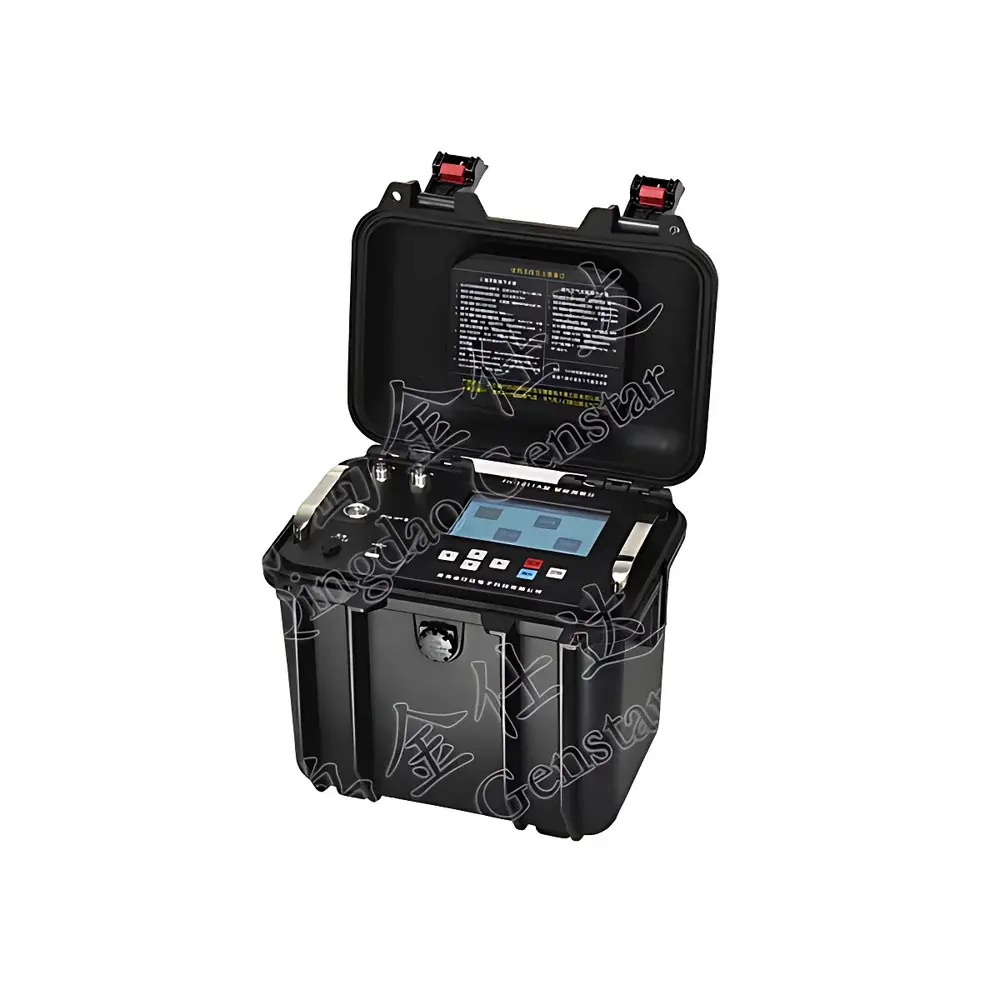
Genetec FH-1011A Intelligent Alpha Spectrometry Radon Monitor
| Brand | Genetec |
|---|---|
| Model | FH-1011A |
| Detection Principle | Pump-Assisted Electrostatic Collection + Alpha Energy Spectrum Analysis |
| Sampling Method | Active (Pump-Driven) |
| Measurement Modes | Real-Time Air, Soil Gas, Water Radon Concentration & Radon Exhalation Rate |
| Display | Wide-Temperature Color TFT Touchscreen (Resistive + Keypad Dual Operation) |
| Power Supply | AC/DC Dual Mode |
| Battery Runtime | Up to 72 h |
| Data Export | USB Flash Drive |
| Connectivity | Bluetooth for Thermal Printing |
| Enclosure | IP65-Rated Industrial Sealed Housing |
| Compliance | GB 50325-2020, HJ 1212-2021, T/CECS 569-2019, EJ/T 605-2018 |
Overview
The Genetec FH-1011A Intelligent Alpha Spectrometry Radon Monitor is a field-deployable, laboratory-grade instrument engineered for quantitative radon-222 (²²²Rn) and radon-220 (²²⁰Rn, thoron) activity concentration measurement in air, soil gas, and water matrices. It operates on the principle of pump-assisted electrostatic collection followed by high-resolution alpha-particle energy spectrum analysis using a passivated implanted planar silicon (PIPS) semiconductor detector. This methodology enables discrimination between radon progeny (e.g., ²¹⁸Po, ²¹⁴Po) and thoron progeny (e.g., ²¹²Po), allowing simultaneous, independent quantification of both radon isotopes without cross-interference. Designed for regulatory compliance and scientific rigor, the FH-1011A supports trace-level environmental radiation monitoring in accordance with Chinese national standards including GB 50325-2020 (Indoor Environmental Pollution Control for Civil Construction Projects), HJ 1212-2021 (Methods for Radon Measurement in Ambient Air), and EJ/T 605-2018 (Specifications for Radon and Progeny Measurements in Uranium Exploration). Its architecture prioritizes metrological stability, low electronic noise, and long-term field reliability under variable temperature and humidity conditions.
Key Features
- High-resolution PIPS semiconductor alpha spectrometer with optimized depletion depth and low leakage current for superior energy resolution (FWHM ≤ 35 keV at 5.3 MeV) and enhanced signal-to-noise ratio
- Pump-controlled active sampling system with precision mass-flow regulation, ensuring consistent volumetric throughput and minimizing flow-induced spectral distortion
- Dual-operation interface: industrial-grade resistive touchscreen integrated with tactile membrane keypad for glove-compatible operation in field environments
- Programmable measurement protocols — including timed start, delayed acquisition, and scheduled continuous monitoring — enabling unattended deployment for up to 72 hours on internal DC power
- Real-time alpha spectrum visualization with on-device peak identification, region-of-interest (ROI) integration, and background subtraction algorithms
- Multi-matrix capability: configurable calibration factors for air, soil gas (via probe insertion), aqueous samples (using emanation vial method), and surface exhalation rate determination
- Robust mechanical design: IP65-rated sealed enclosure with shock-absorbing gasketing, corrosion-resistant aluminum alloy chassis, and thermal management for operation across –10 °C to +50 °C ambient range
Sample Compatibility & Compliance
The FH-1011A accommodates standardized sampling configurations per applicable regulatory frameworks. For indoor air monitoring, it complies with the active grab-sampling and continuous accumulation protocols defined in HJ 1212-2021 and GB 50325-2020 Annex D. Soil gas measurements follow EJ/T 605-2018 requirements for probe depth, sealing, and equilibration time. Aqueous radon analysis utilizes closed-vial emanation techniques aligned with ISO 11665-6:2021 (Measurement of radioactivity in the environment — Air — Part 6: Radon-222 — Methodology for measuring radon and its short-lived decay products in water). All firmware and data handling routines are structured to support audit-ready documentation, including timestamped raw spectra, detector bias history, and environmental sensor logs (temperature, pressure, RH), facilitating GLP-aligned reporting.
Software & Data Management
Instrument control, spectral processing, and report generation are managed via embedded ARM-based firmware with deterministic real-time scheduling. Raw alpha pulse-height data are stored in IEEE 754-compliant binary format with embedded metadata (GPS coordinates optional via external module, operator ID, calibration certificate hash). USB export yields CSV-formatted results with full spectral archives (.spe files), compatible with third-party analysis tools such as GammaVision™ or custom Python-based spectrum fitting pipelines. Bluetooth connectivity supports direct thermal printing of QA/QC summary reports (including detection limit calculation per ISO 11929:2019) without intermediate PC dependency. No cloud upload or remote telemetry is implemented — all data remain under user control, satisfying data sovereignty requirements for nuclear regulatory applications.
Applications
- Indoor radon risk assessment in residential, educational, and healthcare facilities per national building codes
- Pre-construction site evaluation for soil gas radon potential in civil engineering projects
- Geological surveying: fault zone mapping, uranium prospecting, and hydrogeological characterization via radon anomaly detection
- Environmental impact assessment (EIA) for mining, nuclear fuel cycle facilities, and geothermal developments
- Research-grade studies on radon transport mechanisms in unsaturated zones and vadose water systems
- Seismo-tectonic precursor monitoring programs requiring high-temporal-resolution radon time-series
FAQ
What detection technology does the FH-1011A use?
It employs pump-assisted electrostatic collection of radon progeny onto a PIPS semiconductor detector, followed by alpha energy spectrum deconvolution.
Can it distinguish between radon-222 and radon-220 (thoron)?
Yes — spectral separation of ²¹⁸Po (6.00 MeV), ²¹⁴Po (7.69 MeV), and ²¹²Po (8.78 MeV) enables simultaneous, quantitative measurement of both isotopes.
Is the instrument suitable for outdoor long-term unattended monitoring?
Yes — with its IP65 enclosure, wide-temperature display, and 72-hour battery autonomy, it supports autonomous deployments in remote geological or construction sites.
Does it comply with international radon measurement standards?
While primarily certified to Chinese national standards (GB, HJ, EJ/T), its alpha spectrometry methodology aligns with ISO 11665 series principles and is accepted in bilateral technical cooperation frameworks involving IAEA Member States.
How is calibration traceability maintained?
Each unit ships with a NIM-traceable calibration certificate for ²²²Rn and ²²⁰Rn, generated using certified radon reference sources housed in Genetec’s CNAS-accredited (ISO/IEC 17025) calibration laboratory.







