
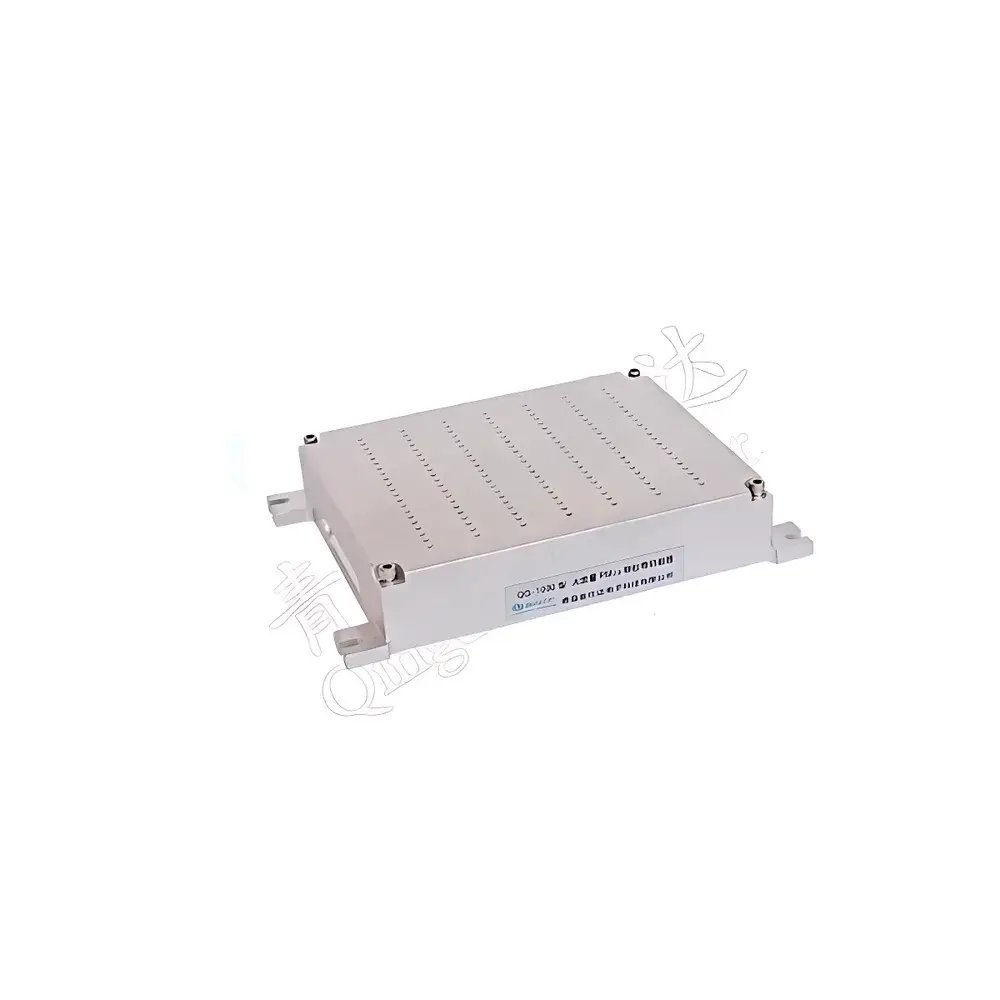
Genetec QG-1000 High-Flow PM10 Size-Selective Inlet
| Brand | Genetec |
|---|---|
| Origin | Shandong, China |
| Manufacturer Type | Original Equipment Manufacturer (OEM) |
| Country of Manufacture | China |
| Model | QG-1000 |
| Pricing | Upon Request |
| Operating Flow Rate | 1.050 m³/min |
| Cut-Point Diameter (Da₅₀) | (10 ± 0.5) µm |
| Geometric Standard Deviation (σg) | (1.5 ± 0.1) |
| Material | Anodized Aluminum Alloy |
| Compliance | HJ 618–2011, HJ/T 93–2003 |
Overview
The Genetec QG-1000 High-Flow PM10 Size-Selective Inlet is a precision-engineered inertial impactor designed for regulatory-grade ambient air monitoring of particulate matter with an aerodynamic diameter ≤10 µm (PM10). It operates on the principle of inertial impaction—where airflow is abruptly accelerated through a nozzle, causing particles above a defined aerodynamic cutoff to deviate from the streamlines and deposit onto a collection surface due to momentum inertia. This physical separation mechanism ensures gravimetrically traceable size selectivity without reliance on filtration or electrostatic effects. The inlet is intended for integration with high-volume air samplers (e.g., 1.05 m³/min flow systems) in fixed-site ambient monitoring networks, reference-grade compliance monitoring stations, and occupational health assessment setups. Its design adheres strictly to the aerodynamic particle sizing conventions defined in ISO 7708 and the U.S. EPA’s PM10 reference method criteria, enabling direct comparability with regulatory datasets.
Key Features
- Anodized aluminum alloy construction eliminates electrostatic charge accumulation—critical for minimizing particle bounce, re-entrainment, and measurement bias during gravimetric analysis per HJ 618–2011.
- Validated Da50 = (10.0 ± 0.5) µm at nominal operating flow (1.050 m³/min), meeting the sharpness and accuracy requirements specified in HJ/T 93–2003 for Class I PM10 samplers.
- Geometric standard deviation σg = (1.5 ± 0.1), confirming narrow cut-point transition behavior essential for reproducible mass concentration reporting across inter-laboratory studies.
- Modular interface compatible with standardized 8-inch (203 mm) inlet flanges and common high-flow pump manifolds, facilitating rapid field deployment and maintenance.
- No consumable components or replaceable membranes—reducing operational cost and eliminating calibration drift associated with filter aging or coating degradation.
Sample Compatibility & Compliance
The QG-1000 is validated for use with quartz fiber, PTFE, or cellulose ester filters mounted downstream in accordance with HJ 618–2011 gravimetric procedures. Its performance has been independently verified by the Chinese Center for Disease Control and Prevention (China CDC), Environmental and Health-Related Product Safety Institute, confirming full conformance with both HJ 618–2011 and HJ/T 93–2003 technical specifications. While not certified to ISO 12103-1 or ISO 29463, its inertial cut-point geometry aligns with the fundamental principles underpinning those standards. For laboratories operating under GLP or ISO/IEC 17025 frameworks, the inlet supports documented traceability via manufacturer-provided test reports, flow calibration certificates, and Da50/σg verification data.
Software & Data Management
The QG-1000 is a passive mechanical component and does not incorporate embedded electronics, firmware, or software interfaces. All operational parameters—including flow rate, temperature, pressure, and sampling duration—are recorded externally by the host sampler’s data acquisition system. To ensure regulatory data integrity, users are advised to pair the inlet with samplers supporting audit-trail functionality, timestamped event logging, and secure export of raw flow and environmental sensor data. When used in networks compliant with China’s National Ambient Air Quality Monitoring Network (NAAQMN) protocols, the inlet contributes to datasets that feed into the national PM10 reporting infrastructure under MEP Order No. 39.
Applications
- Ambient air quality monitoring stations (urban, rural, background sites) requiring continuous or integrated 24-hour PM10 mass concentration data.
- Source apportionment studies where precise size-fractionated sampling upstream of chemical speciation analysis (e.g., ICP-MS, IC, XRF) is required.
- Occupational exposure assessment in industrial settings—especially cement plants, metal foundries, and construction zones—per GBZ 159 and OSHA Method ID-202.
- Method validation and inter-comparison exercises conducted by provincial environmental monitoring centers and third-party testing laboratories.
- Research applications involving aerosol physics, atmospheric chemistry modeling, and deposition velocity estimation.
FAQ
Does the QG-1000 require periodic recalibration?
No—its cut-point performance is determined solely by fixed geometric dimensions and is unaffected by time or usage. However, annual verification of Da50 and σg using monodisperse aerosol challenge tests is recommended for quality assurance programs.
Can it be used for PM2.5 sampling?
No. The QG-1000 is specifically engineered for PM10 size selection. For PM2.5, a separate cyclone or impactor with Da50 ≈ 2.5 µm (e.g., WINS, BGI SCC 1.062) must be employed.
Is it compatible with EPA-approved reference samplers?
It meets the physical design criteria referenced in 40 CFR Part 53 for PM10 inlets but is not itself listed as an EPA-certified equivalent method device; final compliance depends on full system validation per 40 CFR 53.30.
What maintenance is required?
Routine visual inspection for debris accumulation and cleaning of internal surfaces with isopropyl alcohol and lint-free wipes—no lubrication or alignment adjustments are necessary.
Does it meet ISO 9001 manufacturing standards?
Genetec maintains ISO 9001:2015 certification for its production facility in Shandong Province, with documented process controls covering dimensional inspection, material traceability, and final performance verification.
Related Products







