
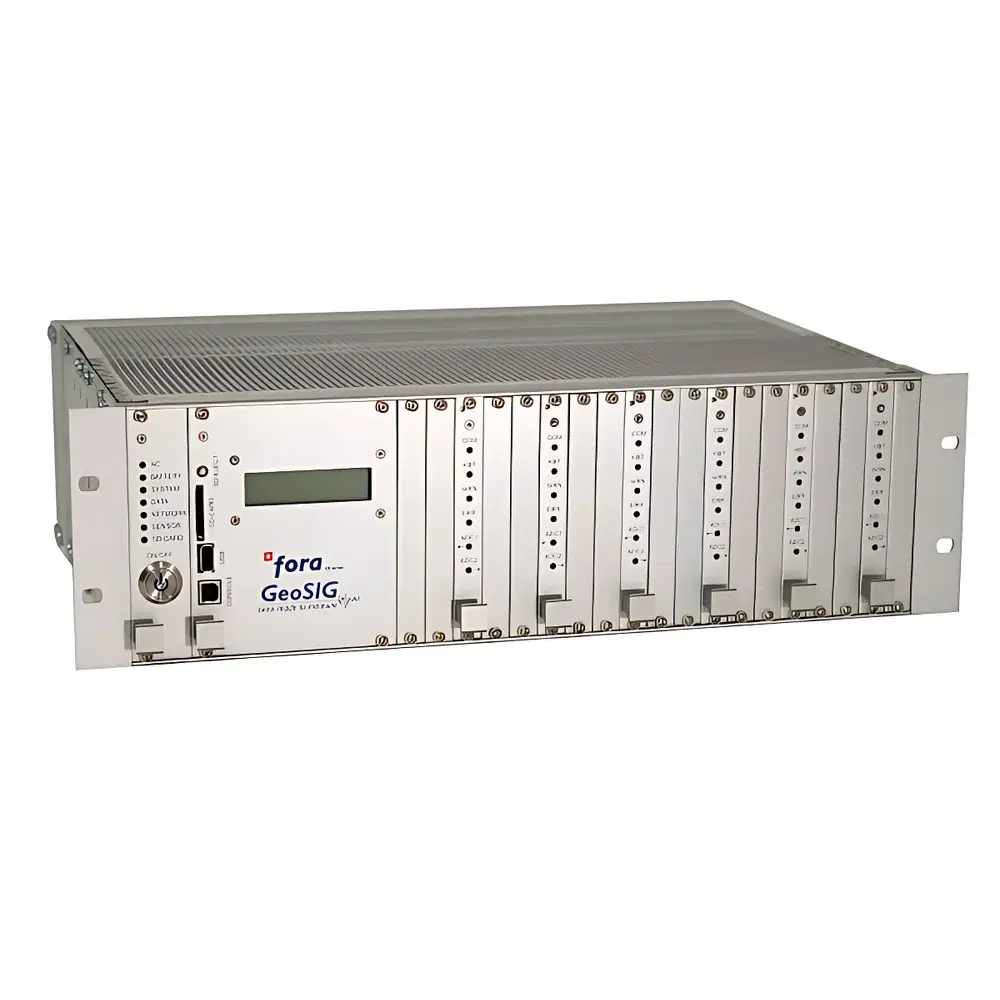
GeoSIG FORA Multi-Channel Data Acquisition System
| Brand | GeoSIG |
|---|---|
| Origin | Switzerland |
| Model | FORA |
| Form Factor | Rack-Mounted (19″), Portable Configuration Available |
| Max Channels per Unit | 36 |
| ADC Resolution | 24-bit and 32-bit per channel |
| Dynamic Range | 137 dB (typ.), up to 150 dB (with optional firmware/hardware configuration) |
| Sampling Rate | Adjustable up to 2000 sps (standard), 5000 sps (high-speed option) |
| Synchronization | True hardware-synchronized sampling across all channels via shared low-jitter TCXO clock with GNSS (GPS/GLONASS/BeiDou) and NTP time alignment |
| Onboard Storage | Internal high-speed SSD up to 1 TB (SATA III), plus mirrored logging to SD card or USB drive |
| Connectivity | Gigabit Ethernet, RS-232/485 serial, 3G/LTE modem interface, satellite modem interface, PSTN modem interface |
| I/O | DVI video output for local visualization, 8-channel programmable relay alarm outputs (via optional 2×4 Alarm Expansion Card) |
| Power | Dual-input redundancy support (AC + DC/battery), integrated battery charger |
| Compliance | Designed for continuous unattended operation in seismic and structural health monitoring applications |
Overview
The GeoSIG FORA Multi-Channel Data Acquisition System is a modular, rack-mounted (19″) digital recording platform engineered for high-fidelity, long-term seismic and environmental vibration monitoring. Built upon a distributed embedded architecture—where each Sensor Interface Module (SiM) plugs vertically into a standardized backplane—the FORA system delivers deterministic real-time acquisition with hardware-level synchronization across all active channels. Its core measurement principle relies on precision sigma-delta analog-to-digital conversion (D-S ADC), enabling ultra-low-noise digitization of geophysical and structural response signals. Unlike software-synchronized or daisy-chained architectures, FORA implements a centralized, low-phase-noise TCXO oscillator referenced to GNSS (GPS, GLONASS, BeiDou) and/or NTP, ensuring sub-microsecond inter-channel timing coherence essential for array-based source localization, modal analysis, and cross-channel correlation studies. The system is deployed globally in permanent and temporary monitoring networks for civil infrastructure—including bridges, dams, nuclear facilities, historical monuments, and high-rise buildings—as well as in geotechnical research, mining-induced seismicity tracking, and railway-induced ground vibration assessment.
Key Features
- Modular scalability: Up to 36 analog input channels per 19″ rack unit; multiple FORA units can be networked to form synchronized arrays exceeding hundreds of channels without timing drift.
- Per-channel 24-bit or 32-bit D-S ADC with configurable gain and anti-aliasing filtering, delivering dynamic range up to 150 dB (A-weighted, RMS) under optimal conditions.
- Sampling rates programmable from 1 sps to 5000 sps per channel, with oversampling and decimation options supporting both broadband seismic and low-frequency structural response capture.
- Onboard non-volatile memory stores full system configuration, calibration metadata, and firmware state—enabling automatic recovery after power interruption without manual reinitialization.
- Dual-storage architecture: Primary logging to internal SATA III SSD (up to 1 TB); simultaneous mirroring to removable media (SD card or USB flash drive) for redundancy and field data retrieval.
- Integrated DVI video output enables direct connection to external monitors for real-time waveform display, system status overview, and configuration verification without host PC dependency.
- Eight independently configurable relay outputs (via optional 2×4 Alarm Expansion Card) support event-driven actuation—e.g., siren triggering, gate closure, or SCADA interface signaling—based on user-defined amplitude, duration, or frequency-band thresholds.
- Power resilience: Accepts dual inputs (AC mains + DC/battery), with built-in smart battery charger and seamless failover—critical for remote or off-grid deployments requiring >99.9% uptime.
Sample Compatibility & Compliance
FORA accepts any sensor compliant with its input voltage range (±10 V, ±5 V, ±2.5 V), impedance, and excitation specifications—including but not limited to geophones (velocity transducers), accelerometers (IEPE and charge-mode), LVDTs, strain gauges (with bridge completion), and piezoelectric pressure transducers. Sensor wiring utilizes screw-terminal blocks for secure, tool-free connection—eliminating soldering or proprietary cabling. All signal paths are galvanically isolated to prevent ground loops and common-mode interference in multi-point installations. The system adheres to IEC 61000-6-2 (EMC immunity) and IEC 61000-6-4 (EMC emissions) standards. Timestamps are traceable to UTC via GNSS or NTP, satisfying requirements for regulatory reporting under ISO 2631-1 (human vibration exposure), ISO 10816 (machine vibration severity), and ASTM E1876 (impulse response testing). Audit trails—including configuration changes, trigger events, and storage medium swaps—are retained with cryptographic hashing for GLP/GMP-aligned validation.
Software & Data Management
GeoSIG’s GMS (GeoSIG Monitoring Software) suite provides configuration, visualization, and post-processing capabilities compatible with Windows and Linux. Firmware updates, channel mapping, and trigger logic are defined offline and deployed via encrypted configuration files. Raw data is stored in open-format miniSEED (for seismic applications) or CSV/NetCDF (for engineering vibration), ensuring interoperability with MATLAB, Python (ObsPy, NumPy), and commercial analysis platforms such as DIAdem or LabVIEW. The system supports RFC-compliant syslog forwarding and MQTT publishing for integration into enterprise SCADA or cloud-based IoT dashboards. All network communications—including remote firmware updates and parameter adjustments—are authenticated using TLS 1.2+ and role-based access control (RBAC). Event-triggered data packets include embedded metadata (sensor ID, calibration factor, orientation, location) and SHA-256 checksums—enabling automated data integrity validation during ingestion pipelines.
Applications
- Structural Health Monitoring (SHM) of critical infrastructure: continuous ambient vibration testing, forced-vibration surveys, and post-event damage assessment.
- Seismic hazard monitoring: dense-array microseismicity detection near dams, tunnels, and waste repositories.
- Railway and traffic-induced vibration: compliance evaluation against BS 5400, DIN 45669, and EN 1998-1 Annex A.
- Mining and blasting vibration control: peak particle velocity (PPV) and frequency content analysis per USBM RI 8507 or DIN 4150-3.
- Environmental baseline studies: long-term low-frequency noise and ground motion characterization in urban, industrial, and protected natural areas.
- Geotechnical instrumentation: integration with inclinometers, piezometers, and extensometers in slope stability and subsidence monitoring networks.
FAQ
Can FORA operate autonomously without network connectivity?
Yes. It supports fully standalone operation with local storage, internal clock holdover (TCXO with GNSS discipline), and programmable trigger logic—ideal for remote sites with intermittent or no internet access.
Is sensor calibration data stored onboard?
Yes. Each channel retains its unique sensitivity, phase response, and calibration history in non-volatile memory, automatically applied during data decoding.
Does FORA support real-time data streaming to third-party servers?
Yes, via TCP/IP, UDP, or MQTT protocols with configurable packet structure, compression, and authentication—compatible with AWS IoT Core, Azure IoT Hub, and custom REST endpoints.
How is time synchronization accuracy verified in the field?
GNSS lock status, PPS jitter (<50 ns typical), and NTP offset logs are continuously recorded and exportable; optional time deviation reports comply with ITU-T G.8272 (enhanced primary reference time clock performance).
What is the expected mean time between failures (MTBF) for continuous operation?
Based on field deployment data across 12+ years, MTBF exceeds 100,000 hours at 25°C ambient; thermal derating applies above 45°C per IEC 60068-2-14.
Related Products







