
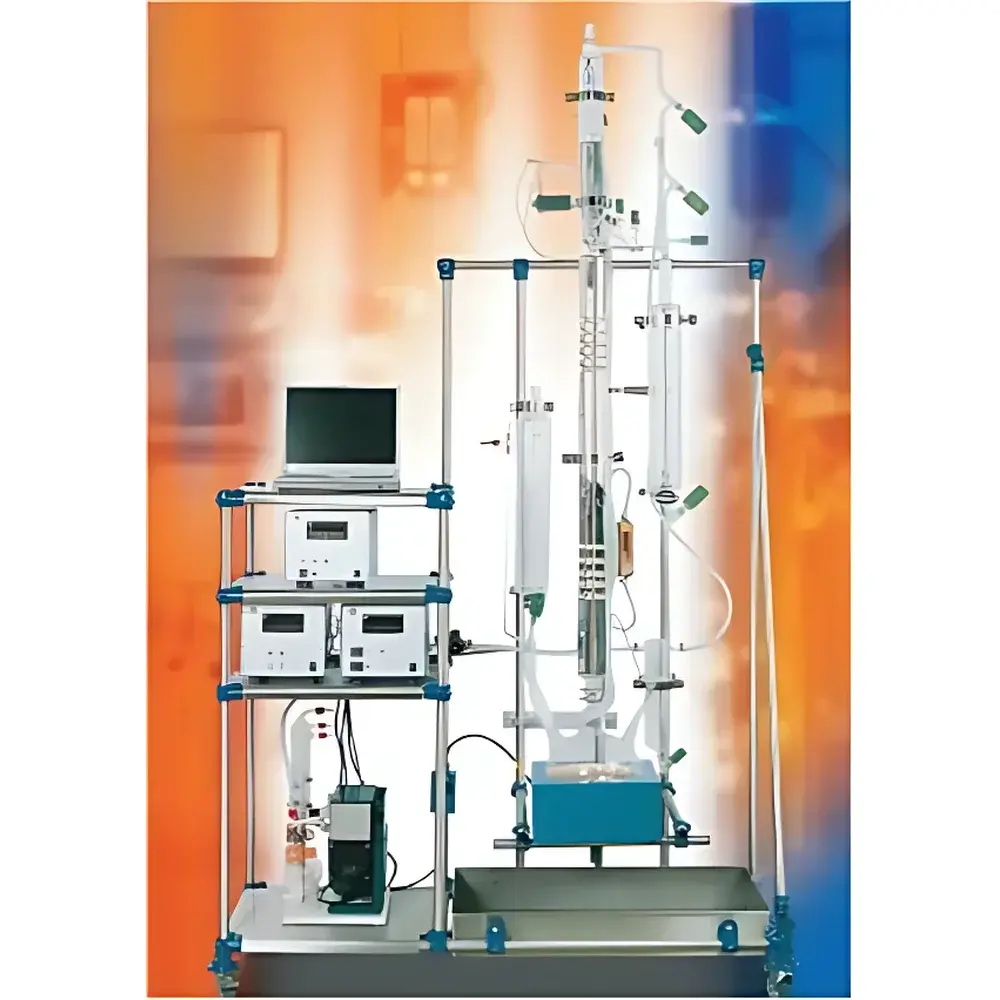
German NORMAG PC-Controlled Vacuum Batch Distillation System
| Brand | NORMAG |
|---|---|
| Origin | Germany |
| Model | NORMAG Vacuum Batch Distillation System |
| Construction Material | High-purity quartz glass (Duran®-grade) |
| Vacuum Capability | Up to 10⁻⁶ mbar |
| Tower Types Available | Packed column, sieve plate column, Vigreux column, micro-rotating band column |
| Thermal Insulation | High-vacuum silvered jacket (10⁻⁶ mbar interlayer) |
| Visual Access | Full-length vertical observation window |
| Structural Feature | Axial thermal expansion compensation corrugated section |
| Control Interface | PC-based LabVIEW-compatible digital control system |
| Compliance | Designed for GLP-compliant operation and ASTM D2892 / ISO 6617 applicability |
Overview
The German NORMAG PC-Controlled Vacuum Batch Distillation System is a precision-engineered laboratory-scale distillation platform designed for high-fidelity separation, purification, and concentration of thermally sensitive, high-value compounds. Operating on the fundamental principles of differential vapor pressure under controlled reduced-pressure conditions, this system enables precise manipulation of boiling points—critical for isolating low-volatility, heat-labile, or high-molecular-weight substances without thermal degradation. Unlike atmospheric or continuous systems, its batch-mode architecture supports method development, process optimization, and small-batch production in pre-pilot settings. The system integrates vacuum control, temperature profiling, reflux ratio modulation, and real-time pressure monitoring into a unified PC-driven interface—ensuring reproducible, auditable, and scalable experimental outcomes across pharmaceutical, fine chemical, petrochemical, and natural product research environments.
Key Features
- Vacuum-optimized quartz glass construction: All wetted components—including columns, condensers, and receivers—are fabricated from high-purity, low-thermal-expansion quartz glass (Duran®-equivalent grade), offering exceptional chemical inertness, UV transparency, and resistance to aggressive solvents, strong acids, and alkalis.
- High-vacuum silvered jacket insulation: The distillation column incorporates a double-wall design with a 10⁻⁶ mbar evacuated, silver-coated interlayer—minimizing radial heat loss and eliminating axial thermal gradients that compromise phase equilibrium and fraction purity.
- Full-height vertical observation window: A seamless, chemically resistant quartz strip runs the entire column length, enabling direct visual monitoring of liquid film formation, vapor ascent, frothing behavior, and flooding onset—supporting empirical tuning of reflux, feed rate, and vacuum setpoints.
- Thermally compensated column architecture: An integrated axial corrugated expansion section accommodates differential thermal expansion between heated and cooled column zones, preventing mechanical stress-induced cracking or seal failure during rapid ramp-up or cooldown cycles.
- Modular tower configuration: Interchangeable column internals—including structured packings, perforated plates, Vigreux indentations, and micro-rotating bands—allow method-specific optimization for relative volatility ranges from 1.05 to >50, supporting both simple and complex mixture separations.
- PC-integrated control system: LabVIEW-compatible software provides synchronized regulation of vacuum level (via digital Pirani/capacitance manometer feedback), heating mantle power, coolant flow, reflux divider position, and data logging at user-defined intervals—with timestamped export to CSV or Excel formats.
Sample Compatibility & Compliance
The system handles samples ranging from 50 mL to 5 L per batch, accommodating viscous oils (e.g., silicone fluids, fatty acid esters), polymeric precursors, essential oils, alkaloid extracts, and API intermediates. Its all-quartz fluid path ensures compatibility with halogenated solvents (CH₂Cl₂, CCl₄), strong oxidizers (HNO₃, H₂O₂), and corrosive reagents (SOCl₂, PCl₅). Designed for GLP and GMP-aligned workflows, it supports 21 CFR Part 11–compliant electronic signatures, audit trails, and user-access-level permissions when deployed with validated software configurations. It meets dimensional and operational requirements referenced in ASTM D2892 (petroleum fractionation), ISO 6617 (vacuum distillation of organic liquids), and USP (distillation apparatus verification).
Software & Data Management
Control and acquisition are managed via a Windows-based application with deterministic real-time I/O handling. Each experimental run generates a structured metadata file containing instrument ID, operator credentials, calibration timestamps, vacuum/temperature setpoint histories, and raw sensor readings (±0.1 mbar, ±0.3 °C accuracy). Data export supports automated integration with LIMS platforms via OPC UA or RESTful API endpoints. Calibration logs, maintenance records, and deviation reports are stored in encrypted local archives with configurable retention policies—facilitating internal audits and regulatory inspections.
Applications
- Development of purification protocols for active pharmaceutical ingredients (APIs) and chiral intermediates under ICH Q5A–Q5E guidelines
- Isolation of heat-sensitive nutraceuticals (e.g., astaxanthin, coenzyme Q10) and fragrance compounds without oxidative decomposition
- Recovery and reuse of high-cost solvents (e.g., DMF, NMP, DMSO) from reaction quenches in R&D-scale synthesis
- Thermodynamic characterization of azeotropic systems and vapor–liquid equilibrium (VLE) data generation for process simulation
- Scale-down modeling of industrial short-path and wiped-film evaporators for technology transfer
FAQ
What vacuum level can the system achieve, and how is it maintained?
The system achieves base pressures down to 10⁻⁶ mbar using a turbomolecular pump backed by a dry scroll pump; pressure stability is actively regulated via a capacitance manometer and proportional throttle valve.
Can the column be customized for specific separation challenges?
Yes—NORMAG offers factory-configured column variants (packed, sieve, rotating band) and accepts custom internal geometry specifications aligned with client separation objectives and mixture volatility profiles.
Is the system compatible with hazardous or highly reactive chemistries?
All process-wetted surfaces are quartz-glass; no metal gaskets or elastomers contact the sample stream—making it suitable for anhydrous HF, bromine, or Grignard reagent workups when operated within defined temperature and pressure limits.
How does the PC control system ensure data integrity for regulatory submissions?
The software implements role-based access control, immutable run logs, electronic signature capture, and tamper-evident audit trails—fully traceable to individual users, instruments, and calibration events per FDA and EMA expectations.
What maintenance is required to sustain long-term vacuum performance?
Routine checks include oil-free pump filter inspection every 200 operating hours, quartz surface cleaning with piranha solution (when appropriate), and annual recalibration of pressure and temperature sensors by an accredited metrology lab.



