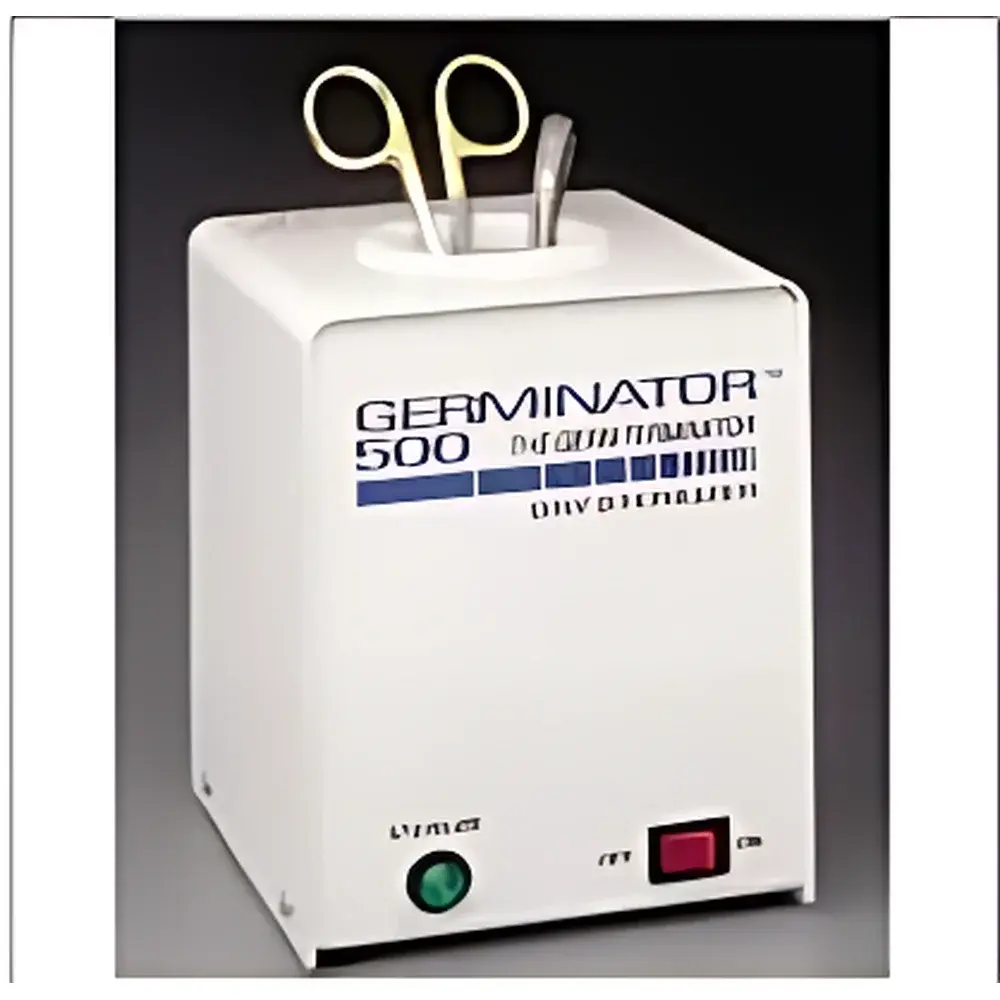
Germinator 500 Glass Bead Sterilizer
| Origin | USA |
|---|---|
| Manufacturer Type | Authorized Distributor |
| Origin Category | Imported |
| Model | Germinator 500 |
| Quotation | Upon Request |
| Warm-up Time | 20 min |
| Operating Temperature | 250 °C (500 °F) |
| Sterilization Time | 2–5 s |
| Well Dimensions | 20 cm depth × 5 cm diameter |
| Unit Dimensions | 17.1 cm H × 13.3 cm W × 13.3 cm D |
| Weight | 2.04 kg |
| Power Supply | 230–250 V, 60 Hz, 110 W |
| Glass Beads | 1.5 mm lead-free soda-lime glass spheres |
| Safety Certifications | CE, LVD, EMC (Test Report No. 991004/GERM/EMC |
| Warranty | 1 year |
Overview
The Germinator 500 Glass Bead Sterilizer is a compact, dry-heat sterilization system engineered for rapid decontamination of microsurgical and anatomical instruments in laboratory, veterinary, and academic surgical settings. It operates on the principle of conductive thermal sterilization: stainless steel–lined wells filled with precisely calibrated, lead-free glass beads are heated to a stable 250 °C (500 °F). When instrument tips are immersed, heat transfers instantly via direct contact—achieving microbial inactivation (including spores) within 2–5 seconds through sustained dry-heat exposure. Unlike autoclaving or chemical immersion, this method eliminates moisture retention, corrosion risk, and volatile organic compound (VOC) exposure. The unit complies with NIH guidelines for small-animal surgical instrumentation and is validated for use in GLP-compliant environments where traceability and repeatability of sterilization cycles are essential.
Key Features
- Instant, residue-free sterilization: Achieves reliable microbial kill (including Bacillus atrophaeus spores) in ≤5 seconds—no chemicals, no steam, no UV degradation of delicate instrument surfaces.
- Thermally stable bead bath: Stainless steel well maintains uniform 250 °C temperature with ±2 °C stability; 1.5 mm lead-free glass beads ensure optimal thermal mass and minimal attrition over extended use.
- Benchtop ergonomics: Compact footprint (17.1 × 13.3 × 13.3 cm) and low weight (2.04 kg) optimize space-constrained labs; cool-to-touch chassis and ambient-air zone above the well permit safe, continuous operation without external ventilation.
- Durable, serviceable architecture: Modular power cord and exclusive well collar design simplify maintenance; stainless steel construction resists oxidation and repeated thermal cycling.
- Regulatory-aligned safety: Fully CE-marked per Low Voltage Directive (LVD 2014/35/EU) and EMC Directive (2014/30/EU); test reports available for audit (No. 991004/GERM/EMC; 041800/AC187/LVD).
Sample Compatibility & Compliance
The Germinator 500 is validated for sterilizing fine-tipped, non-lumened instruments—including microscissors, iris forceps, needle holders, and biopsy punches—with maximum insertion depth of 20 cm. It is not intended for hollow devices, plastic-coated tools, or temperature-sensitive polymers (e.g., PTFE, silicone tubing). Instrument compatibility aligns with ASTM E535–22 (Standard Practice for Validation of Dry-Heat Sterilization Processes) and supports compliance with NIH Guide for the Care and Use of Laboratory Animals (Section IV.C.2.b), which recommends dry-heat methods for frequent inter-procedural decontamination in rodent surgery. While not a terminal sterilizer per ISO 17665, it meets requirements for critical instrument reprocessing between sequential procedures under controlled conditions.
Software & Data Management
The Germinator 500 is a standalone analog device with no embedded firmware or digital interface. Its operational simplicity ensures zero software validation burden—ideal for institutions maintaining strict FDA 21 CFR Part 11–exempt workflows or those requiring deterministic, non-programmable sterilization steps. Temperature stability is verified mechanically via calibrated bimetallic thermostats; warm-up time (20 min) and operating temperature (250 °C) are factory-set and user-verifiable using NIST-traceable thermocouples. For laboratories implementing electronic lab notebooks (ELN) or quality management systems (QMS), manual log entries—including date/time, operator ID, instrument type, and visual bead condition—fulfill GLP/GMP documentation requirements for routine sterilization verification.
Applications
- Routine decontamination of microsurgical instruments during multi-step rodent neurosurgery or cardiovascular interventions.
- Inter-procedural sterilization in teaching laboratories performing serial dissections or embryonic tissue isolation.
- Point-of-use sterilization in field veterinary clinics lacking autoclave infrastructure.
- Complementary sterilization step following ultrasonic cleaning—eliminating residual biofilm without introducing moisture into precision mechanisms.
- Validation control in studies assessing sterilization efficacy of novel antimicrobial coatings on surgical metals.
FAQ
How often must the glass beads be replaced?
Bead replacement is required when accumulated fines reduce bath depth or impede full insertion—typically after 6–12 months of daily use. Visual inspection and tactile resistance during instrument insertion serve as primary indicators.
Can the Germinator 500 sterilize instruments with lumens or hinges?
No. It is validated only for solid, non-lumened tips. Hollow structures retain contaminants and cannot achieve uniform thermal penetration.
Is pre-cleaning required before bead sterilization?
Yes. Organic debris must be removed via enzymatic soak or ultrasonic cleaning prior to insertion; carbonized residue compromises bead integrity and thermal transfer efficiency.
Does the unit require calibration or periodic certification?
While no formal recalibration is mandated, users should verify operating temperature annually using a NIST-traceable probe; records support ISO/IEC 17025 and CAP accreditation requirements.
What is the expected service life of the unit under standard lab use?
With proper bead maintenance and voltage regulation, the heating element and chassis sustain >5 years of continuous duty—validated by accelerated life-cycle testing per IEC 60068-2-2.