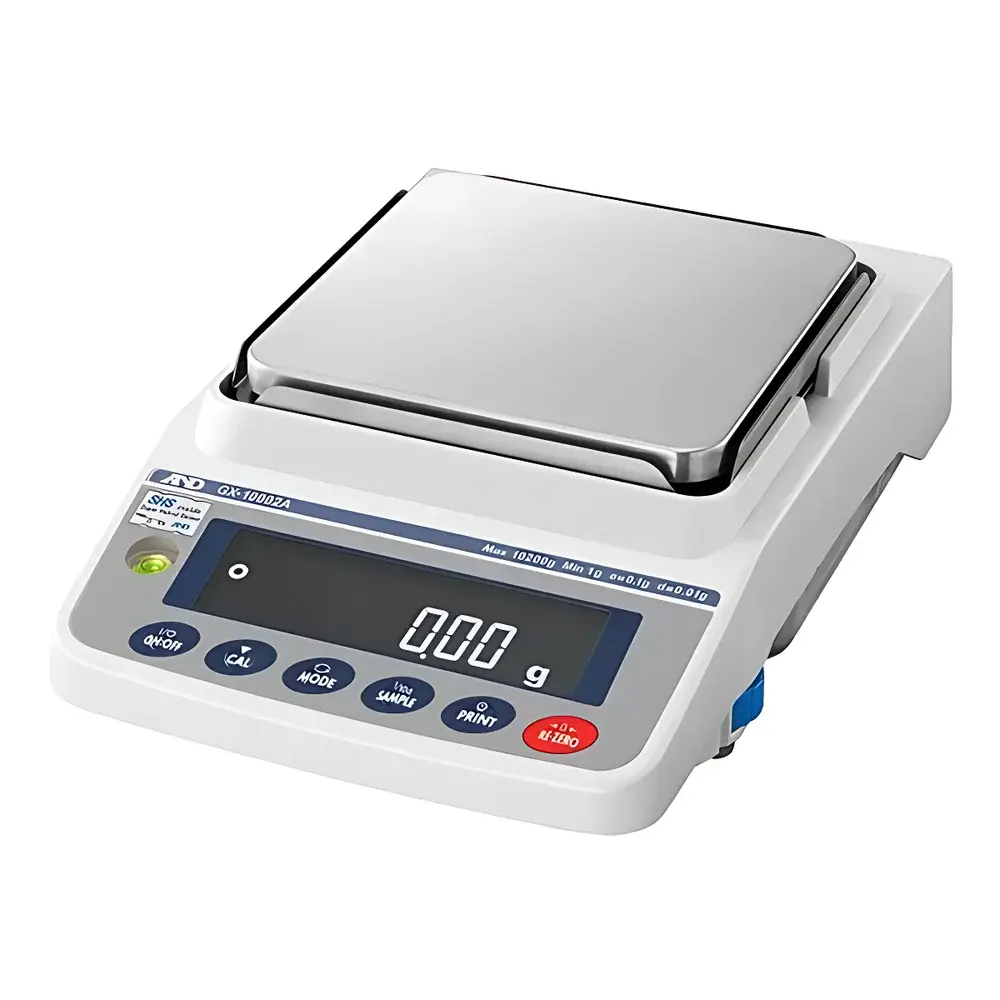
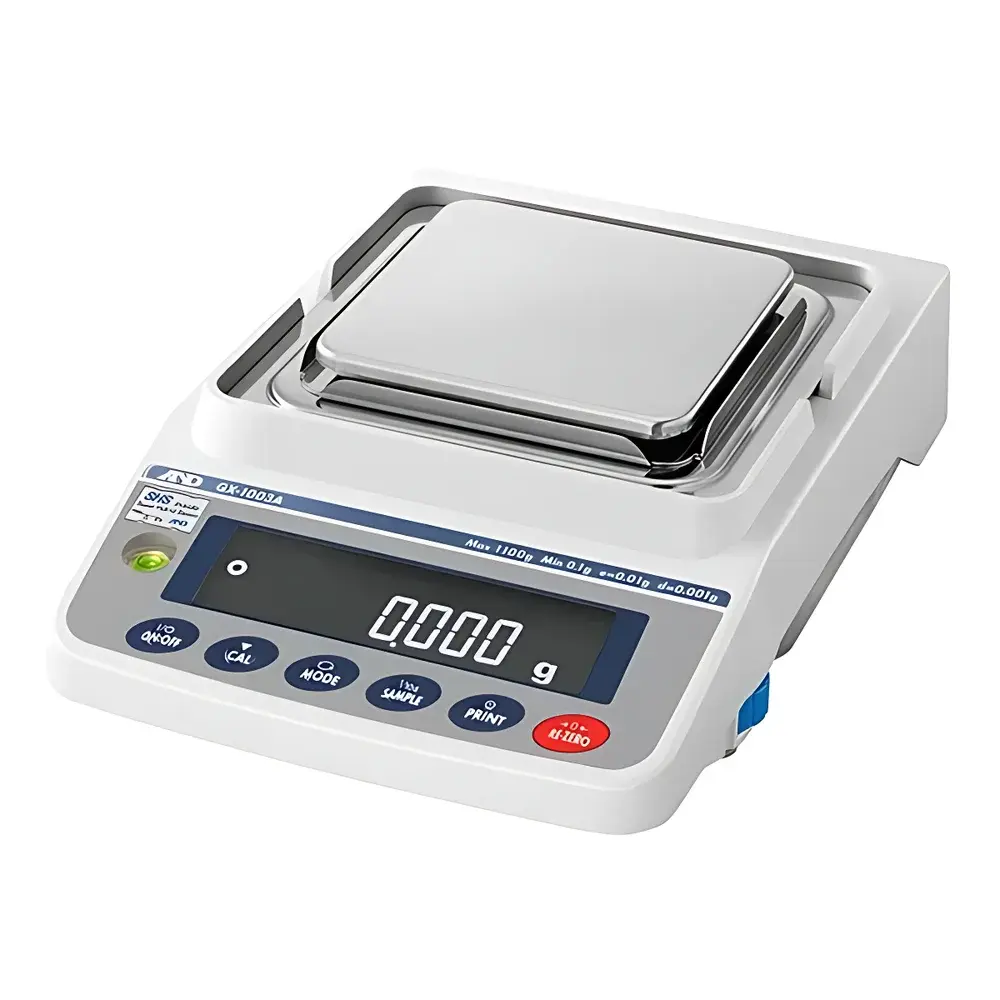
AND GF-4002A Precision Top-Loading Balance
| Brand | AND/A&D |
|---|---|
| Origin | Japan |
| Model | GF-4002A |
| Maximum Capacity | 4200 g |
| Readability | 0.01 g |
| Repeatability | 0.01 g |
| Calibration | External |
| Instrument Type | Precision Balance |
| Dimensions (W×D×H) | 212 × 317 × 93 mm |
| Pan Size | 165 × 165 mm |
| Stabilization Time | ≤1.0 s (at 50 g load) |
| Compliance | ISO 9001, ISO/IEC 17025 compatible workflows, GLP/GMP-ready documentation support |
Overview
The AND GF-4002A Precision Top-Loading Balance is an engineered solution for routine mass measurement in quality control laboratories, educational institutions, and industrial production environments where reproducible, traceable weighing at 0.01 g readability is required. Designed and manufactured in Japan by A&D Company, Ltd.—a globally recognized leader in metrological instrumentation—the GF-4002A employs electromagnetic force compensation (EMFC) technology to deliver high linearity, minimal drift, and robust temperature stability across ambient operating conditions (10–40 °C). Its top-loading architecture optimizes workflow efficiency for bulk samples, powders, containers, and packaged goods, while maintaining compliance with fundamental metrological principles defined in OIML R76 and NIST Handbook 44. The balance is not intended for analytical applications requiring sub-milligram resolution but excels in applications demanding consistent repeatability (±0.01 g) and rapid stabilization—critical for batch verification, formulation checks, and inventory reconciliation.
Key Features
- Electromagnetic force compensation (EMFC) sensor system ensures long-term stability and resistance to mechanical shock and vibration.
- Large 165 × 165 mm stainless steel weighing pan accommodates wide-diameter containers, beakers, and sample trays without edge-loading error.
- Compact low-profile housing (93 mm height) minimizes bench space requirements while enabling integration beneath fume hoods or into automated material handling stations.
- External calibration capability using certified Class M2 weights supports audit-ready traceability per ISO/IEC 17025 and internal calibration SOPs.
- Dual-range display interface (g and oz) with selectable decimal places (0.01 g or 0.1 g) enables flexible unit reporting across multi-departmental workflows.
- Integrated overload protection and auto-zero tracking minimize operator intervention and reduce measurement downtime.
- RS-232 serial interface standard; optional USB-to-serial adapter available for direct data capture into LIMS or Excel-based QA records.
Sample Compatibility & Compliance
The GF-4002A is validated for use with non-corrosive solid and granular materials, including pharmaceutical excipients, polymer pellets, metal shavings, agricultural commodities, and pre-packaged consumer goods. It is unsuitable for volatile liquids, magnetic samples, or specimens generating static charge without proper grounding protocols. All units ship with factory calibration certificates traceable to JCSS (Japanese Calibration Service System), supporting regulatory alignment with FDA 21 CFR Part 11 when paired with compliant data logging software. The device meets CE marking requirements for electromagnetic compatibility (EMC Directive 2014/30/EU) and low voltage safety (LVD Directive 2014/35/EU). Routine performance verification per ASTM E898–22 (Standard Guide for Verification of Balances Used in Weighing Operations) is recommended prior to first use and at defined intervals thereafter.
Software & Data Management
Data output follows ASCII-based protocol over RS-232, enabling seamless integration with third-party laboratory informatics systems. The balance transmits weight values with timestamp (when connected to a time-synchronized host), unit identifier, and stable-flag confirmation (“S” = stable reading achieved). No proprietary software is bundled; however, the device is fully compatible with open-source tools such as SerialPort Monitor and commercial platforms including LabWare LIMS, Thermo Fisher SampleManager, and custom Python-based QA dashboards. Audit trail functionality—including user ID tagging and calibration event logging—is achievable only when interfaced with externally managed software that enforces 21 CFR Part 11 electronic signature and record retention policies.
Applications
- Raw material receipt inspection in food, chemical, and pharmaceutical manufacturing (e.g., verifying net weight of 4 kg ingredient drums).
- Batch sampling for moisture content determination via gravimetric loss-on-drying (LOD) procedures per USP <731>.
- Calibration lab support for verifying weights up to 4.2 kg prior to distribution to field technicians.
- Educational labs conducting stoichiometric experiments requiring precise reagent mass input within ±0.01 g tolerance.
- Warehouse logistics operations performing palletized load verification and shipping manifest reconciliation.
- Environmental testing labs weighing soil/sediment composites prior to sieving or extraction protocols.
FAQ
What is the minimum sample weight that can be reliably measured on the GF-4002A?
The minimum weighable quantity (MWQ) is determined by the balance’s readability and repeatability. With a repeatability of 0.01 g, the MWQ is typically ≥20 × 0.01 g = 0.2 g under controlled environmental conditions.
Does the GF-4002A support internal calibration?
No—it requires external calibration using certified reference weights. Internal calibration is not implemented in this model series.
Can the balance be used in a humid or dusty environment?
It carries an IP42 ingress protection rating—suitable for dry indoor laboratories only. Condensation, dust accumulation, or corrosive vapors will compromise sensor integrity and void warranty coverage.
Is GMP/GLP documentation support included?
The hardware provides all necessary outputs (stable flag, weight value, unit code) required for compliant data capture; however, full GMP/GLP compliance depends on the external software and procedural controls implemented by the end user.
What is the warm-up time before achieving specified accuracy?
A minimum 30-minute stabilization period at constant ambient temperature is recommended prior to calibration or critical measurements.