
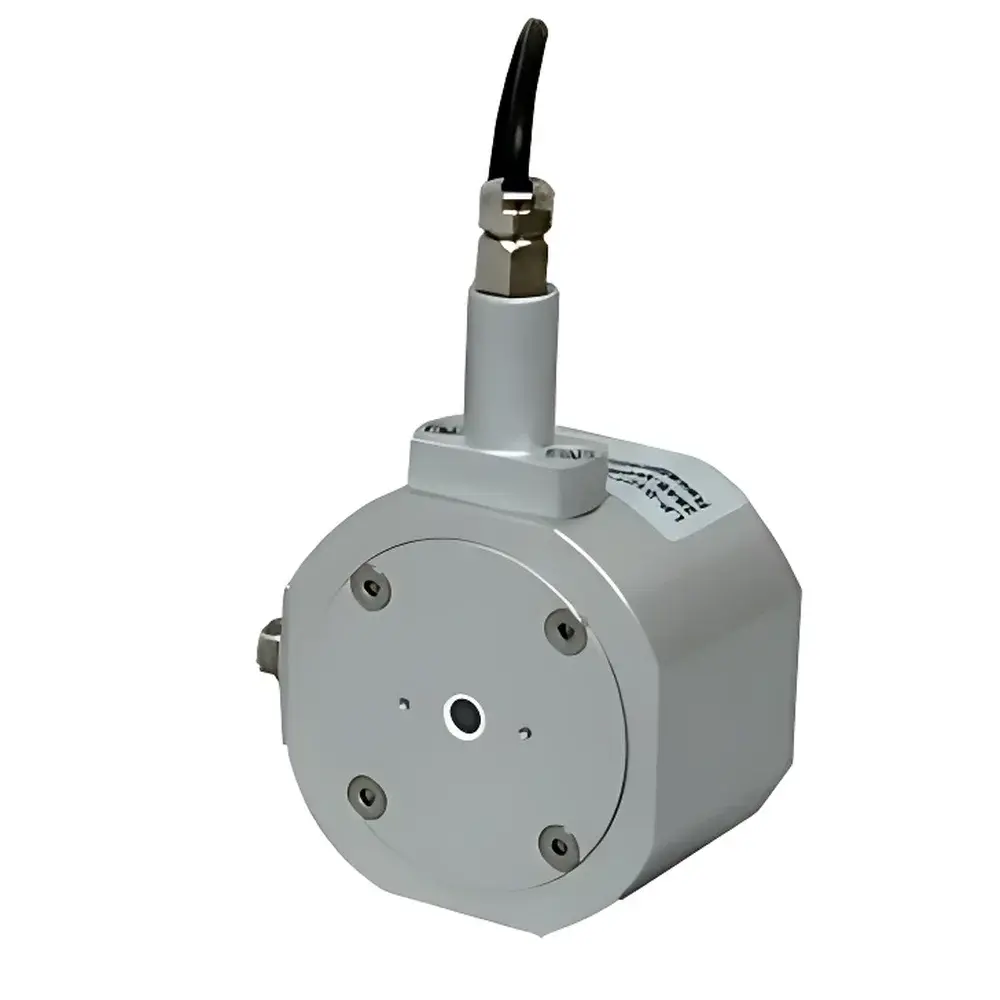
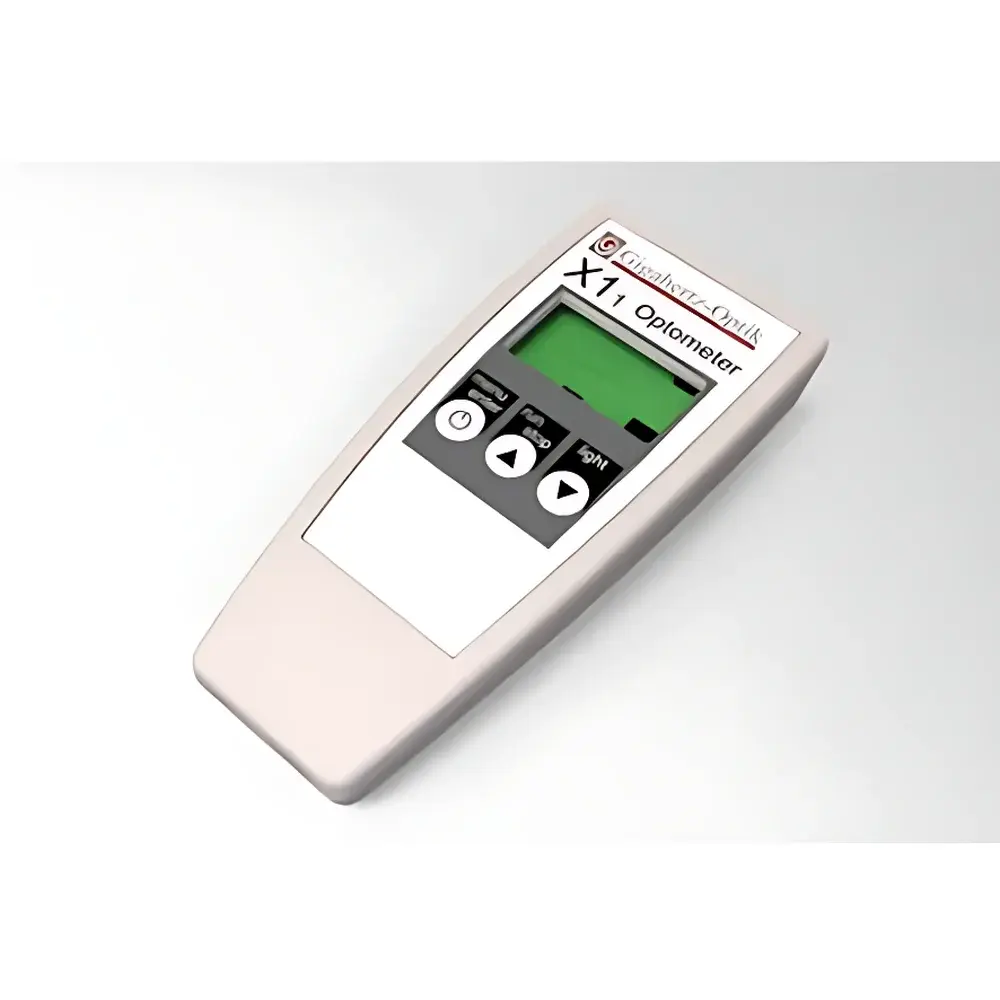
Gigahertz-Optik X1 Optometer with ISD-3P-Si Integrating Sphere Detector
| Brand | Gigahertz-Optik |
|---|---|
| Origin | Germany |
| Model | X1 + ISD-3P-Si |
| Spectral Range | 400–1100 nm |
| Detector Type | Silicon photodiode integrating sphere |
| Entrance Aperture | 5 mm Ø |
| Sphere Diameter | 30 mm Ø (ODM98) |
| Typical Minimum Detectable Power | 7.8 nW @ 630 nm, 5.6 nW @ 900 nm |
| Typical Maximum Power | 1.56 W @ 630 nm, 1.13 W @ 900 nm |
| Measurement Modes | CW, pulse energy, radiant exposure (dose), peak-to-peak, Blondel-Rey luminous intensity, data logging |
| Calibration | NIST-traceable, plug-in calibration data via detector head connector |
Overview
The Gigahertz-Optik X1 Optometer paired with the ISD-3P-Si integrating sphere detector is a precision optical power measurement system engineered for traceable, high-stability radiometric characterization of laser and LED sources across the visible to near-infrared spectrum (400–1100 nm). Based on calibrated silicon photodiode technology integrated into a 30 mm ODM98-type integrating sphere, this configuration enables accurate, spatially uniform detection of collimated and divergent beams—critical for applications demanding compliance with ISO 11554, IEC 60825-1, and ANSI Z136.1 laser safety standards. The X1 main unit provides real-time signal processing with dual-range analog-to-digital conversion, supporting both low-noise nanowatt-level detection and high-power watt-level measurements without manual range switching. Its architecture adheres to metrological best practices: each ISD-3P-Si detector head includes embedded EEPROM-stored calibration coefficients, ensuring automatic correction for spectral responsivity, linearity, and angular dependence upon connection.
Key Features
- Integrated NIST-traceable calibration: Plug-and-play detector heads deliver factory-applied spectral correction factors directly to the X1 unit via digital handshake—eliminating manual coefficient entry and reducing operator error.
- High dynamic range operation: Achieves >109 measurement span (7.8 nW to 1.56 W at 630 nm) through adaptive gain control and 24-bit ADC resolution, enabling single-instrument validation of low-power alignment beams and high-power processing lasers.
- Multi-mode radiometric capability: Supports continuous-wave (CW) power, pulse energy (J), radiant exposure (J/m²), peak irradiance (W/m²), and Blondel-Rey luminous intensity—facilitating full laser safety assessment per IEC 62471 and EN 60825-1 Annex D.
- Low-noise front-end design: Input-referred noise floor < 10 fA/√Hz ensures stable baseline performance during long-integration measurements (100 ms to 10 s), essential for characterizing ultra-low-power quantum dot emitters or fiber-coupled VCSEL arrays.
- Rugged, modular construction: Aluminum housing with EMI-shielded electronics meets IEC 61326-1 industrial EMC requirements; detector head features SMA-threaded mounting interface compatible with standard optical rails and kinematic mounts.
Sample Compatibility & Compliance
The ISD-3P-Si detector is optimized for free-space beam measurement of collimated or moderately divergent sources (beam diameters ≤5 mm at entrance port). Its 30 mm ODM98 integrating sphere—coated with spectrally neutral BaSO₄—provides Lambertian response up to ±10° incidence angle and maintains <±0.5% spatial non-uniformity across the full 400–1100 nm band. The system complies with ISO/IEC 17025 calibration requirements when used with accredited laboratory services; all delivered calibration certificates reference DIN EN ISO/IEC 17025:2017 and include measurement uncertainty budgets per GUM (JCGM 100:2008). For regulated environments, the X1 firmware supports optional audit trail logging (GLP/GMP-compliant mode) and can be configured to meet FDA 21 CFR Part 11 electronic record requirements when deployed with validated networked data acquisition software.
Software & Data Management
Gigahertz-Optik’s proprietary BEO (Basic Evaluation Optometer) software enables real-time visualization, statistical analysis (mean, std dev, min/max over time), and automated report generation in PDF or CSV format. Raw data streams are timestamped with microsecond resolution and support external synchronization via TTL trigger input—critical for correlating power output with pulsed laser driver signals. For integration into automated test benches, the X1 provides SCPI-compliant USB-Virtual COM and Ethernet (TCP/IP) interfaces, allowing seamless interoperability with LabVIEW, Python (PyVISA), MATLAB, and PLC-based control systems. All calibration metadata—including date, technician ID, and uncertainty contributors—is embedded in exported files to satisfy ISO 10012 and ILAC-P10 traceability mandates.
Applications
- Laser diode production testing: In-line verification of threshold current, slope efficiency, and power stability across wafer-level burn-in and final test stages.
- Fiber optic component qualification: Measuring coupled power from pigtailed lasers, isolators, and modulators under controlled temperature and bias conditions.
- Medical laser system validation: Radiant exposure mapping for dermatology and ophthalmic devices operating at 635 nm, 808 nm, or 980 nm wavelengths.
- Photobiomodulation research: Quantifying low-level light therapy (LLLT) dose delivery across multi-wavelength LED arrays (e.g., 630/850 nm combinations).
- National metrology institute (NMI) transfer standards: Serving as a secondary standard for calibrating handheld power meters in accredited calibration laboratories.
FAQ
Is the ISD-3P-Si detector suitable for measuring pulsed laser energy?
Yes—the X1 supports pulse energy mode with integration windows adjustable from 10 µs to 10 s, and the ISD-3P-Si’s fast rise time (<10 ns) enables accurate capture of Q-switched and gain-switched pulses down to 5 ns duration.
Can the X1 store calibration data for multiple detectors?
Yes—up to 16 unique detector profiles can be stored internally; the unit automatically loads the correct coefficients when a calibrated head is connected.
Does the system support spectral correction for non-standard light sources?
While factory calibration covers CIE standard illuminants A, B, and D65, custom spectral weighting functions (e.g., melanopic, scotopic) can be loaded via BEO software for specialized photobiological assessments.
What is the recommended recalibration interval?
Gigahertz-Optik recommends annual recalibration for ISO/IEC 17025 compliance; stability data shows typical drift <±0.3% per year under controlled lab conditions.
Is remote operation possible over Ethernet?
Yes—full SCPI command set is accessible via TCP/IP port 5025; secure authentication and TLS encryption are supported in firmware v3.2+.




