
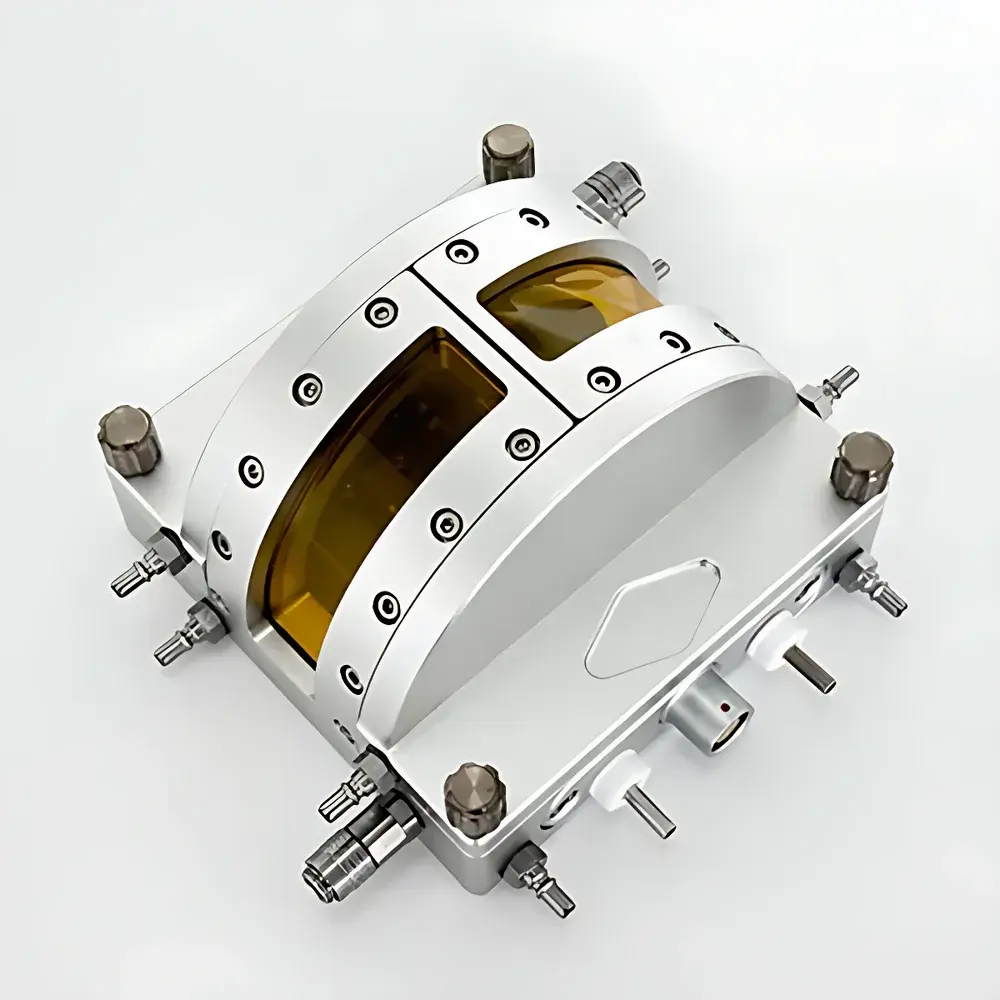
GKinst GK-DHS600 In Situ XRD Cryo-Heating Stage
| Brand | GKinst |
|---|---|
| Model | GK-DHS600 |
| Temperature Range | −195 °C to +600 °C |
| Diffraction Angle Coverage | 0°–164° |
| Chamber Type | Hermetic Sealed (Optional Vacuum Upgrade to 1 Pa) |
| Sample Stage Dimensions | 25 mm × 25 mm |
| Viewing Window Material | Kapton Polyimide Film |
| Origin | Anhui, China |
Overview
The GKinst GK-DHS600 In Situ XRD Cryo-Heating Stage is an engineered thermal control module designed for integration with laboratory-scale powder X-ray diffractometers (XRD). It enables real-time structural characterization of crystalline and semi-crystalline materials under precisely controlled temperature conditions—from cryogenic immersion cooling at liquid nitrogen temperatures (−195 °C) to high-temperature annealing up to 600 °C. Based on resistive heating and Peltier-assisted active cooling principles, the stage maintains thermal stability within ±0.5 °C over extended dwell periods, supporting quantitative phase analysis, lattice parameter evolution tracking, and kinetic studies of solid-state transformations. Its compact form factor and standardized mounting interface ensure compatibility with major OEM XRD goniometers—including Bruker D2 PHASER, PANalytical Empyrean, Rigaku SmartLab, and Thermo Scientific ARL EQUINOX platforms—without requiring beamline modification or optical recalibration.
Key Features
- Wide operational temperature range: −195 °C to +600 °C, achieved via dual-mode thermal actuation (liquid nitrogen circulation + resistive heating)
- Full 0°–164° 2θ diffraction angle coverage preserved during operation, enabling unobstructed access to low-angle scattering and high-resolution Bragg peak detection
- Hermetically sealed chamber with integrated O-ring sealing and Kapton polyimide viewing windows (transmission >85% in 5–20 keV X-ray range)
- Optional vacuum upgrade path: chamber can be retrofitted with a vacuum feedthrough and connected to a turbomolecular pumping system to achieve base pressure ≤1 Pa, minimizing air scattering and oxidation during high-temperature experiments
- Standardized sample holder geometry (25 mm × 25 mm planar surface) accommodates common XRD sample holders, capillaries, and custom substrates
- Integrated Pt100 RTD sensor with 0.1 °C resolution and NIST-traceable calibration certificate supplied with each unit
Sample Compatibility & Compliance
The GK-DHS600 supports diverse sample formats including pressed pellets, thin films on Si/SiO₂ wafers, powder-filled capillaries, and single crystals mounted on low-background stubs. Its inert Kapton window and optional vacuum capability make it suitable for air-sensitive systems—such as lithiated cathode materials (e.g., NMC, LFP), metal–organic frameworks (MOFs), and reactive intermetallic precursors—where ambient exposure would induce parasitic oxidation or hydration. The stage complies with ISO 17025 general requirements for testing laboratories and meets mechanical safety provisions outlined in IEC 61010-1 for electrical equipment used in laboratory environments. All firmware and hardware interfaces are designed to support audit-ready operation in GLP- and GMP-regulated settings, including timestamped thermal log export and user-accessible calibration history.
Software & Data Management
The stage operates via RS-232 or USB-C serial communication protocol and is fully compatible with standard XRD acquisition software suites—including Bruker DIFFRAC.SUITE, PANalytical HighScore Plus, and Rigaku SmartLab Studio II—through vendor-provided API extensions or third-party scripting (Python/LabVIEW). Real-time temperature feedback is synchronized with detector acquisition triggers, allowing automatic time-stamped metadata embedding into raw .raw, .udf, or .xye files. Thermal profiles can be programmed as multi-step ramps, isothermal holds, or cyclic protocols with dwell times from 10 s to 72 h. Data logs (temperature, setpoint error, heater current) are exported in CSV format with millisecond timestamp resolution, facilitating post-acquisition correlation with Rietveld refinement outputs or lattice strain calculations.
Applications
- Phase transition mapping in battery electrode materials during charge/discharge thermal cycling
- In situ thermal expansion coefficient (CTE) determination via Rietveld-refined unit cell parameters
- Dehydroxylation kinetics of layered double hydroxides (LDHs) and clay minerals
- Thermal stability assessment of perovskite solar absorber layers (e.g., MAPbI₃) under inert/vacuum atmospheres
- Crystallization onset and polymorph selection in pharmaceutical APIs under controlled thermal gradients
- Stress relaxation and texture evolution in sputtered semiconductor thin films during rapid thermal processing
FAQ
Is the GK-DHS600 compatible with synchrotron beamlines?
Yes—its low-Z construction (aluminum alloy body, Kapton windows) minimizes parasitic scattering; users have successfully deployed it at bending magnet beamlines operating between 5–15 keV.
Can the stage be operated under reactive gas flow (e.g., H₂, NH₃)?
The standard hermetic chamber supports inert gas purging; for reactive gases, optional stainless-steel gas inlet/outlet ports with Swagelok fittings are available upon request.
What is the typical thermal equilibration time at 600 °C?
From ambient to 600 °C: ≤12 minutes with <±1 °C overshoot; stabilization time to ±0.3 °C is <90 seconds under static load.
Does the system include temperature calibration traceability?
Each unit ships with a factory calibration report referencing NIST SRM 1750a (Indium), validated across five points (−195 °C, 0 °C, 100 °C, 300 °C, 600 °C).
Is remote monitoring supported during long-duration experiments?
Yes—via Ethernet-to-serial bridge or direct USB connection, enabling unattended overnight runs with automated email alerts on thermal deviation or communication timeout.





