
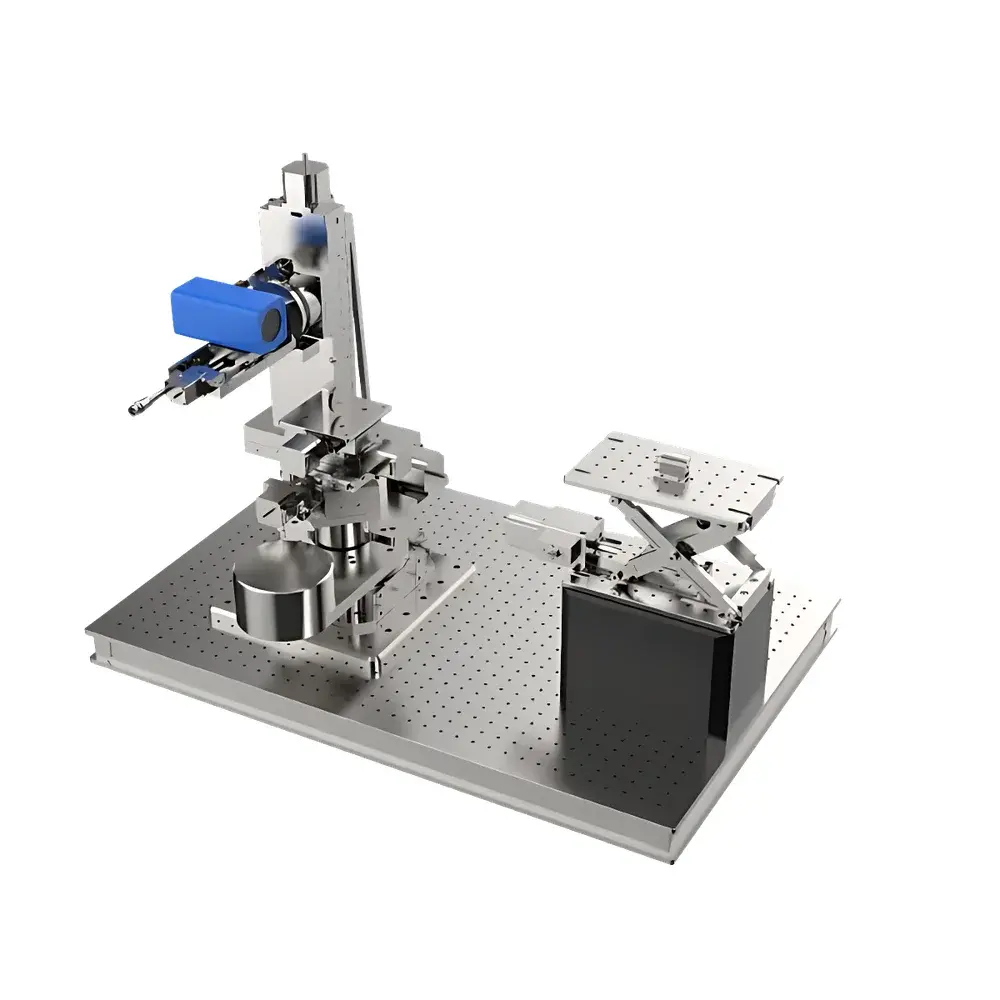
GKinst GK-DLS-01 Dynamic Light Scattering Analyzer
| Brand | GKinst |
|---|---|
| Model | GK-DLS-01 |
| Laser Wavelength | 633 ± 0.5 nm |
| Output Power | > 30 mW |
| Power Stability | < 0.5% |
| Spectral Linewidth | < 0.03 nm |
| Coherence Length | > 1 m |
| Detector Type | APD |
| Photosensitive Area | Φ0.5 mm |
| Spectral Response Range | 400–800 nm |
| Measurement Principle | Dynamic Light Scattering (DLS) |
| Molecular Weight Range | 10³–10⁸ g/mol |
| Hydrodynamic Diameter Range | 0.3 nm – 10 μm |
| Minimum Sample Volume | ≥ 0.5 μL |
| Origin | Anhui, China |
| Instrument Type | Benchtop DLS System |
Overview
The GKinst GK-DLS-01 Dynamic Light Scattering Analyzer is a benchtop optical instrument engineered for the precise determination of hydrodynamic size distributions and polydispersity indices of colloidal particles and macromolecules in suspension. It operates on the physical principle of dynamic light scattering—also known as photon correlation spectroscopy (PCS)—where fluctuations in scattered laser intensity, induced by Brownian motion of particles in solution, are temporally autocorrelated to extract diffusion coefficients. These coefficients are subsequently converted to hydrodynamic diameters via the Stokes–Einstein equation, assuming spherical geometry and known solvent viscosity and temperature. Designed for routine characterization in regulated and academic environments, the GK-DLS-01 delivers high reproducibility in sub-micron to low-micron particle sizing without requiring sample dilution or filtration in most cases. Its integrated temperature-controlled cuvette holder supports measurements from 5 °C to 60 °C with ±0.1 °C stability, enabling thermal stability studies and aggregation onset detection.
Key Features
- Laser source: He–Ne gas laser (633 ± 0.5 nm), delivering >30 mW output power with <0.5% RMS power stability over 8 hours and spectral linewidth 1 m) for robust autocorrelation.
- High-sensitivity avalanche photodiode (APD) detector with Φ0.5 mm active area and broad spectral response (400–800 nm), optimized for backscatter and side-scatter configurations.
- Automated correlation analysis engine implementing cumulant, CONTIN, and non-negative least squares (NNLS) algorithms for multimodal distribution deconvolution.
- Benchtop form factor with integrated Peltier-based temperature control (5–60 °C, ±0.1 °C), supporting ISO 22412-compliant measurement protocols.
- Modular optical path design accommodating standard 12 mm square quartz cuvettes (≥0.5 μL minimum volume) and optional capillary flow cells for low-volume or high-throughput screening.
- FDA 21 CFR Part 11–ready software architecture with electronic signatures, audit trails, and user access levels—validated for GLP/GMP-aligned laboratories.
Sample Compatibility & Compliance
The GK-DLS-01 accommodates aqueous and organic dispersions—including proteins, liposomes, polymer nanoparticles, micelles, and inorganic colloids—with minimal sample preparation. It complies with ISO 22412:2017 (“Particle size analysis — Dynamic light scattering”) for reporting Z-average diameter (dZ) and polydispersity index (PdI). For pharmaceutical applications, it supports USP and particulate matter testing workflows when coupled with appropriate validation protocols. All firmware and data handling routines conform to ICH Q5C and ICH Q5A guidelines for biopharmaceutical characterization. The system is CE-marked and meets EMC Directive 2014/30/EU and Low Voltage Directive 2014/35/EU requirements.
Software & Data Management
The GK-DLS Control Suite is a Windows-based application offering real-time correlation curve visualization, batch processing, and export to CSV, TXT, and ASTM E2919-compliant XML formats. Raw intensity autocorrelation functions (ACFs) are stored with full metadata—including laser power, temperature, count rate, and acquisition time—enabling retrospective reanalysis. The software includes built-in QC checks (e.g., count rate drift alert, baseline deviation flagging) and supports LIMS integration via OPC UA and RESTful API endpoints. Audit trail logs record all user actions, parameter changes, and report generations with timestamps and operator IDs, satisfying FDA 21 CFR Part 11 and EU Annex 11 traceability mandates.
Applications
- Biopharmaceutical development: Monitoring aggregation kinetics of monoclonal antibodies and vaccine candidates under stress conditions (pH, temperature, ionic strength).
- Nanomaterial synthesis: In-process verification of gold nanoparticle, quantum dot, and polymer nanoparticle size during reduction or self-assembly.
- Food & beverage R&D: Assessing protein stability in dairy emulsions, casein micelle dissociation, and polysaccharide conformational transitions.
- Coatings & inks: Quantifying pigment dispersion stability and predicting shelf-life based on time-resolved PdI trends.
- Academic research: Teaching core principles of colloidal science, statistical mechanics of Brownian motion, and light–matter interaction in soft condensed matter physics labs.
FAQ
What is the minimum required sample volume for reliable DLS measurement?
The GK-DLS-01 achieves statistically valid correlation data with ≥0.5 μL of clarified dispersion in standard quartz cuvettes. For turbid or highly concentrated samples, dilution or use of low-volume capillary cells (0.1–0.3 μL) is recommended.
Does the system support multi-angle DLS (MADLS) or electrophoretic light scattering (ELS)?
The GK-DLS-01 is configured for fixed-angle (90° or 173° backscatter) DLS only. MADLS and ELS capabilities require hardware upgrades and are available as OEM-customized variants upon request.
How is temperature calibration verified during operation?
An embedded NTC thermistor adjacent to the sample compartment provides continuous feedback; calibration is traceable to NIST-certified reference probes and validated per ISO/IEC 17025 procedures.
Can raw correlation data be exported for third-party analysis?
Yes—both normalized ACFs and unprocessed photon count time-series (in HDF5 format) are exportable, preserving full temporal resolution for advanced modeling in MATLAB, Python (NumPy/SciPy), or commercial DLS analysis packages.
Is the instrument suitable for GMP-regulated quality control environments?
When deployed with IQ/OQ/PQ documentation packages, 21 CFR Part 11-compliant software configuration, and periodic performance verification using NIST-traceable polystyrene standards (e.g., 60 nm, 200 nm, 500 nm), the GK-DLS-01 meets GMP QC requirements for particle size release testing.
Related Products




