
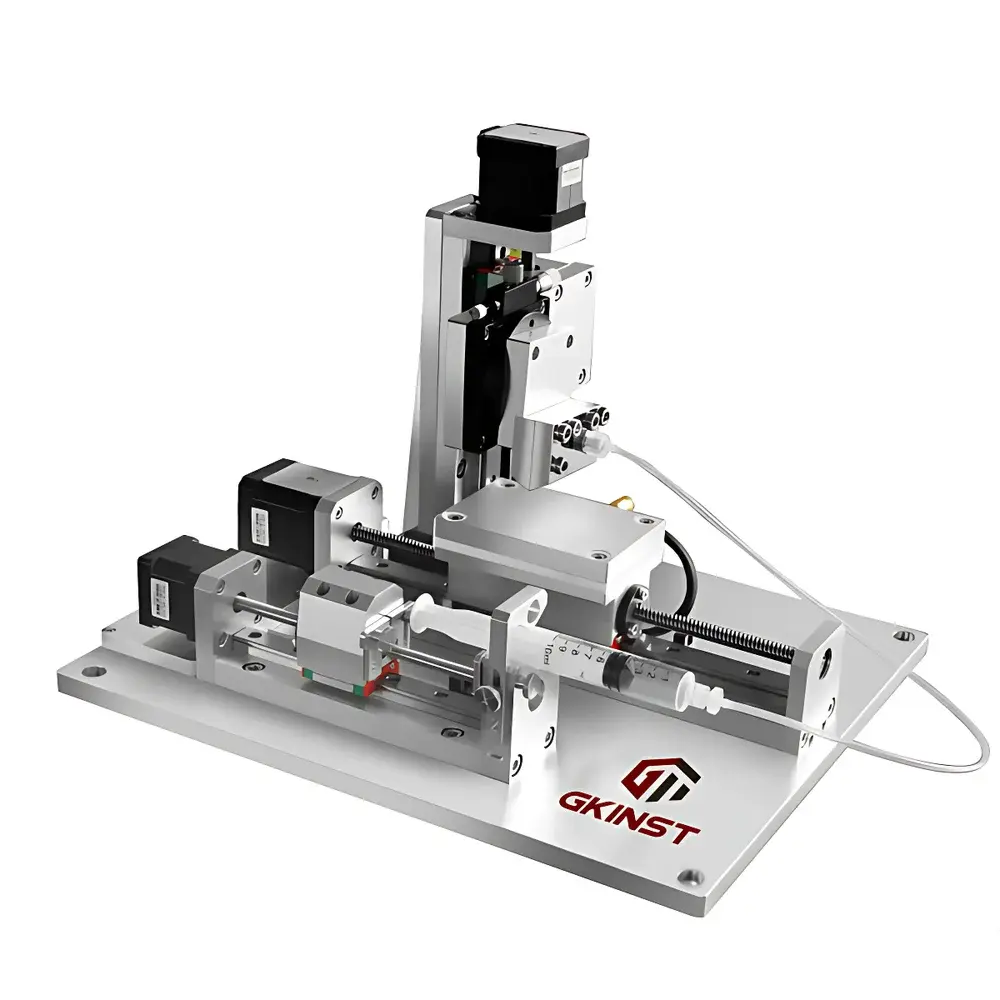
GKinst GK-TB01 Precision Slot-Die Coating Head System
| Brand | GKinst |
|---|---|
| Model | GK-TB01 |
| Construction Material | Stainless Steel |
| Coating Width Range | 15–25 mm (Default: 25 mm) |
| Doctor Blade Gap (Shim Thickness) | 100 µm |
| Stage Temperature Range | Up to 100 °C |
| Maximum Translation Stroke | 100 mm |
| Stage Velocity Range | 100 µm/s – 50 mm/s |
| Stage Flatness | <20 µm |
| Stage Surface Roughness | 3 µm |
| Maximum Substrate Thickness | 20 mm |
| Pump Integration | High-Precision Syringe Pump Compatible |
| Application Scope | R&D, Process Optimization, Ink Formulation, Small-Batch Film Fabrication |
Overview
The GKinst GK-TB01 Precision Slot-Die Coating Head System is a benchtop, modular slot-die coating platform engineered for controlled, scalable thin-film deposition in research and early-stage process development environments. Unlike spin coating or blade coating, slot-die technology operates on a continuous, non-contact meniscus-controlled principle: a precisely metered fluid stream is delivered through a narrow rectangular die opening onto a moving substrate, forming a stable wet film whose thickness is governed by volumetric flow rate, substrate velocity, and the defined gap between the die lip and substrate surface. This deterministic relationship enables high reproducibility (<±2% thickness variation across 25 mm width) and direct scalability from lab-scale formulation trials to pilot-line parameter mapping. The GK-TB01 integrates a stainless-steel slot-die head with fixed 100 µm shim-defined gap geometry, optimized for Newtonian and low-viscosity non-Newtonian fluids (e.g., conductive polymer dispersions, perovskite precursor inks, battery slurry model systems). Its rigid mechanical architecture minimizes thermal drift and vibration coupling—critical for sub-micron thickness control during slow-speed (<1 mm/s) or high-temperature (up to 100 °C) coating sequences.
Key Features
- Stainless-steel slot-die head with chemically inert, electropolished internal flow channels—compatible with polar solvents (e.g., DMF, NMP), aqueous electrolytes, and mild acid/base formulations.
- Fixed-gap configuration using precision-ground 100 µm stainless shims; eliminates manual gap adjustment variability and ensures long-term dimensional stability under thermal cycling.
- Motorized linear stage with 100 mm travel, programmable velocity (100 µm/s to 50 mm/s), and bidirectional repeatability of ±0.5 µm—enabling step-and-repeat, gradient, and multi-pass coating protocols.
- Heated substrate stage (max 100 °C) with uniform temperature distribution (±1.5 °C over 100 × 100 mm area) and integrated thermocouple feedback for solvent evaporation kinetics studies.
- Stage flatness <20 µm and surface roughness Ra ≤3 µm—maintains consistent meniscus geometry across full 25 mm coating width, minimizing edge bead defects and thickness tapering.
- Modular interface for third-party syringe pumps (e.g., Harvard Apparatus PHD Ultra, Chemyx Fusion 200) with analog/digital I/O synchronization for closed-loop flow–velocity coordination.
Sample Compatibility & Compliance
The GK-TB01 accommodates rigid and flexible substrates up to 20 mm thick—including silicon wafers, glass slides, PET/PI foils, and metal foils—without requiring vacuum clamping. Its open-frame design permits real-time optical access for in situ monitoring (e.g., side-view meniscus imaging, IR thermography). All wetted components comply with ISO 8502-3 for surface cleanliness verification prior to coating. While not certified for GMP production, the system supports GLP-aligned documentation: stage position logs, pump flow timestamps, and temperature histories can be exported in CSV format for audit trails. It meets general laboratory safety standards per IEC 61010-1 and is compatible with fume hood integration for volatile solvent handling.
Software & Data Management
The GK-TB01 operates via standalone motion controller firmware (no proprietary PC software required). Motion parameters (velocity profile, stroke limits, dwell times) are configured through ASCII command protocol over RS-232 or USB-CDC, enabling seamless integration into Python- or LabVIEW-based automation frameworks. Pump synchronization signals (TTL start/stop, analog flow setpoint) are hardware-triggered to eliminate software latency. All operational metadata—including stage position vs. time, heater setpoint vs. actual, and external pump status—is timestamped with microsecond resolution and stored locally on an embedded SD card. Exported logs conform to ASTM E2500-17 guidelines for raw data integrity and traceability.
Applications
- R&D of functional thin films: organic photovoltaics (OPV), perovskite solar cells, printed electronics, solid-state battery electrodes, and anti-reflective coatings.
- Ink formulation screening: viscosity–thickness correlation studies, solvent evaporation rate impact on film morphology, and additive dispersion stability assessment.
- Process window definition: mapping defect onset (e.g., ribbing, streaking, drying cracks) as a function of flow rate, speed, temperature, and gap height.
- Reference sample preparation: certified reference materials (CRMs) for spectroscopic calibration, cross-sectional TEM lamella generation, and interfacial adhesion testing substrates.
- Technology transfer support: generating reproducible coating data packages for scale-up to roll-to-roll (R2R) or sheet-to-sheet (S2S) pilot lines.
FAQ
Is the GK-TB01 suitable for shear-thinning or viscoelastic inks?
Yes—its low-inertia stage and precise flow synchronization allow stable meniscus formation for moderate-viscoelasticity fluids (e.g., PVP solutions, nanocellulose dispersions), provided extensional relaxation times remain below ~100 ms.
Can the coating width be adjusted without replacing the die head?
No—the 15–25 mm range is achieved via interchangeable die inserts; the standard GK-TB01 ships with a 25 mm fixed-width insert. Custom widths require factory-manufactured dies with matched flow manifolds.
Does the system include environmental control (e.g., nitrogen purge or humidity regulation)?
Not natively—but the open chassis design permits integration of glovebox adapters, local N₂ curtains, or custom enclosure interfaces for inert-atmosphere or low-RH operation.
What maintenance is required for long-term accuracy?
Biannual verification of stage flatness (using optical flat interferometry) and shim gap metrology (via SEM cross-section or laser displacement sensor) is recommended. Stainless-steel wetted surfaces require citric acid passivation after exposure to halide-containing inks.
Related Products






