
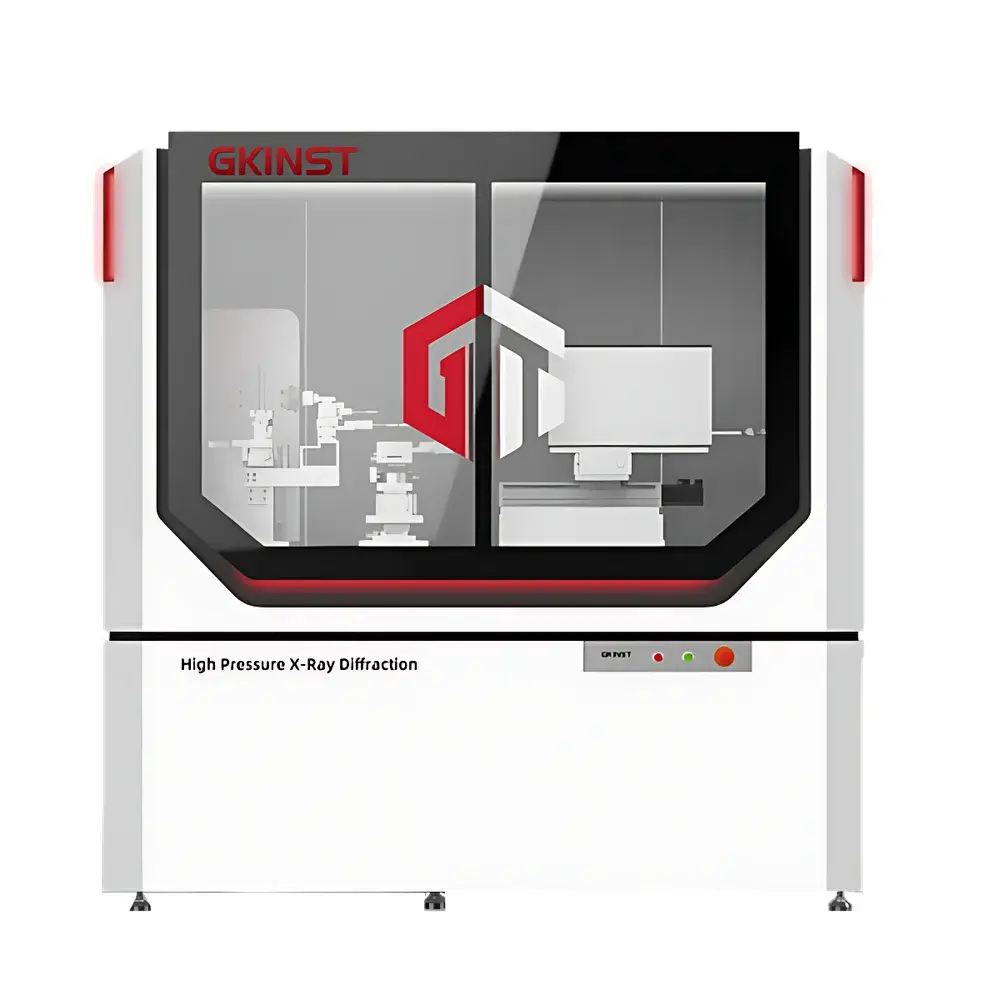
GKINST HPXRD High-Pressure X-ray Diffractometer
| Brand | GKINST |
|---|---|
| Origin | Anhui, China |
| Manufacturer Type | Authorized Distributor |
| Country of Origin | China |
| Model | HPXRD |
| Configuration | Floor-Standing |
| X-ray Source | Liquid-Metal In Target (E1 Type) |
| High-Flux Mode | 90 μm focal spot, 1.9 × 10⁸ ph/s, divergence 3.15 mrad |
| Micro-Focus Mode | 15 μm focal spot, 1.8 × 10⁷ ph/s, divergence 12.6 mrad |
| Ultra-Micro Mode | 10 μm focal spot, 1.0 × 10⁶ ph/s, divergence 2 mrad |
| XY Stage Repeatability | ±0.2 μm, travel ±10 mm |
| Z Stage Repeatability | ±0.2 μm, travel ±10 mm |
| φ Axis Repeatability | 0.002°, travel ±135° |
| X₁Y₁ Stage Repeatability | ±0.2 μm, travel ±12.5 mm |
Overview
The GKINST HPXRD High-Pressure X-ray Diffractometer is a laboratory-scale, floor-standing instrument engineered for in situ structural characterization of crystalline materials under extreme pressure conditions—up to multi-megabar regimes—without reliance on synchrotron beamtime. It integrates diamond anvil cell (DAC) compatibility with a high-brilliance liquid-metal indium (In) E1-type microfocus X-ray source and precision goniometric motion control. Based on Bragg’s law and angular-dispersive X-ray diffraction (ADXRD), the system enables quantitative phase identification, lattice parameter refinement, strain analysis, and equation-of-state (EOS) determination via Rietveld or Le Bail full-pattern fitting. Its optical architecture supports both powder and single-crystal geometries, with optimized beam collimation and detector alignment to minimize background scattering and maximize signal-to-noise ratio at low photon counts typical of high-pressure experiments.
Key Features
- Triple-mode liquid-metal In-target X-ray source delivering tunable trade-offs between flux and spatial resolution: high-flux (90 µm, 1.9 × 10⁸ ph/s), microfocus (15 µm, 1.8 × 10⁷ ph/s), and ultra-microfocus (10 µm, 1.0 × 10⁶ ph/s) configurations;
- Five-axis motorized stage system (XY, Z, φ, X₁Y₁) with sub-micron positional repeatability (±0.2 µm) and angular precision (0.002°), enabling precise DAC centering, sample alignment, and rotational symmetry mapping;
- DAC-integrated sample chamber design accommodating standard 16:1 or 30:1 culet anvils, with optional cryogenic or resistive heating stages for combined high-P/T studies;
- Rigorous mechanical stability achieved through granite baseplate construction and vibration-damped optical table integration, ensuring long-exposure data integrity;
- Modular detector interface supporting industry-standard area detectors (e.g., PILATUS3, EIGER2 XE) with real-time frame integration and dynamic range optimization for weak high-pressure diffraction signals.
Sample Compatibility & Compliance
The HPXRD accommodates diverse sample forms—including polycrystalline powders, oriented single crystals, thin films, and amorphous precursors—within standard symmetric or non-symmetric DAC configurations. Sample environment options include He, Ne, or Ar pressure-transmitting media, compatible with ruby fluorescence or Sm:YAG internal pressure calibration per ISO 11146 and ASTM E2847 guidelines. All motion control firmware complies with IEC 61508 functional safety standards for laboratory automation. The system supports GLP-compliant experiment logging, including timestamped metadata for pressure, temperature, stage position, exposure time, and detector gain—traceable to NIST-traceable calibration sources.
Software & Data Management
Control and analysis are unified within GKINST DiffraX Suite v4.x—a platform built on Python 3.10 and Qt6, featuring modular GUI workflows for acquisition planning, real-time pattern monitoring, and post-acquisition processing. The software implements automated peak search using modified Thompson–Cox–Hastings pseudo-Voigt fitting, integrates with GSAS-II and FullProf for Rietveld refinement, and exports CIF, XYE, and HDF5 formats compliant with the ICDD PDF-4+ database schema. Audit trails meet FDA 21 CFR Part 11 requirements, with electronic signatures, user-role access control, and immutable experiment logs stored in encrypted SQLite databases. Raw frames and processed intensities are archived with SHA-256 checksums for long-term reproducibility verification.
Applications
- Equation-of-state modeling of planetary mantle minerals (e.g., bridgmanite, ferropericlase) under Earth’s lower-mantle conditions;
- In situ tracking of pressure-induced structural transitions in high-Tc superconductors (e.g., H₃S, LaH₁₀) and hydrogen-rich hydrides;
- Elastic tensor determination via stress-strain analysis from azimuthally resolved diffraction patterns;
- Texture evolution and plastic deformation mechanisms in nanocrystalline metals and covalent ceramics under non-hydrostatic stress;
- Phase stability mapping of metastable polymorphs in pharmaceutical co-crystals and energetic materials under confinement.
FAQ
Is the HPXRD compatible with third-party diamond anvil cells?
Yes—the instrument uses standardized kinematic mounts and accepts commercially available DACs with 1/4″-20 or M6 threading, including those from Almax-eos, DACLab, and UHV Design.
What X-ray detectors are supported out of the box?
The system provides native drivers for Dectris PILATUS3 and EIGER2 XE series detectors; custom SDK integration is available for other area detectors upon request.
Can the HPXRD perform combined high-pressure and low-temperature measurements?
Yes—when coupled with closed-cycle cryostats (e.g., Janis ST-500 or BlueFrog systems), it achieves stable operation down to 4 K while maintaining DAC alignment within ±0.5 µm over 24-hour runs.
Does the software support automated pressure ramping during data collection?
Yes—DiffraX Suite enables synchronized pressure stepping via digital I/O control of external pressure controllers (e.g., Haskris or MRC units), with trigger-locked exposure initiation and metadata stamping.
Is remote operation and monitoring supported?
Yes—SSH-enabled CLI access and web-based dashboard (HTTPS/TLS 1.3) allow secure off-site instrument control, live diffraction image streaming, and real-time alarm notifications via SMTP or Slack webhooks.





